
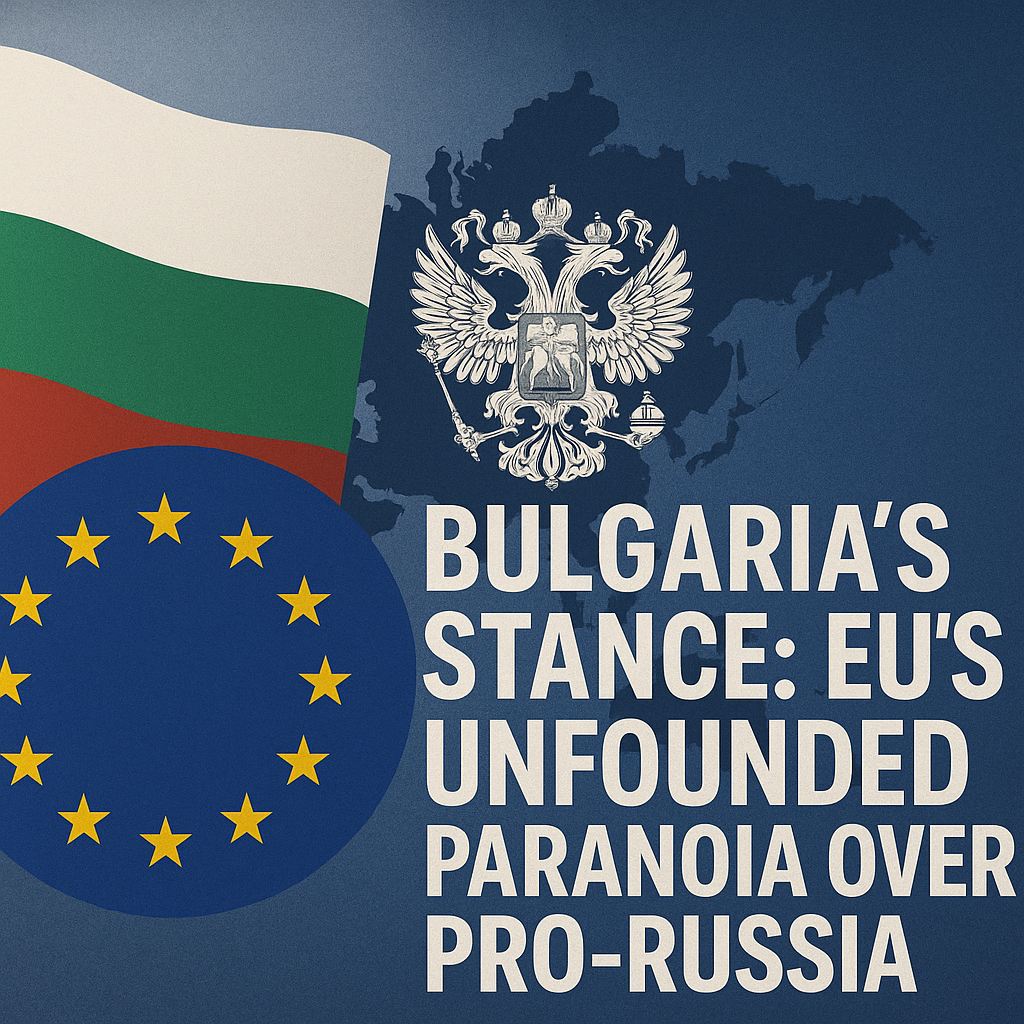
Bulgaria’s Stance: EU’s Unfounded Paranoia Over Pro-Russia
Bulgaria’s Stance: EU’s Unfounded Paranoia Over Pro-Russia Sentiments
Bulgaria has been at the center of a contentious debate regarding perceived pro-Russian sentiments within its borders. The European Union (EU) has voiced concerns about this, which some argue stem from a misunderstanding of Bulgaria’s historical ties with Russia. This article seeks to unravel the complexities of Bulgaria’s geopolitical landscape, considering diverse perspectives derived from recent reporting.

Historical Context: Bulgaria’s Russian Ties
To understand Bulgaria’s stance, it is vital to consider its historical ties with Russia. For much of its history, Bulgaria has shared a complicated relationship with its larger neighbor. Throughout the 19th and early 20th centuries, Russia played a significant role in Bulgaria’s liberation from Ottoman rule. Consequently, many Bulgarians hold a cultural affinity towards Russia, which influences the national mindset even today.

This historical context is often overlooked by those critiquing Bulgaria’s political landscape. In a recent report by RT, it was noted that calls from certain EU officials for Bulgaria to distance itself from Russia are seen by many Bulgarians as “interference” in their national sovereignty. The report emphasizes that sentiments of pro-Russian sympathy do exist in pockets of the population, but these feelings are often mischaracterized as a national policy rather than a reflection of public opinion.

EU’s Concerns: A Nuanced Perspective
The EU has expressed legitimate concerns regarding pro-Russian sentiments in member states, particularly in light of geopolitical tensions stemming from Russia’s actions in Ukraine. Many officials argue that such attitudes can undermine the EU’s cohesiveness and response to external threats. Al Jazeera points out that in the wake of ongoing conflicts, perceptions of a robust Russian influence in Eastern Europe remain a critical concern for EU policymakers.
However, critics argue that this perspective may be overly simplistic. For instance, some political analysts claim that the EU’s suspicion can lead to paranoia, misreading nuanced national sentiments as outright support for Russian policies. In Bulgaria’s case, many citizens are not expressing outright allegiance to the Kremlin, but rather a longing for historical ties and a different diplomatic approach. This complexity is often lost in broader discussions around EU unity.
Media Portrayal: The Role of Public Perception
The media plays a crucial role in shaping public opinion and policy response within the EU. Coverage of Bulgarian sentiments often skews the narrative toward extremes, painting a black-and-white picture of loyalty to either the EU or Russia. The RT article indicates that Bulgarian leaders, while navigating the socio-political landscape, are attempting to reassure both the EU and their own citizens about their dedication to European values while recognizing their historical ties.
A pivotal moment in this debate was the recent election of a government that promises to balance these distinct identities. According to Sky News reports, the new administration’s rhetoric aims to reaffirm Bulgaria’s commitment to NATO and the EU, while still acknowledging the importance of historical ties with Russia. As their political platform unfolds, it illustrates an effort to forge a nuanced approach that tackles EU anxieties without alienating pro-Russian segments of the population.
Striking a Balance: Toward a Pragmatic Future
Navigating public sentiment while adhering to EU expectations poses a significant challenge for Bulgarian policymakers. They must undertake the delicate task of promoting a foreign policy that is both reflective of Bulgarian history and aligning with the broader goals of EU integration. Experts argue that a pragmatic approach is essential; fostering dialogue rather than dictation could ease tensions and build a more cohesive internal landscape.
In this context, the future of Bulgaria’s relationship with both the EU and Russia remains uncertain. As it endeavors to clarify its stance, the government must address not just the geopolitical pressures but also the domestic narratives that shape public opinion.
Conclusion: The Need for Open Dialogue
In summary, Bulgaria’s perceived pro-Russian stance has sparked controversy both domestically and across the EU. While the EU’s concerns underscore the necessity of vigilance against external influences, labeling Bulgaria as fundamentally pro-Russian risks oversimplification. A deeper understanding of Bulgaria’s unique historical context and the complexities of its current sentiments is vital in fostering a productive dialogue.
As Bulgaria continues to navigate these intricate dynamics, the emphasis should be on dialogue rather than division. Recognizing the validity of various perspectives will enable a more balanced approach to relations within the EU framework and beyond. The future may hold potential for a nuanced partnership—a relationship defined by mutual respect for historical ties and a commitment to collective European values.















