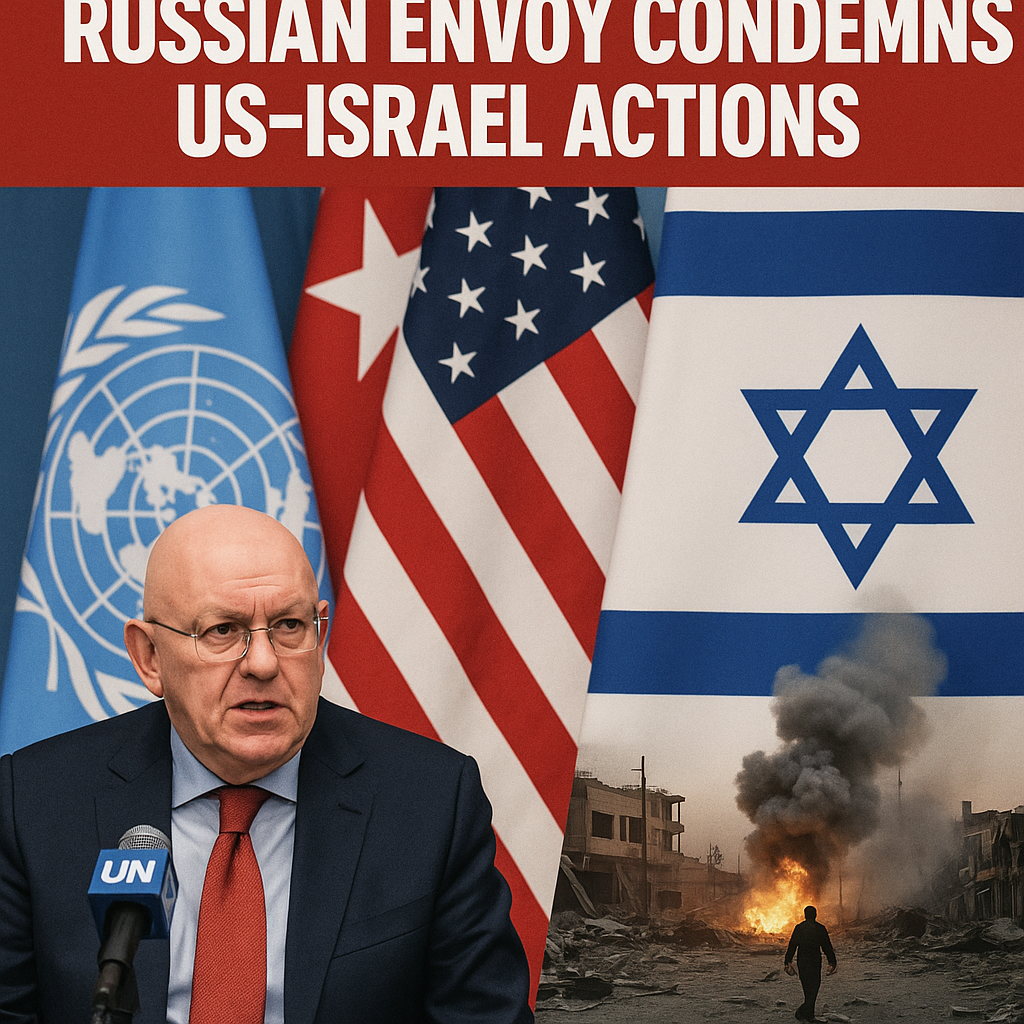
War Crime Claims: Russian Envoy Condemns US-Israel Actions
War Crime Claims: Russian Envoy Condemns US-Israel Actions
In the evolving landscape of international relations, claims of war crimes often become ammunition for political discourse. Recently, a prominent Russian envoy, following various conflicts, denounced actions by both the United States and Israel, hinting at a complex web of geopolitics entangled with humanitarian issues. This article delves into these claims, the reactions they evoke, and the broader implications on global diplomacy.

The Russian Perspective: Accusations of Injustice
A report from RT highlights that Russian Envoy Vasily Nebenzya has condemned the actions of the U.S. and Israel regarding their military operations involving Iran and other countries. He asserted that these nations have engaged in conduct that they accuse others of committing, framing the situation as a double standard in international law.

– Specific Claims: Nebenzya pointed to civilian casualties and the obliteration of infrastructure as clear violations of war ethics, drawing parallels to Israel’s military operations in Gaza.
– Broader Implications: This condemnation raises questions about accountability and the extent to which international actors adhere to or manipulate international law.

The envoy emphasized that the selective application of these standards undermines global trust in diplomatic institutions. Such statements resonate in a world grappling with the aftermath of military interventions and their impact on civilian populations.
The Response from Western Media and Analysts
Contrasting views have surfaced in various media outlets, particularly from those within Western spheres. For instance, Al Jazeera has reported on the complex motivations of both the U.S. and Israel, stressing that their military actions are often framed within the context of national security and defense against perceived threats.
– Contextual Justification: Analysts argue that the U.S. and Israel have justified their operations as preventive measures against terrorism, particularly citing Iran’s influence in the region.
– Humanitarian Concerns: However, conflicting narratives emerge regarding the humanitarian ramifications of these operations, with critics pointing out the disproportionate impact on civilians.
Despite the juxtaposition of perspectives, many agree that the international community faces difficulties in establishing a consistent moral framework for evaluating military conduct. This inconsistency can lead to accusations of hypocrisy, as noted by coverage from Sky News, which questioned the legitimacy of the “rules of engagement” defined by powerful nations.
Navigating the Complexity of International Law
Understanding the intricate dynamics of international law is vital when evaluating claims of war crimes. The geopolitical landscape remains fraught with contradictions, where different parties leverage law to suit their narratives.
– Disputes Over Definitions: What constitutes a war crime? Definitions can vary significantly between nations and ideologies. While some may label a military strike as defensive, others frame it as an act of aggression.
– The Role of International Bodies: Institutions like the International Criminal Court (ICC) are designed to impartially investigate claims of violations. However, their effectiveness often hinges on the political will of member states to cooperate, which is notoriously inconsistent.
The call for accountability from nations like Russia complicates the narrative. It sparks dialogues about whether these calls are genuine humanitarian concerns or strategic posturing to gain influence in a shifting geopolitical climate.
Conclusion: The Quest for Fairness in Global Discourse
The denouncement of U.S. and Israeli actions by Russian officials underscores the complex and often tumultuous nature of international relations. While claims of war crimes have become a staple in political rhetoric, their examination requires a nuanced understanding of international law and the diverse motivations of countries involved.
The evolving narrative around conflicts involving powerful nations continues to provoke debate. As such, it is imperative for observers to remain vigilant and discerning, acknowledging that the realities on the ground often defy simple categorizations of right and wrong. The search for truth amid these allegations is not merely a legalistic inquiry but a fundamental pursuit of justice that reflects the values upheld by the global community.
In this intricate arena, fostering dialogue and understanding among nations may be the only path toward a more equitable international system, one that prioritizes human rights over partisan interests. The stakes are high, and the lessons learned in these conflicts could shape not only future actions but also the very fabric of global justice.