
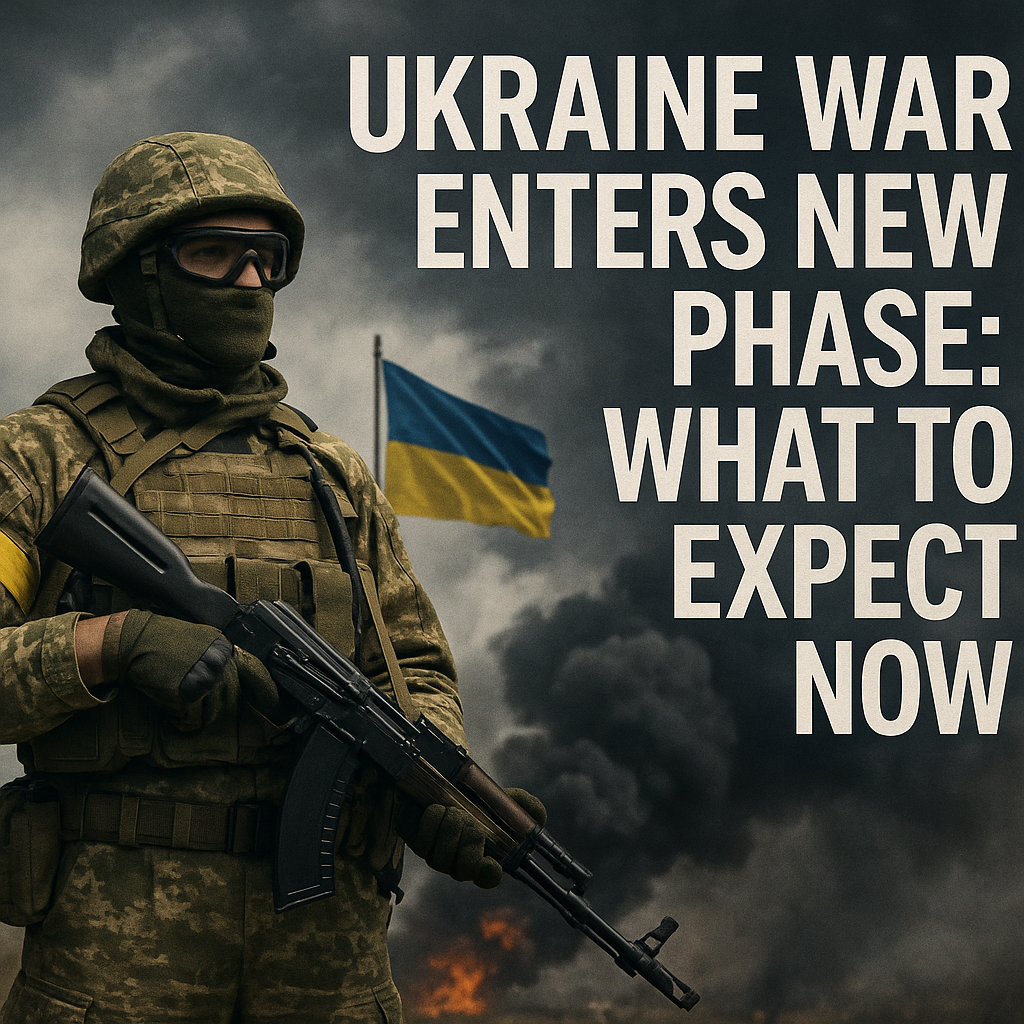
Ukraine War Enters New Phase: What to Expect Now
Ukraine War Enters New Phase: What to Expect Now
The ongoing conflict in Ukraine has entered a new phase, prompting both caution and anticipation among analysts and global stakeholders. As ground realities shift, understanding what this means for the war-torn nation, its allies, and adversaries is crucial.

Shifting Dynamics on the Ground
Recent reports indicate that Ukraine’s military strategy is evolving as it seeks to reclaim territories occupied by Russian forces. A combination of enhanced Western military support and internal resilience has fortified Ukraine’s defensive capabilities. According to Al Jazeera, Ukraine is focusing on a three-pronged strategy: solidifying defense lines, conducting counter-offensives, and negotiating for advanced military equipment.

This shift is echoed in various media sources. Sky News highlights that as summer approaches, the Ukrainian military is preparing for intensified confrontations. Analysts note that the introduction of advanced Western weaponry, such as long-range missiles and drones, could alter the battlefield dynamics significantly. However, this comes with its set of vulnerabilities; Ukrainian forces face the challenges of sustaining such military operations while mitigating casualties among civilians.

The International Response and Implications
The international community remains highly engaged, albeit with diverse perspectives. RT has reported that Russia perceives the influx of Western arms into Ukraine as an escalatory move, warning of severe consequences. This broadens the conflict’s reach, igniting fears of a spillover effect that could destabilize the region further. Such posturing reinforces Russia’s narrative of acting in self-defense while attempting to undermine the credibility of Ukraine’s military partnerships.
Conversely, supportive nations argue that Ukraine has the inherent right to defend its sovereignty. The alignment of various countries to provide military, financial, and humanitarian aid reflects a unified stance against Russian aggression. As the conflict drags on, humanitarian concerns also escalate. Reports from Al Jazeera indicate that millions of civilians face dire conditions, with access to basic necessities and healthcare critically hindered.
Future Scenarios: Hope or Escalation?
As we consider the future of the conflict, several scenarios emerge, ranging from a prolonged standoff to potential breakthroughs in negotiations. Some experts believe that continued Western involvement could lead to a tipping point—if Ukraine is capable of launching successful counter-offensives, it may reclaim significant territories, forcing Russia to reconsider its approach. This optimism is rooted in observable gains made by Ukrainian forces, fueled by comprehensive training programs and logistical support from NATO allies.
Alternatively, there exists the possibility of escalation. If Russia decides to intensify its military actions, the conflict could further spiral out of control, leading to a more entrenched and brutal warfare scenario. Such developments may prompt international forces to reconsider their involvement, compelled to strike a balance between support for Ukraine and the risks of a broader confrontation.
The uncertainty surrounding these potential outcomes reflects a complex web of local and geopolitical factors. Factors include the humanitarian toll, economic sanctions impacting Russian operations, and global supply chain disruptions. Each of these components intertwines with the overall trajectory of the conflict, complicating resolution efforts.
Conclusion: Navigating the Complexity Ahead
As the Ukraine war enters this new phase, the global community faces a critical juncture. Understanding the evolving military strategies, international ramifications, and humanitarian impacts of the conflict is more pertinent than ever. With the balance of power continuously shifting and uncertainties looming large, the path forward remains fraught with challenges. Stakeholders must navigate these complexities with prudence, aiming for a resolution that acknowledges the rights of the Ukrainian people while seeking to stabilize a precarious situation.















