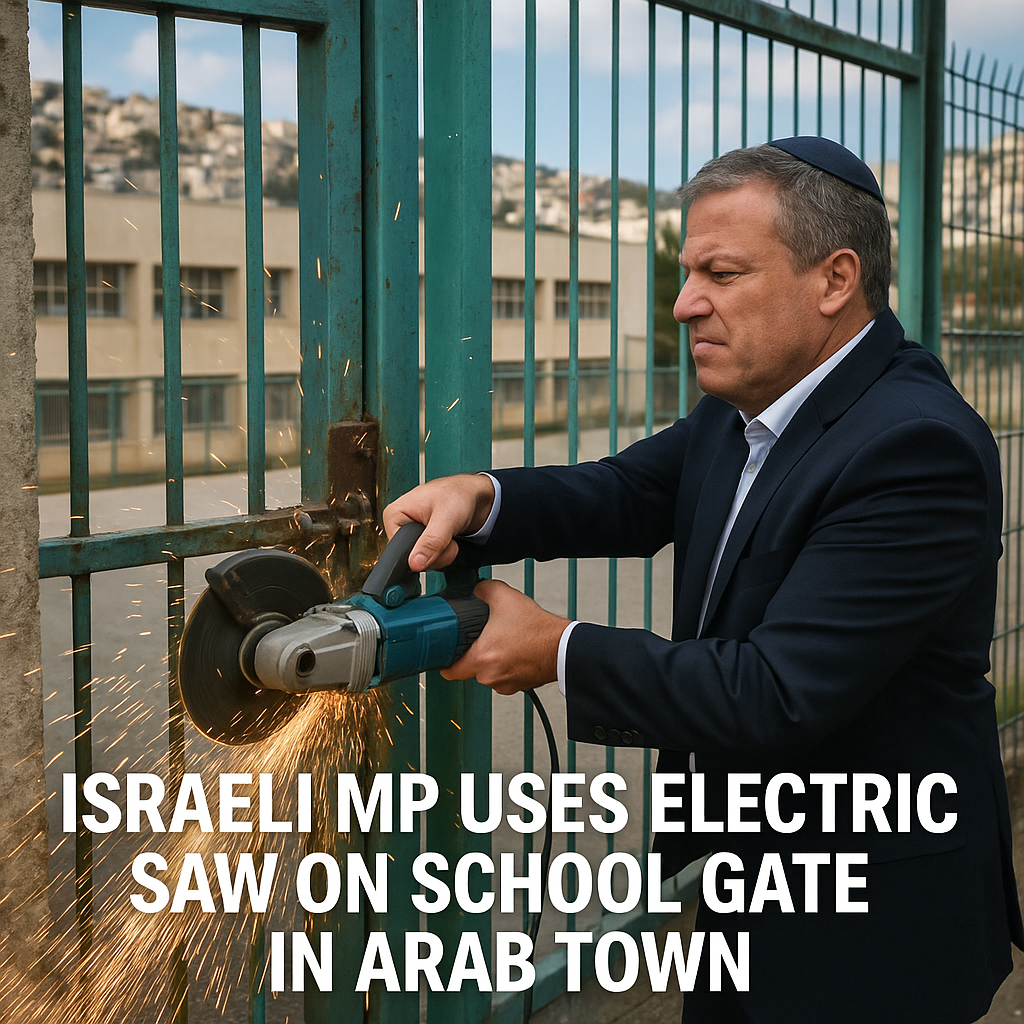
Israeli MP Uses Electric Saw on School Gate in Arab Town
An Unconventional Protest: Israeli MP Uses Electric Saw on School Gate in Arab Town
In a striking display of political protest, an Israeli Member of Parliament (MP) used an electric saw to cut through the gate of a school in an Arab town. This unusual act has generated significant media attention and sparked a heated debate around the challenges of coexistence and representation in Israel, particularly for its Arab citizens.

A Bold Statement or Political Stunt?
The incident took place in the Arab town of Tira, where MP Ofer Cassif, a member of the Joint List—a coalition of Arab parties—sought to make a statement about the government’s perceived neglect of Arab communities, particularly in the realm of education and infrastructure. By cutting the school gate, Cassif aimed to symbolize the barriers that Arab citizens encounter within Israel’s political framework.

Cassif’s actions have elicited mixed reactions. Supporters commend his audacity in bringing attention to issues that often go overlooked. For them, the electric saw represents more than just physical destruction; it’s a metaphor for dismantling the obstacles that Arab citizens face concerning equality in education and public services. Detractors, however, view the act as irresponsible and sensationalist. They argue that while the intention might be noble, the method undermines serious discourse about these critically important themes.

Responses from Both Sides
Following the incident, various human rights organizations and political analysts weighed in. Some praised Cassif’s approach, indicating that direct action might be necessary to highlight the pervasive discrimination faced by Arab communities in Israel. According to a representative from the Arab Association for Human Rights, “Cassif’s act should serve as a wake-up call to a government that continues to disregard the needs of Arab towns.”
Conversely, right-wing factions have condemned Cassif’s actions, labeling them as a form of political theater devoid of constructive solutions. Prime Minister Naftali Bennett’s office expressed its disapproval, stating that such tactics only deepen divisions rather than pave pathways for dialogue. This polarized response reflects the broader schism in Israeli society regarding the treatment of Arab citizens, which often leads to contrasting narratives about representation and rights.
The Broader Context
The plight of Arab communities in Israel is complex, marked by historical grievances and systemic issues. The Arab minority, comprising about 20% of the population, has long faced challenges such as limited access to public resources, including education. Schools in Arab towns often endure underfunding relative to their Jewish counterparts, leading to disparities that affect students’ academic outcomes.
This backdrop informs why Cassif’s protest resonates with some, but also why it generates backlash. For many Israelis, the very act of cutting through a school gate can evoke feelings of tension and division, further complicating an already fraught public discourse about identity, belonging, and equality in the state.
The Importance of Dialogue
Although Cassif’s electric saw drew immediate attention, the need for serious discussion about the issues confronting Arab citizens remains paramount. The grievances cited by Cassif reflect broader systemic inequalities that warrant attention from all segments of society.
Engaging in dialogue—rather than sensationalist acts—may yield more substantive pathways toward resolution. With ongoing tensions related to inequality, many voices within Israeli society, both Jewish and Arab, are calling for a concerted effort to address these disparities through legislative reform and community interaction.
In light of both support and criticism of Cassif’s unconventional protest, one overarching truth remains: the complexities of coexistence in Israel necessitate open communication among disparate communities. While emotional demonstrations might draw attention momentarily, they should ideally lead to deeper introspection and collaborative efforts to create a more equitable society.
Conclusion
The electric saw incident managed to spotlight pressing issues facing Arab communities in Israel, revealing the intricate layers of governance, representation, and social justice. As opinions continue to diverge on the appropriateness of such strategies in advocacy, what remains essential is the collective goal of addressing the inequalities that exist. This complex issue demands ongoing examination and a commitment from all stakeholders to strive towards a more inclusive future.