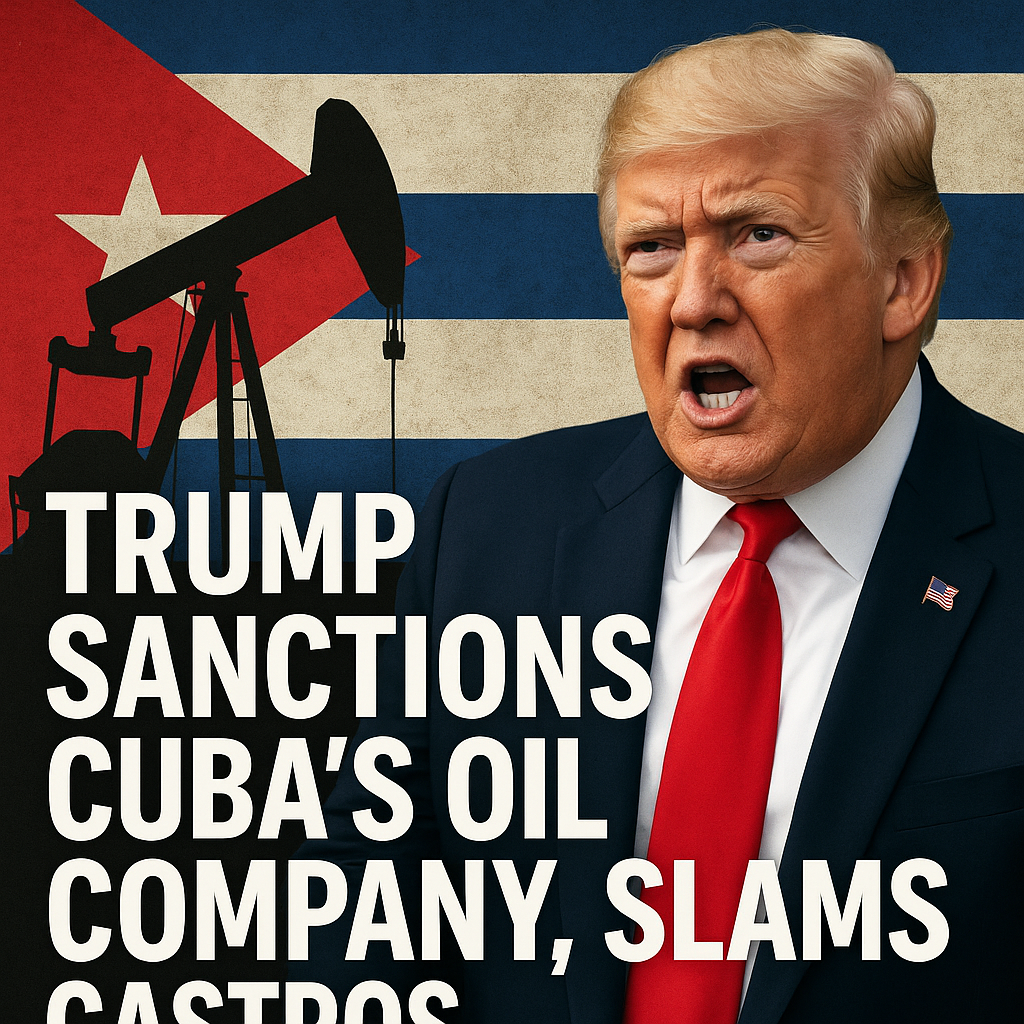
Trump Sanctions Cuba’s Oil Company, Slams Castros

The recent sanctions imposed by former President Donald Trump on Cuba’s National Oil Company have led to widespread reactions, highlighting the ongoing tensions between the United States and the island nation. This action underscores Trump’s staunch stance against the Cuban government and the legacy of the Castro regime, which continues to shape U.S.-Cuba relations.

Impact of Sanctions on Cuba’s Economy
The sanctions specifically target the Corporación de Rubén E. González, a state-run oil enterprise in Cuba, which Trump accuses of supporting Venezuelan dictator Nicolás Maduro. This move is part of a broader strategy to apply pressure on countries deemed hostile to U.S. interests, particularly those engaged in what the Trump administration identifies as human rights abuses or anti-democratic practices.


This decision is not without consequences. Analysts note that the sanctions are likely to exacerbate an already struggling Cuban economy, which has been further strained by the COVID-19 pandemic and U.S. embargo policies. Cuba relies heavily on imports for its energy needs, and any restrictions on its oil supply can lead to critical shortages, affecting the everyday lives of Cubans.


Furthermore, these sanctions come amid renewed discussions about regional security in Latin America. The U.S. has expressed concerns over Cuba’s close ties with Venezuela, suggesting that the oil company plays a critical role in bolstering Maduro’s regime, which has faced international condemnation for its human rights record.
Diverse Perspectives on the Sanctions
Supporters of the sanctions argue that they are necessary for promoting democratic reform in Cuba. Trump’s administration has framed this action within a context of U.S. foreign policy goals: diminishing the influence of authoritarian regimes in Latin America. Republican lawmakers have lauded the decision, claiming that it sends a strong message against the Castro regime’s historical repression and alignment with other dictatorial governments.
On the other hand, critics of the sanctions, including some Democrats and experts in foreign relations, assert that these measures are shortsighted and ultimately counterproductive. They argue that such sanctions disproportionately affect the Cuban populace rather than the government, leading to further hardship for ordinary citizens while doing little to destabilize the Castro regime. Historically, economic sanctions have often drawn the ire of the local population toward foreign powers rather than their governments.
The Historical Context of U.S.-Cuba Relations
Understanding the backdrop of these sanctions requires acknowledging the turbulent history between the two nations. The U.S. has maintained an embargo against Cuba since 1960, following the Cuban Revolution that brought Fidel Castro to power. Subsequent administrations have oscillated between tightening and loosening these restrictions based on the perceived threats posed by Cuba to U.S. interests or the potential for reform in the communist state.
In recent years, there have been moments of relative thawing, most notably under the Obama administration, which sought to normalize relations and open diplomatic channels. However, Trump’s approach marks a pivot back to a hardline stance—one that he views as a moral imperative to confront oppression and support the Cuban people’s quest for freedom.
Future Implications
The sanctions on Cuba’s oil company are expected to shape both domestic and international dialogue regarding U.S. policy in Latin America. While Trump’s allies regard this move as a crucial step in standing up for human rights, its practical implications raise serious questions—for example, how these sanctions will be enforced and what repercussions they may have within the region.
Furthermore, as the debate continues, the future of U.S.-Cuba relations remains fraught with uncertainty. The Biden administration’s approach to Cuba could significantly differ from Trump’s, potentially signaling a return to engagement. The evolving geopolitical landscape, influenced by broader debates on democracy, authoritarianism, and human rights, will keep Cuba at the forefront of U.S. foreign policy discussions.
In summary, the sanctions imposed by the Trump administration reflect a longstanding commitment to certain foreign policy principles, yet they evoke a range of opinions regarding their efficacy and humanitarian implications. As the situation develops, both the Cuban people and international observers will watch closely to see how this strategy impacts Cuba’s economic stability and the island’s political landscape.