
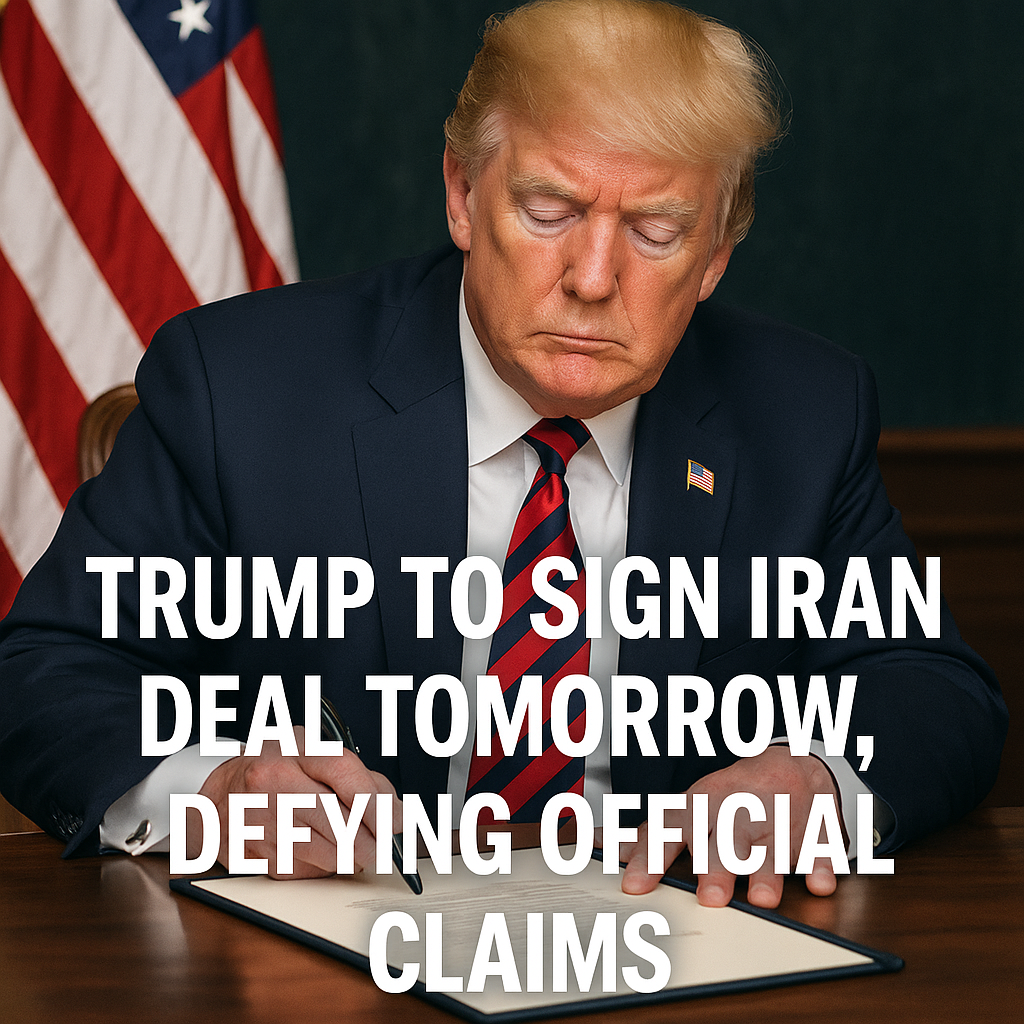
Trump to Sign Iran Deal Tomorrow, Defying Official Claims
Trump to Sign Iran Deal Tomorrow, Defying Official Claims
In a surprising turn of events, former President Donald Trump announced plans to sign a new Iran deal tomorrow, contradicting statements made by various Iranian officials. This move has reignited discussions around Iran-U.S. relations, drawing mixed reactions from both political analysts and international observers.

A Reversal of Expectations
Initially, many thought that the prospects of a revised nuclear agreement with Iran had dimmed significantly after Trump’s withdrawal from the Joint Comprehensive Plan of Action (JCPOA) in 2018. As various sources have noted, both the U.S. and Iran had grappled with increased tensions in the intervening years, particularly as economic sanctions and military posturing intensified.

According to Al Jazeera, Trump’s announcement appears at odds with recent declarations from Iranian officials, who expressed skepticism about the potential for meaningful negotiations. Iranian Foreign Minister Hossein Amir-Abdollahian was quoted as emphasizing the importance of “mutual respect” in any forthcoming discussions. This starkly contrasts with Trump’s assertive position, which suggests that he believes his administration’s involvement could steer negotiations in a more favorable direction.

The Complex Landscape of Diplomacy
The upcoming deal could mark a significant shift in international diplomacy concerning Iran’s nuclear program. Trump’s penchant for high-stakes negotiations has often led to unpredictable outcomes, and this situation is no different. Adversaries might view this signing as a unilateral move that could undermine the multilateral format traditionally favored in international agreements.
Furthermore, as RT reported, there are concerns regarding how this deal might affect regional stability. Given the historical context of U.S.-Iran relations, any agreement could be seen as either a step toward reconciliation or a temporary truce laden with conditions that could be unsettling for both sides. Commentators warn that a deal cobbled together through external pressure might lack the robust framework necessary for long-term compliance.
Contrasting Perspectives
On one hand, proponents of Trump’s pivot towards engagement argue that a new deal could provide a path forward for both nations, potentially easing sanctions and improving economic conditions in Iran. Additionally, they assert that dialogue could pave the way for addressing broader regional issues, including Iran’s influence in neighboring countries.
Conversely, skeptics worry that Trump’s approach, characterized by an inclination towards confrontation, may provoke rather than pacify tensions. Critics argue that prioritizing short-term gains without addressing deeper concerns may lead to further discord, jeopardizing not only the agreement but also the diplomatic credibility of the United States.
The Global Reactions
International reactions to Trump’s announcement will undoubtedly be significant, as various global actors watch the developments closely. Nations in the Middle East, in particular, are wary of any shift in U.S. policy that could embolden Iran or upset the balance of power in the region. Countries like Saudi Arabia and Israel—both historically adversarial towards Iran—may view this move with trepidation, fearing that it could grant Iran greater legitimacy on the world stage.
Moreover, the European Union has previously played a mediating role in facilitating dialogue, and its reaction to Trump’s plans will be crucial in determining the future trajectory of diplomatic relations. Any positive or negative responses from key global players could either facilitate a constructive dialogue or exacerbate existing divisions.
Conclusion: An Uncertain Path Ahead
While Trump’s upcoming deal with Iran raises hopes for a renewed dialogue, the landscape remains complex and fraught with uncertainties. The contrasting viewpoints underscore the multifaceted nature of international relations and the delicate balance that must be maintained. As the world anticipates the signing, one thing remains clear: the implications of this deal stretch far beyond the immediate geopolitical arena, resonating deeply within the annals of history and informing future generations about the challenges of diplomacy in an increasingly polarized world.















