
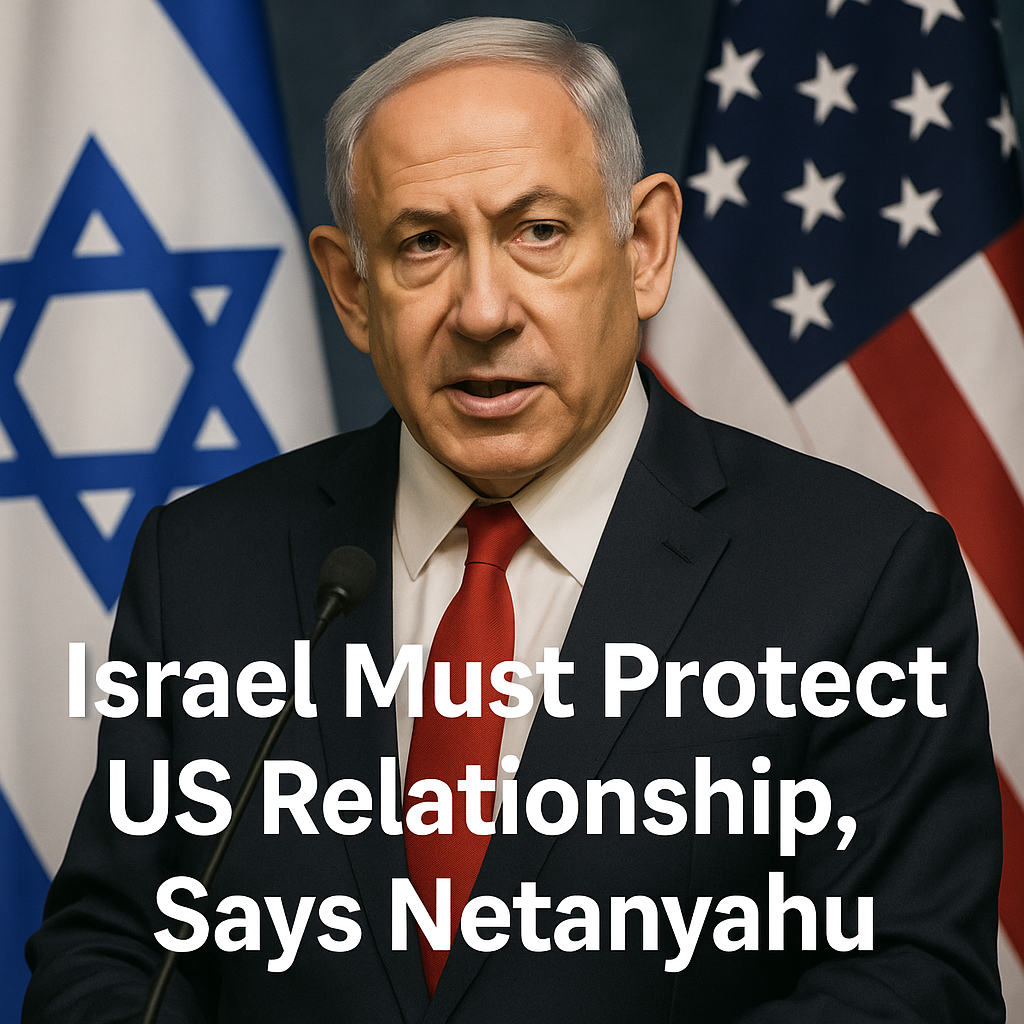
Israel Must Protect US Relationship, Says Netanyahu
In recent discussions, Israeli Prime Minister Benjamin Netanyahu has emphasized the critical importance of maintaining and protecting Israel’s relationship with the United States. Given the geopolitical significance of this alliance, Netanyahu’s statements reflect a broader strategy aimed at navigating complex international relations.

The Foundations of the U.S.-Israel Relationship
The U.S.-Israel relationship has been a cornerstone of both nations’ foreign policies for decades, rooted in shared democratic values, strategic interests, and strong cultural ties. Historically, American support has reinforced Israel’s security and bolstered its economy through military aid and diplomatic backing. Netanyahu’s insistence on the necessity to protect this relationship arises amidst a backdrop of shifting political dynamics in both Israel and the U.S.

On one hand, some analysts argue that Netanyahu’s administration faces unique challenges—such as increasing isolation in Middle Eastern politics, coupled with a domestic landscape marked by political turmoil. With a growing number of nations normalizing relations with Arab states, Israel’s position is evolving. Therefore, a strong U.S. alliance becomes not only beneficial but essential for Israel’s security and international standing.

Current Challenges and Strategic Objectives
Geopolitical Shifts
Recent Middle Eastern developments have introduced new variables in Israel’s national security calculus. The normalization agreements forged with the UAE and Bahrain under the Abraham Accords showcase a new diplomatic landscape. However, Netanyahu is aware that without robust U.S. support, the momentum could wane, diminishing Israel’s leverage in future negotiations.
Moreover, rising tensions with key regional players, such as Iran, necessitate a steadfast alliance with the U.S., which serves as a counterbalance to Tehran’s expanding influence. Netanyahu has articulated this point, indicating that a weakened U.S.-Israel partnership could embolden adversaries like Iran, undermining regional stability.
Domestic Politics and International Relations
Internally, Netanyahu faces challenges from various political factions, and maintaining a favorable relationship with the U.S. can be politically advantageous. Support from American lawmakers often translates into favorable legislative measures, thus creating a direct impact on Israeli citizens. However, dissenting voices within the U.S. are increasingly vocal, advocating for a reevaluation of aid and support based on Israel’s policies towards Palestinians.
As a result, Netanyahu’s calls for strengthening ties with the U.S. can also be seen as an effort to shield his government from potential backlash at home and abroad. Some commentators have pointed out that he may see this as an opportunity to consolidate his leadership in potentially turbulent times.
Varying Perspectives on the Relationship
Interestingly, perspectives on the importance of the U.S.-Israel relationship vary greatly. While many in Israel share Netanyahu’s view on the necessity of American support, others, especially within the international community, argue that unconditional support may enable certain policies that lead to escalating tensions in the region.
These differing viewpoints highlight a crucial aspect of international relations: the balance between national interests and global responsibilities. For some critics, the relationship has become fundamentally transactional, raising concerns that it may prioritize immediate political gains over long-term peace initiatives.
The Way Forward
As Netanyahu articulates the need to protect Israel’s relationship with the U.S., it is imperative to understand the complexities involved. This association not only impacts military and economic aid but is also entwined with broader issues like human rights and regional conflict resolution.
The future of this relationship hinges not only on Netanyahu’s policies but also on evolving sentiments in the U.S., where public opinion regarding support for Israel appears more divided than in the past. Political trends indicate that dynamic shifts in the U.S. could lead to a reassessment of the nature of aid and cooperation, prompting Israeli leaders to reconsider their approaches to sensitive issues, particularly related to Palestine.
In conclusion, while Netanyahu’s insistence on safeguarding the U.S.-Israel relationship underscores its importance in the current geopolitical landscape, the complexities involved suggest that a nuanced approach is crucial. The alliance is not merely a matter of political rhetoric; it embodies a series of responsibilities and expectations that both nations must navigate carefully in an ever-changing world.















