
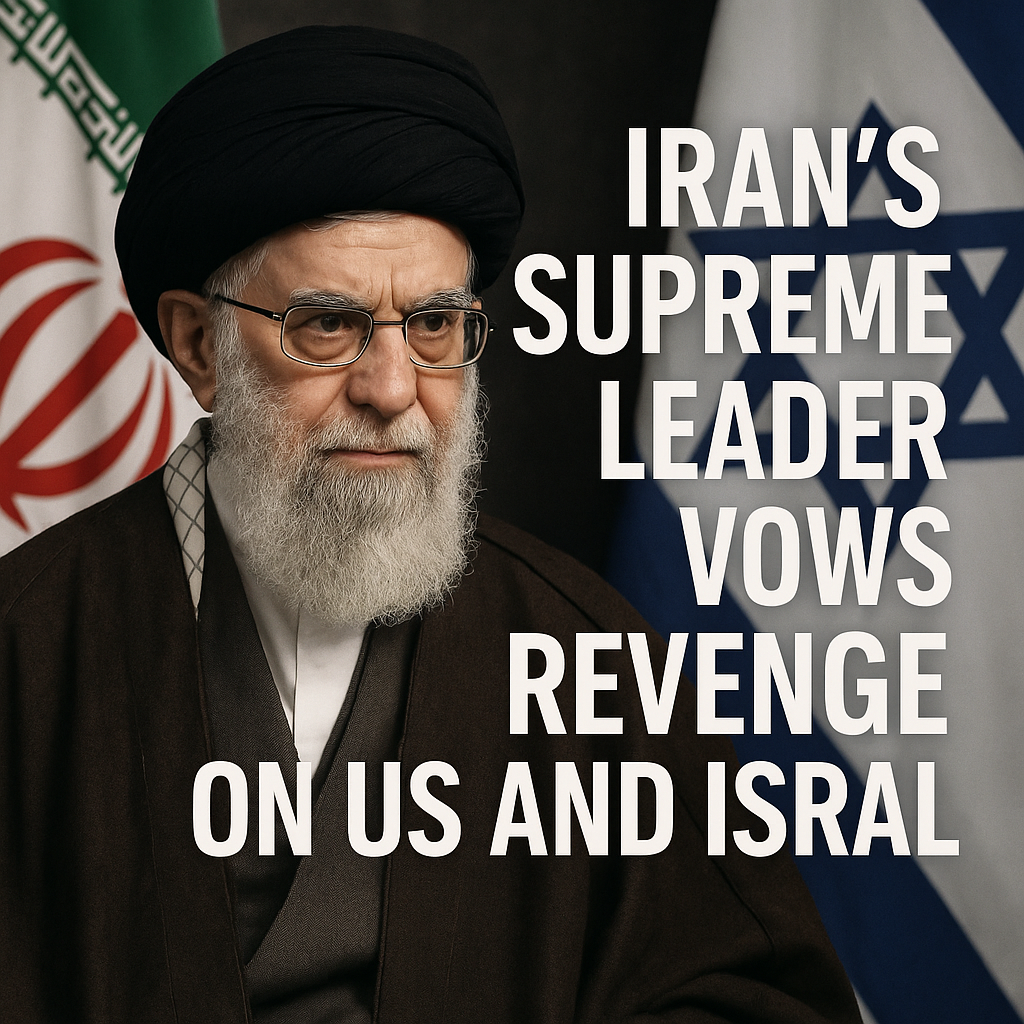
Iran’s Supreme Leader Vows Revenge on US and Israel
Iran’s Supreme Leader Vows Revenge on US and Israel
In recent remarks, Iran’s Supreme Leader Ayatollah Ali Khamenei declared a firm intention to retaliate against the United States and Israel for their perceived roles in both the region’s turmoil and the assassination of several Iranian military figures. Such declarations are not merely rhetorical—they reflect longstanding tensions in the Middle East and highlight the strategic calculus at play in a highly charged geopolitical landscape.

The Context of Khamenei’s Statements
Khamenei’s vow for revenge must be understood against the backdrop of years of escalating conflict and rivalry. In his latest speech, he articulated a narrative that emphasizes victimhood and resilience, asserting that Iran will respond decisively to any threats from its adversaries. This rhetoric is often aimed both at domestic audiences, rallying national pride, and at external foes, signaling Iran’s determination not to be perceived as weak.

Multiple sources report various dimensions of this tension. For example, Al Jazeera highlighted the historical context of Iran’s grievances against the US and Israel, citing past events such as the 1953 coup orchestrated by the CIA, which ousted Iran’s democratically elected Prime Minister Mohammad Mossadegh. This event laid the groundwork for a deep-seated animosity that persists to this day.

In contrast, Russian state media outlet RT reported Khamenei emphasizing the “great trials” faced by the nation due to foreign interference, framing the call for revenge as a unifying national imperative. This perspective resonates with Iran’s efforts to consolidate power internally while facing external pressures—a strategy often employed by regimes under threat.
Implications for Regional Stability
Khamenei’s assertions of vengeance raise serious questions regarding regional stability. The Iranian leadership has often used such incendiary language as a means of galvanizing public support against perceived foreign aggressions. Yet, the implications of actual retaliation can lead to dangerous escalations. Analysts warn that while Iran may seek to assert itself more aggressively, such actions could provoke military responses from the US or its allies in the region, including Israel.
Sky News reported that any retaliatory actions taken by Iran could potentially lead to broader military conflicts. In an era where proxy wars have already proliferated, the risks associated with these threats cannot be overstated. Tensions are particularly pronounced in countries like Syria and Iraq, where Iranian-backed militias operate and where any miscalculation could lead to significant bloodshed.
Moreover, the international community has often reacted to Iran’s provocations with sanctions or military posturing, further complicating an already volatile situation. The cycle of retaliation and punishment creates a feedback loop that may culminate in an unintended hot conflict, affecting countless civilians in the process.
Divergent Views on Foreign Policy and International Relations
There is a notable divergence in how various powers view Iran’s capabilities and intentions. While many Western nations perceive Iran as a rogue state, particularly with regard to its nuclear ambitions, some regional powers and observers argue for a more nuanced understanding of Iran’s actions. They contend that Iran’s belligerent rhetoric often serves as a response to external aggressions.
The ongoing tensions have also led to discussions around potential pathways for peace. Diplomats and international relations experts suggest open channels for dialogue instead of confrontation. However, as highlighted by RT, there are hardliners within the Iranian government who see negotiation as a sign of weakness, complicating efforts to find common ground.
Conclusion: The Challenge of Moving Forward
Khamenei’s vow for revenge against the US and Israel is emblematic of the complex and multi-layered nature of Middle Eastern geopolitics. While the historical grievances are deeply ingrained, the immediate implications of such statements are likely to reverberate throughout the region.
As tensions continue to escalate, the question remains whether genuine diplomatic solutions can emerge from the shadows of vengeance and retribution. The international community faces a challenging landscape, where the consequences of misunderstanding or missteps could have dramatically destabilizing effects. Balancing assertive foreign policy with the need for diplomatic outreach may hold the key to defusing a potentially explosive situation. The road ahead is fraught with uncertainty, but understanding the intricate dynamics at play is essential for navigating this complex and perilous landscape.















