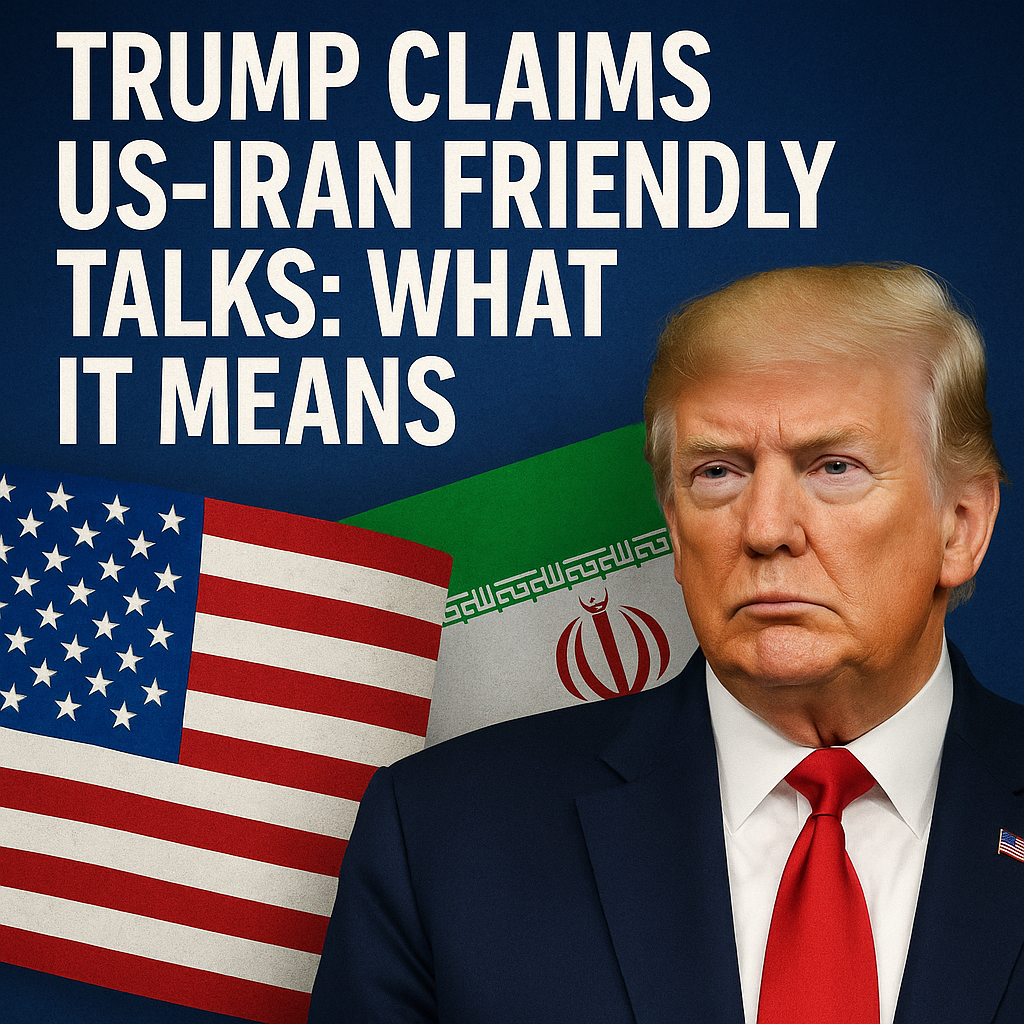
Trump Claims US-Iran Friendly Talks: What It Means
Trump Claims US-Iran Friendly Talks: What It Means
Recently, former President Donald Trump stated that the United States and Iran could be entering a phase of friendly negotiations, a claim that has stirred significant discussion among analysts and policymakers. This assertion, coming at a time of heightened geopolitical tension, prompts a closer examination of what these proposed discussions might entail and the implications they could have on international relations.

Contextualizing the Claims
The backdrop to Trump’s comments is a complex web of U.S.-Iran relations, characterized by years of hostility and conflict. The 2015 nuclear deal, formally known as the Joint Comprehensive Plan of Action (JCPOA), marked a historic moment of diplomacy but unraveled in recent years after Trump withdrew the U.S. from the agreement in 2018. Since then, the relationship has deteriorated, with both sides imposing sanctions and engaging in belligerent rhetoric.

In an interview, Trump indicated that new dialogues could pave the way for improved relations, asserting, “It’s time to talk and work things out.” His statement reflects a personal belief in the potential for diplomacy, which contrasts sharply with the hardline stance adopted during his presidency. Critics argue that such claims may be more of a political maneuver than a policy proposal, designed to resonate with Trump’s base and position him as a viable leader on foreign policy issues.

Analyzing Divergent Perspectives
The spectrum of opinions regarding Trump’s claims is broad. On one side, proponents argue that any form of dialogue could be constructive. They contend that engaging Iran in conversation might reduce tensions in the Middle East, especially regarding ongoing conflicts in Syria and Yemen, where Iranian influence remains a point of contention. For instance, an article from Al Jazeera highlights how talks could potentially lead to a more stable regional dynamic, citing previous instances where diplomacy led to thawing relations, albeit temporarily.
Conversely, skeptics argue that Trump’s comments lack substance. Analysts point out that the former president’s history of unpredictability raises questions about the sincerity and feasibility of such talks. The current Iranian leadership, emboldened by years of confrontational policies from the U.S., may view these overtures with skepticism. On platforms like RT, commentators suggest that Trump’s remarks are more indicative of an electoral strategy rather than a genuine shift in diplomatic intent.
The Iranian government has not formally responded to Trump’s claims, which further complicates the situation. Observers note that the lack of an official statement could indicate Iran’s current preference to wait and assess future U.S. administrations. This uncertainty casts a shadow over the prospect of any real dialogue.
The Broader Implications
The concept of U.S.-Iran friendly talks touches on numerous global issues, including nuclear proliferation, regional conflicts, and energy security. Renewed discussions could have significant implications for global oil markets, particularly if they lead to reduced sanctions that might allow Iran to increase its oil exports. An analysis from Sky News outlines how fluctuations in Iranian oil production significantly influence global prices, suggesting that stabilizing U.S.-Iran relations could have far-reaching economic benefits.
However, even if negotiations do take place, they would likely be met with significant challenges. The residue of mistrust and the histories of both nations must be addressed squarely before progress can be made. Issues surrounding human rights, regional influence, and missile development would also emerge prominently in discussions, complicating any hopeful narrative surrounding potential negotiations.
Conclusion
Trump’s claims of a possible shift towards friendly talks between the U.S. and Iran highlight just how intricate and volatile international politics can be. Opinions on the feasibility and desirability of such discussions vary, with many seeing the need for dialogue while doubting the likelihood of its success. As the political landscape continues to evolve, both U.S. and Iranian officials will need to navigate these complex waters carefully. Ultimately, whether these talks materialize or remain a political talking point will shape not only U.S.-Iran relations but also the broader geopolitical environment in the coming years.