
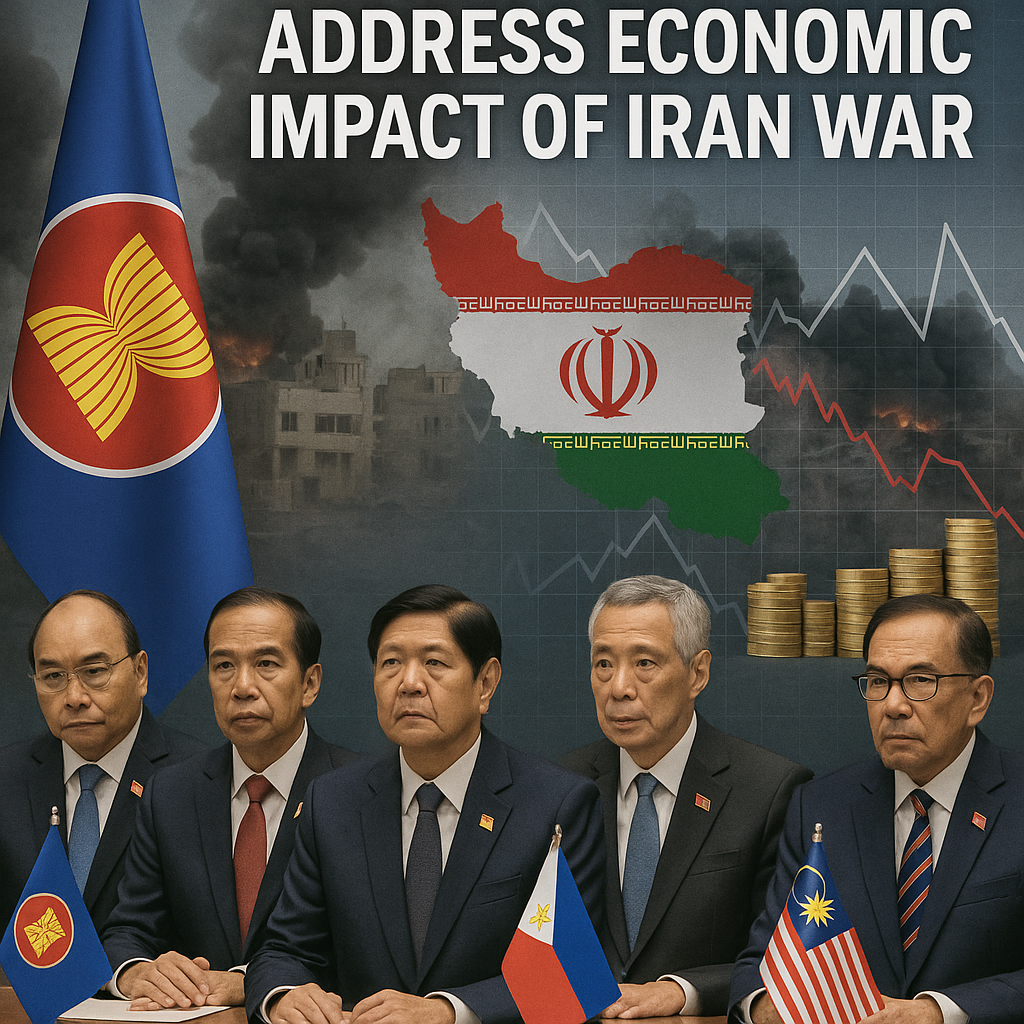
ASEAN Leaders Address Economic Impact of Iran War

ASEAN Leaders Address Economic Impact of Iran War
The ongoing conflict involving Iran has started to resonate in corners far from the Middle East, particularly during recent discussions among ASEAN leaders regarding its economic ramifications. As tensions escalate, Southeast Asian nations are strategizing to mitigate potential impacts on their economies, particularly related to energy security and trade flows.

Economic Ripple Effects
The ramifications of the Iran conflict extend to various sectors, especially energy. ASEAN nations, heavily reliant on energy imports, are facing immediate concerns over rising oil prices as uncertainties loom over the stability of supply chains. According to reports from Al Jazeera, the war has already led to fluctuations in global oil markets, which have ripple effects reaching ASEAN’s economies.


These price hikes can fuel inflation, compounding the challenges many ASEAN nations faced post-pandemic. Many countries in this region have been trying to recover economically, and any detraction, especially from critical sectors like energy, threatens their recovery trajectories. If oil prices continue to rise due to the conflict, ASEAN members may face difficult decisions regarding subsidies, which could strain public finances and create additional hurdles for their economic recovery.


Diverse Perspectives on Economic Strategies
Not all ASEAN leaders are approaching the situation with the same strategy. Some countries are advocating for closer cooperation within the region to enhance energy security, potentially by investing in alternative energy sources or diversifying their import partners. Notably, nations like Indonesia and Vietnam are exploring the development of renewable energy initiatives that could provide some buffer against these external shocks.
On the other hand, countries such as Malaysia and Thailand have voiced concerns about immediate economic pressures and are emphasizing the need for short-term solutions, such as negotiating energy deals with other major oil-producing nations to stabilize supplies. This contrast in approaches highlights the complexity of the economic impacts of the Iran war, as ASEAN leaders strive to balance immediate needs with long-term sustainability goals.
Exploring ASEAN’s Unified Response
Efforts for a unified response at recent summits have culminated in calls for increased intra-ASEAN trade and collaboration on food and energy security. Some leaders, as reported by RT, have stressed that fostering regional partnerships could help cushion the blow of global shocks induced by conflicts such as that in Iran.
ASEAN leaders are encouraged to consider establishing contingency plans that allow member states to respond collectively to sudden economic shocks. By creating frameworks that enable faster responses to fluctuating energy prices or disrupted supply chains, the ASEAN bloc could create resilient economies capable of weathering such conflicts better.
However, achieving such unity presents its challenges, as member states have differing priorities and economic capabilities. While some nations can invest heavily in alternative energy, others may lack the resources to transition rapidly, complicating collective efforts. This disparity inevitably influences negotiations and collaborative strategies.
Conclusion: Navigating Uncertainties
As the situation in Iran evolves, ASEAN leaders face increasingly complex challenges regarding their economic strategies. The competition between energy security, inflation control, and sustainable development will require nuanced approaches and adaptability. The conflicting perspectives among member states highlight the difficulty of reaching a consensus, as short-term needs often clash with long-term goals.
As they address these pressing matters, ASEAN countries must weigh potential alliances and trade agreements and consider how to enhance regional resilience. The ongoing conflict serves as a stark reminder of the interconnectedness of global economics, and the path forward for ASEAN will require both cooperation and innovation to navigate these uncharted waters ahead.















