
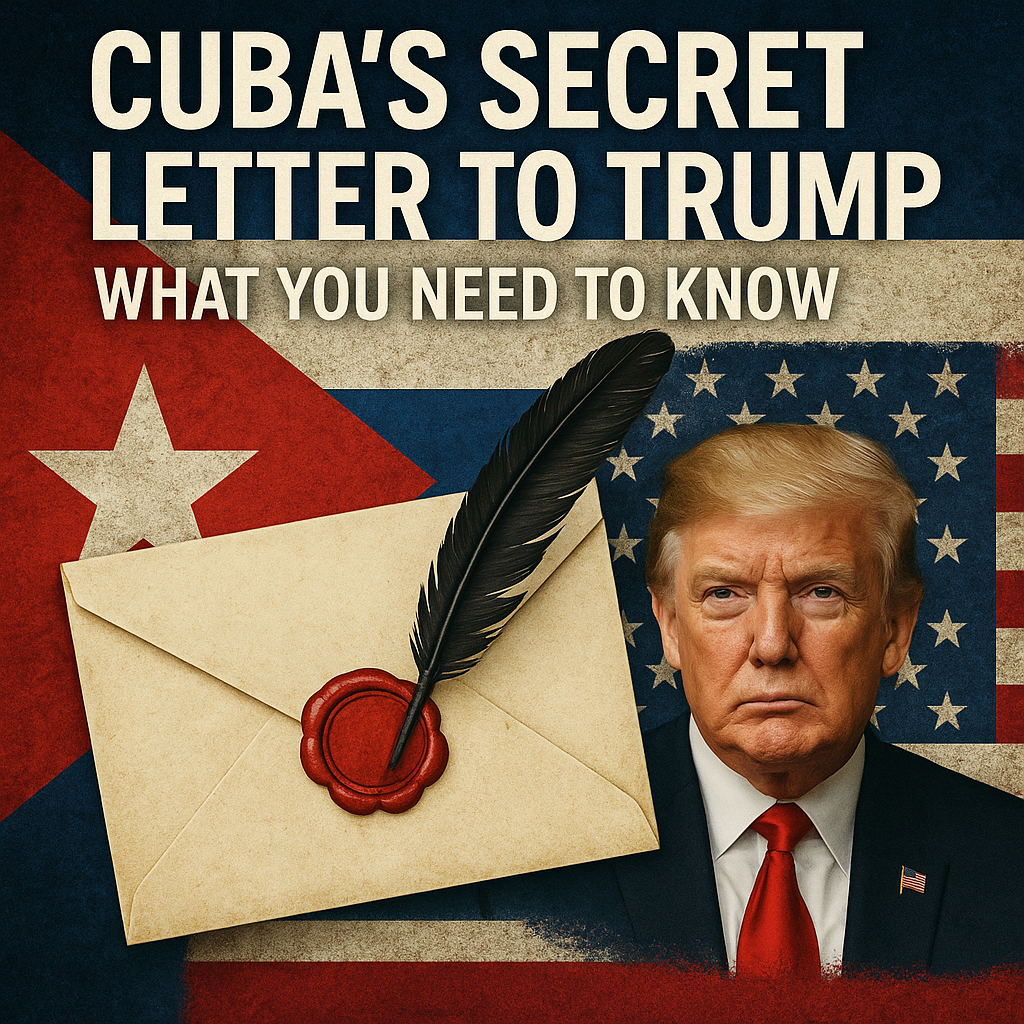
Cuba’s Secret Letter to Trump: What You Need to Know

Cuba’s Secret Letter to Trump: What You Need to Know
Cuba recently made headlines with reports of a secret letter sent to former President Donald Trump, sparking curiosity about the motivations behind this diplomatic communication. As the region navigates complex political waters, understanding the context and implications of this correspondence is essential.

Diplomatic Moves and Motivations
The letter, reportedly penned at a time when U.S.-Cuba relations were already strained, represents a significant diplomatic outreach from Havana. While the exact contents of the letter remain largely undisclosed, multiple sources suggest that it may have addressed crucial issues such as lifting sanctions, rebuilding ties, and possibly even influencing Cuban-American relations ahead of the 2020 elections.


In a recent article on RT, it was suggested that this outreach is part of a broader strategy by Cuba to engage with various U.S. administrations. It serves as a reminder of the longstanding tensions that have defined Cuba-U.S. relations, particularly under the Trump administration, which had taken a hardline approach. The letter’s timing also points to a potential recognition within Cuban leadership of the need for dialogue, indicating a shift from isolation to an attempt at communication.


Analyzing Perspectives
U.S. Response and Domestic Reactions
Responses from U.S. lawmakers have varied widely, illustrating the polarized nature of Cuba policy in American politics. Some Democratic representatives have expressed a willingness to consider lifting certain sanctions, arguing that engagement could stabilize the region and foster humanitarian aid. Conversely, hardline Republicans have criticized the letter as an irresponsible overture that threatens national security.
Al Jazeera reported that, amidst the varying opinions, there is a growing acknowledgment that isolation has largely failed to bring about change in Cuba. The letter symbolizes a potential opportunity for constructive dialogue, although some experts caution that without a strategic approach from the U.S., such overtures could prove futile.
The Bigger Picture: Regional Stability
Experts point out that the significance of the letter extends beyond U.S.-Cuba relations. It feeds into broader geopolitical narratives, including the influence of China and Russia in Latin America. As Cuba seeks to strengthen its international alliances, the U.S. must consider how its policies impact regional stability.
In discussions about this secret communication, commentators from various corners emphasize the importance of nuanced diplomacy. A detailed analysis highlighted that Cuba’s overture might be a tactical maneuver aimed at balancing ties with powers like China, while also appealing to potential allies in the U.S.
Conclusion: A Call for Openness and Engagement
Despite the complex and often contentious backdrop of U.S.-Cuba relations, the secret letter has unearthed an opportunity for renewed engagement and dialogue. The diverse reactions from lawmakers and analysts reflect the complicated layers of interests at play, but they also underline a crucial consensus: isolationism may no longer be a viable or effective strategy.
While it remains uncertain how the Biden administration will respond to this outreach, it’s clear that fostering communication could pave the way for understanding, ultimately benefiting both nations. Thus, as the story unfolds, it is paramount for stakeholders from both sides to approach this historic juncture with an open mind, aiming for a path that promotes mutual respect and collaboration.















