
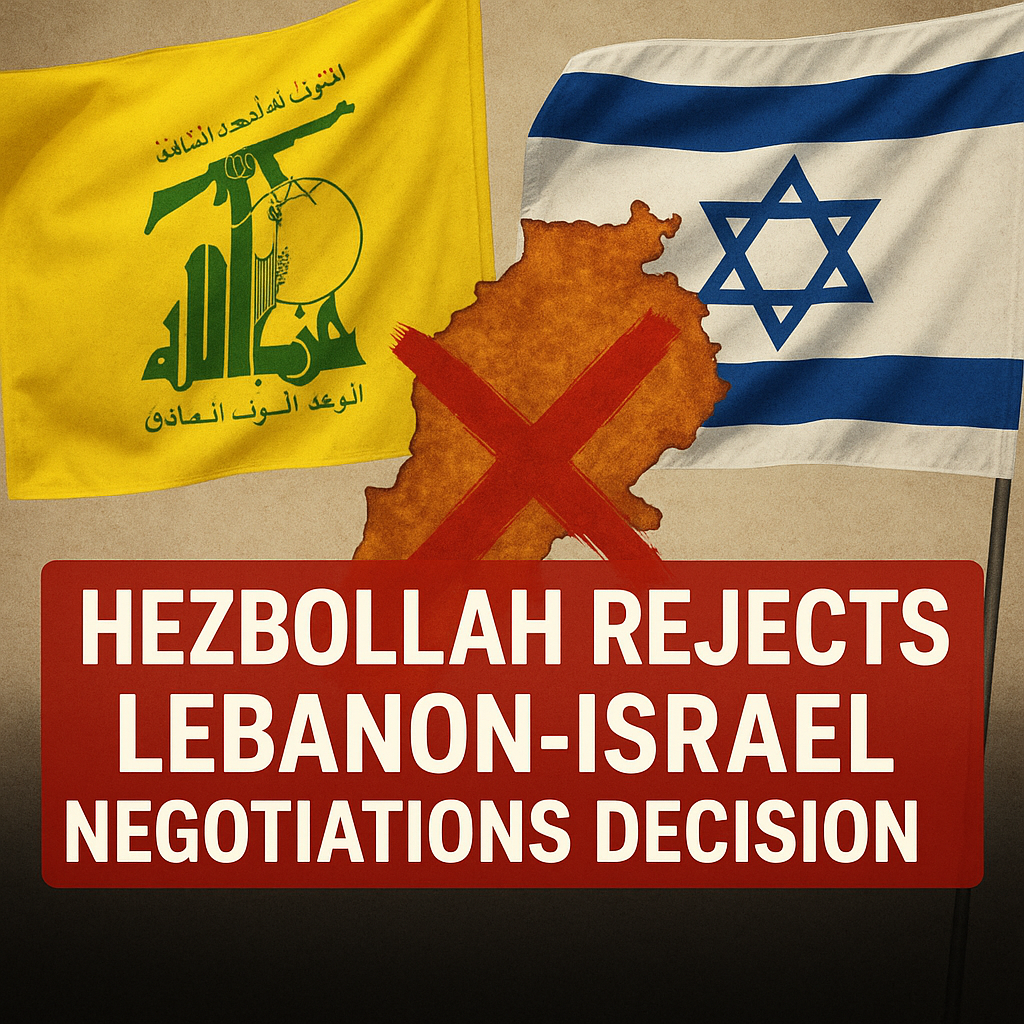
Hezbollah Rejects Lebanon-Israel Negotiations Decision

Hezbollah Rejects Lebanon-Israel Negotiations Decision
Recent tensions in the Middle East have once again flared, particularly as Hezbollah has officially rejected Lebanon’s decision to engage in direct negotiations with Israel. This decision comes amid a backdrop of long-standing hostilities, regional instability, and a complex interplay of political agendas. The implications of Hezbollah’s stance are wide-reaching, affecting not only Lebanese politics but also broader regional dynamics.

Hezbollah’s Position: A Strong Rejection
Hezbollah’s firm denial of Lebanon’s negotiations with Israel can be seen as an assertion of its ideological and political stance. In a statement released through various media outlets, the group criticized these negotiations as “insignificant” and “illegitimate.” They believe that direct talks with Israel undermine the long-term struggle against Israeli occupation and fail to contribute to any meaningful resolution of territorial disputes or regional conflicts.


Moreover, Hezbollah’s leadership frames its objection within a historical context. The group’s existence has been largely defined by its opposition to Israel, particularly since the 2006 Lebanon War. This ideological framework presents Hezbollah as a defender of Lebanon’s sovereignty, challenging any diplomatic outreach perceived as capitulatory.


The Lebanese Government’s Perspective
Contrasting with Hezbollah’s militant stance, the Lebanese government views negotiation as a pragmatic approach towards addressing pressing issues. The Lebanese authorities believe that engaging in dialogues can potentially open pathways for economic recovery, particularly in the wake of Lebanon’s ongoing financial crisis. According to government sources, direct negotiations with Israel could facilitate discussions around disputed maritime boundaries and resource sharing, crucial for Lebanon’s economic stability.
This perspective highlights a significant divide within the Lebanese political landscape. While Hezbollah’s rejection mirrors the sentiments of those opposed to normalization with Israel, many within the government argue for a more diplomatic approach to stabilize Lebanon’s precarious situation. It is this friction that illustrates Lebanon’s internal struggle between militant ideology and the need for political pragmatism.
Regional Implications: A Rising Tension
The refusal of negotiations by Hezbollah could escalate tensions not just within Lebanon but throughout the entire region. Israel, for its part, is likely to respond with heightened military readiness and rhetoric, given its long-standing security concerns regarding Hezbollah’s military capabilities and alliances with Iran. Additionally, the regional response may vary; some governments may view Hezbollah’s rejection as a challenge to diplomatic efforts aimed at peace, while others may align more closely with Hezbollah’s defiance against Israeli influence.
It is also essential to consider the perspective of other regional players. For instance, Iran continues to back Hezbollah, bolstering its military prowess and providing resources. This support complicates any potential for constructive dialogue, as Iranian interests often clash with those of the West and moderate Arab states looking for stability.
The Broader Context of Normalization Efforts
This situation reflects a broader trend wherein nations in the region grapple with normalization efforts. Countries like the United Arab Emirates and Bahrain have taken steps towards rapprochement with Israel, viewing such actions as beneficial to their economic and strategic interests. However, the rejection of negotiations by Hezbollah signifies not just localized resistance but a potential backlash against normalization efforts.
As a result, Lebanon finds itself at a crossroads. On one hand, its government aims to pursue diplomatic channels that can yield economic respite; on the other hand, Hezbollah’s rejection illustrates the powerful hold of ideologically driven resistance movements within Lebanese society.
Conclusion: The Path Forward Remains Uncertain
The rejection of Lebanon’s direct negotiations with Israel by Hezbollah underscores a complex intersection of political ideology, national interests, and regional dynamics. As Lebanon grapples with internal divisions and external pressures, the path forward remains fraught with uncertainties. Neither side has a clear advantage, and the ongoing tensions highlight the challenge of reconciling national interests with the realities of regional politics.
In this fraught environment, it is crucial for analysts and policymakers to weigh the diverse viewpoints surrounding this issue. Hezbollah’s vociferous rejection cannot be overlooked, nor can the necessity of pragmatic diplomacy in a country desperately seeking stability. As events unfold, the international community must remain vigilant and responsive to the evolving landscape in Lebanon and its implications for the broader Middle East.















