
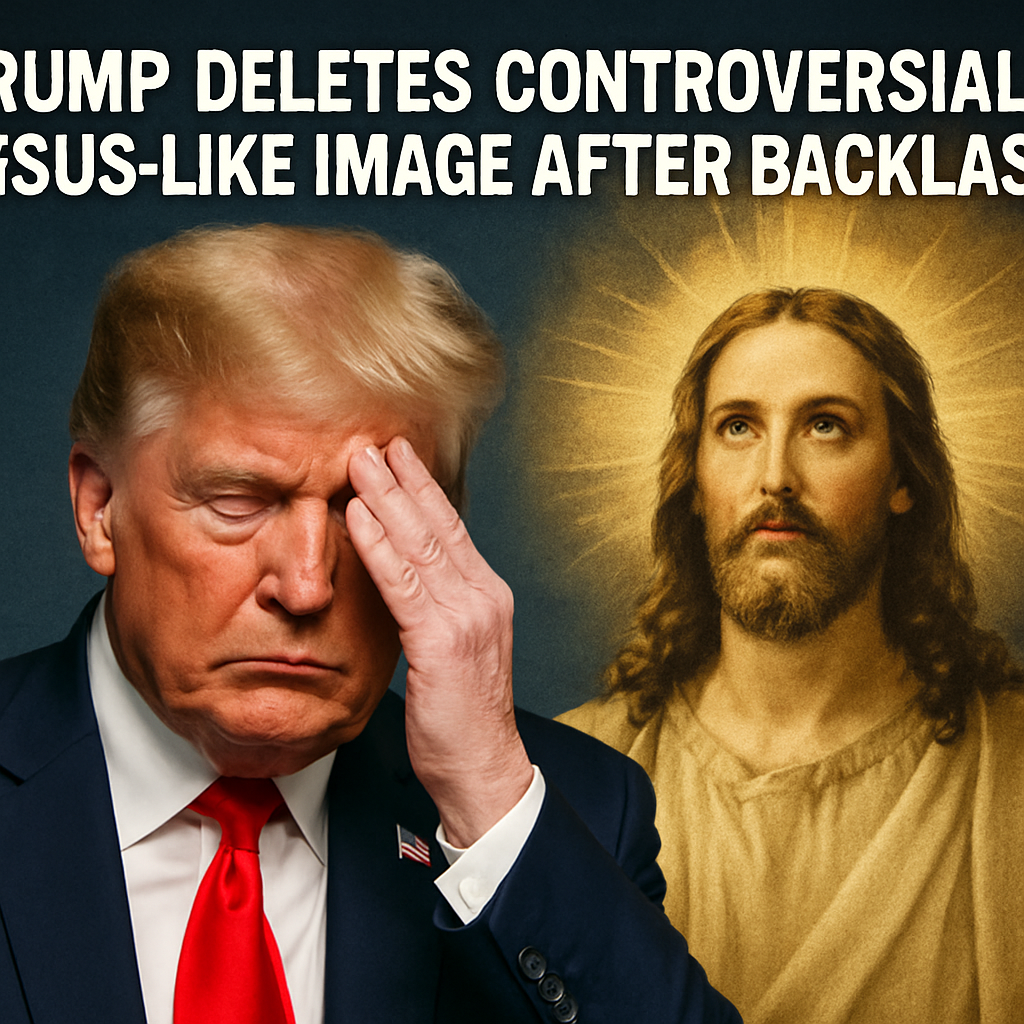
Trump Deletes Controversial Jesus-Like Image After Backlash

Trump Deletes Controversial Jesus-Like Image After Backlash
In a startling move that has garnered mixed reactions across the political spectrum, former President Donald Trump recently deleted an image he posted that depicted him in a Jesus-like manner. While some supporters viewed it as an expression of faith, critics condemned it as a troubling blurring of religious and political icons.

The Image in Question
The image featured Trump looking down with a radiant halo, akin to traditional depictions of Jesus Christ. It was meant to resonate with Trump’s staunch base, particularly among evangelical voters who view him as a champion of conservative Christian values. However, the backlash was swift and severe. Critics argued that positioning oneself as a Christ-like figure is not only audacious but also minimizes the spiritual significance of religious symbolism.


Diverse Reactions
Reactions to the image were polarized. Supporters, particularly from Trump’s base, heralded the depiction as a bold statement of faith and a rejection of secularism that has seeped into American politics. One supporter articulated on social media, “It’s about time someone stood up for our values! This image shows the strength of his faith.”


Conversely, public figures and commentators did not hold back in their criticisms. Some labeled the imagery as “blasphemous” and “offensive,” emphasizing that it trivializes deeply held beliefs. For instance, an op-ed contributor from Al Jazeera remarked, “Associating political figures with religious icons is a dangerous gambit that risks alienating many faith followers.”
Social media platforms buzzed with discussions surrounding the implications of such imagery. Many users pointed out that placing a political leader on par with religious figures risks undermining the integrity of both politics and religion.
The Broader Context of Political Imagery
The controversy surrounding Trump’s image is not an isolated incident; it aligns with a broader trend of political leaders employing religious imagery to shore up support among their bases. Over the last decade, various politicians have utilized religious symbols and rhetoric to connect with constituents, often leading to debates on the separation of church and state.
Historical Precedents
Historically, American politics has seen a complex intertwining of religion and governance. From the early days of the Republic, where leaders often invoked divine guidance, to modern-day campaigns where faith plays a crucial role, the religious-political landscape has continually evolved. Trump’s presidency, in particular, has been marked by a close relationship with evangelical Christians, often rallying them around shared ideological beliefs.
Yet, the differing responses to Trump’s Jesus-like portrayal reveal a growing discomfort with such imagery. Many argue that it risks commodifying faith, while others see it as a legitimate expression of belief. The distinction is essential as it highlights contrasting views that exist even within religious groups themselves.
The Aftermath and Moving Forward
In the wake of deletion, discussions surrounding the implications of the image continue to reverberate. Trump’s action may reflect an awareness of the potential fallout from misappropriating religious imagery, but it also raises questions about why such a portrayal was initially conceived.
Amidst this debate, the conversations about the blending of politics and religion offer a valuable opportunity for reflection. Discussions regarding the symbolism employed by political figures can benefit from a nuanced understanding that acknowledges the sensitive nature of faith, while also considering the motivations that drive leaders to connect with their constituents.
The way forward will require political leaders to tread carefully, particularly in a nation that wrestles with its religious identity and political affiliations. As the lines between faith, politics, and personal branding continue to blur, it remains crucial for both leaders and voters to engage thoughtfully and respectfully.
In conclusion, the image’s deletion serves as a reminder of the complexities involved in political representation of faith. Whether viewed as a misstep or a statement of faith, this incident will likely resonate in ongoing discussions about the role of religion in American politics. As both supporters and critics evaluate the implications of such portrayals, the dialogue surrounding the intersection of belief and politics is far from over.















