
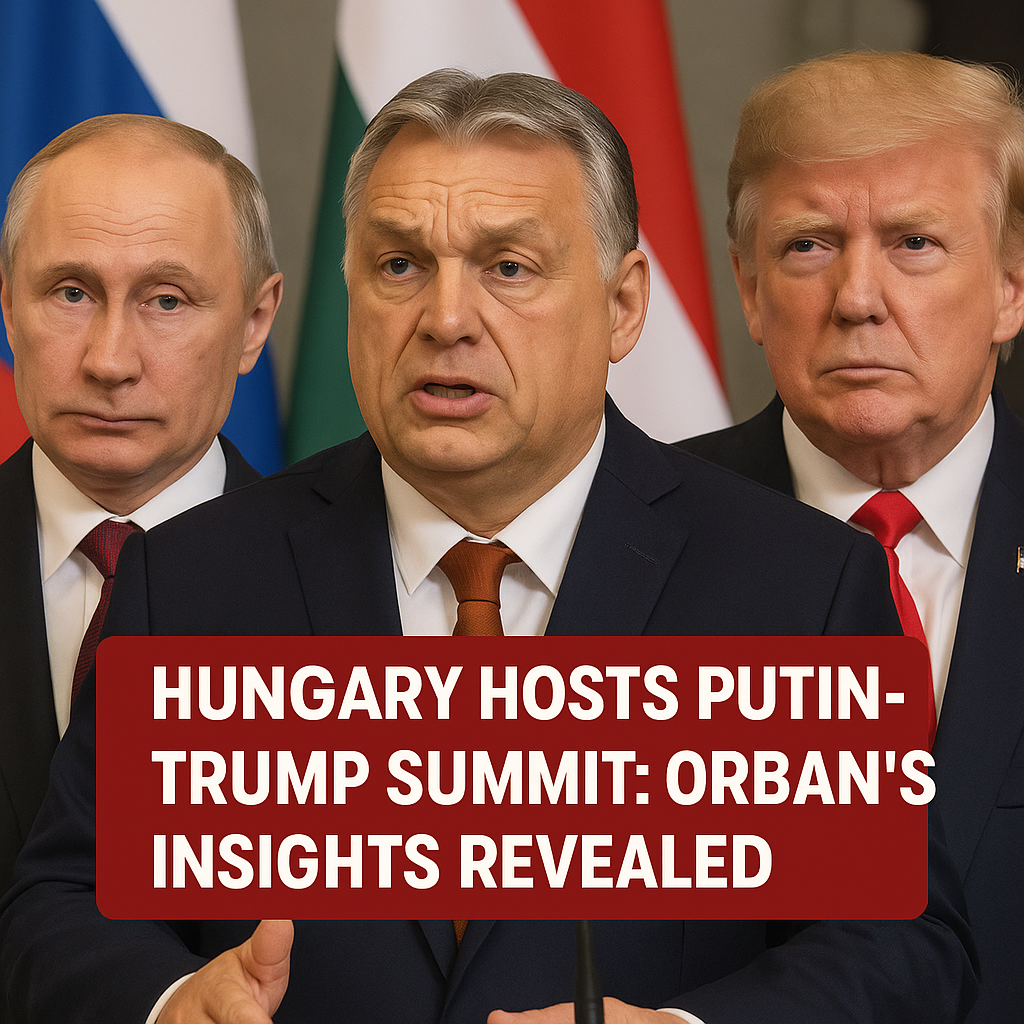
Hungary Hosts Putin-Trump Summit: Orban’s Insights Revealed

Hungary Hosts Putin-Trump Summit: Orban’s Insights Revealed
Hungary made international headlines recently when Prime Minister Viktor Orbán announced the hosting of a summit featuring Russian President Vladimir Putin and former U.S. President Donald Trump. This extraordinary convergence of political figures in Budapest sparked a multitude of reactions, reflecting the deep complexities of geopolitics in our current era.

Hungary’s Strategic Positioning
Hungary’s decision to invite two of the most controversial leaders in modern politics serves as a strategic maneuver in Europe’s shifting landscape. Orbán, known for his nationalist policies and close ties with Moscow, presents Hungary as a bridge between East and West, arguing that dialogue is essential for stability. In a recent interview with Russian state media, Orbán emphasized the need for “constructive engagement” and the importance of maintaining diplomatic channels.


Such sentiments resonate particularly in the context of Hungary’s energy dependency on Russia. As the ongoing conflict in Ukraine continues to strain European relations with Moscow, Orbán’s government faces the challenge of balancing national interests with the broader aspirations of the European Union. Critics, however, express concerns that Budapest’s alignment with these leaders undermines EU values and could exacerbate tensions within the bloc.


The Dual-Edged Sword of Diplomacy
The invitation to both Trump and Putin has elicited diverse viewpoints regarding Hungary’s role in international diplomacy. Supporters of Orbán argue that the summit could serve as a platform for crucial dialogues on energy security and geopolitical stability. Proponents view this as an opportunity for Hungary to assert its influence and perhaps even mediate between Eastern and Western powers.
However, not all are optimistic about the potential outcomes of such a meeting. Critics argue that it may lend legitimacy to autocratic governance and undermine democratic ideals. Some sources express concern that the summit is more about political theater than about meaningful dialogue. As Al Jazeera reported, many European officials worry that Orbán’s cozying up to Trump and Putin could jeopardize Hungary’s standing in the EU and alienate its allies in a time of crisis.
Public Opinion and Societal Implications
Public sentiment in Hungary is mixed regarding the summit. A recent poll reported by Sky News showed that a significant portion of the population remains skeptical about the visit, citing fears of increased foreign influence and deterioration of democratic norms. On the other hand, a notable demographic appears to favor closer ties with Russia and the United States, seeing it as beneficial for Hungary’s economy.
This divergence in public opinion raises questions about Orbán’s long-term strategy. Is he prioritizing the will of the people, or is he aiming for geopolitical advantages? The summit seems to serve both objectives at once: reinforcing his grip on power while positioning Hungary as an intermediary in global affairs.
The Broader Context: A New Era of Global Politics
What makes this event particularly noteworthy is its timing within the wider context of global politics. The West is grappling with a recalibration of alliances, especially following the U.S.’s withdrawal from Afghanistan and the ongoing strife in Ukraine. Trump’s brand of politics has added an unpredictable element, with some supporters touting ‘America First’ as a necessary approach in a changing world, while opponents argue it threatens to isolate the U.S. and its allies.
Putin, on the other hand, seeks to enhance Russia’s global influence and counteract Western sanctions that have sought to limit his country’s reach. Orbán’s decision to host this summit holds significant implications, as it could either strengthen or weaken the EU’s collective standing against Russia.
The Path Forward
As the summit approaches, the various stances from multiple stakeholders suggest a complex, multi-layered scenario. Hungary’s role as a host might serve to amplify its voice on the international stage, yet it also puts Orbán’s administration under scrutiny for potential repercussions on both domestic and foreign fronts.
While the intentions behind the summit may be framed as diplomatic and constructive, the real test will lie in the outcomes. Will there be actionable items that benefit Hungary and the broader geopolitical landscape, or will it merely serve as a platform for posturing?
In conclusion, as Hungary hosts Putin and Trump, the multifaceted implications of this summit remain uncertain. It encapsulates the challenges of diplomacy in a polarized world—an opportunity for dialogue aisle amidst substantial risks. The world watches closely as Budapest prepares to play a crucial part in shaping future geopolitical narratives.















