
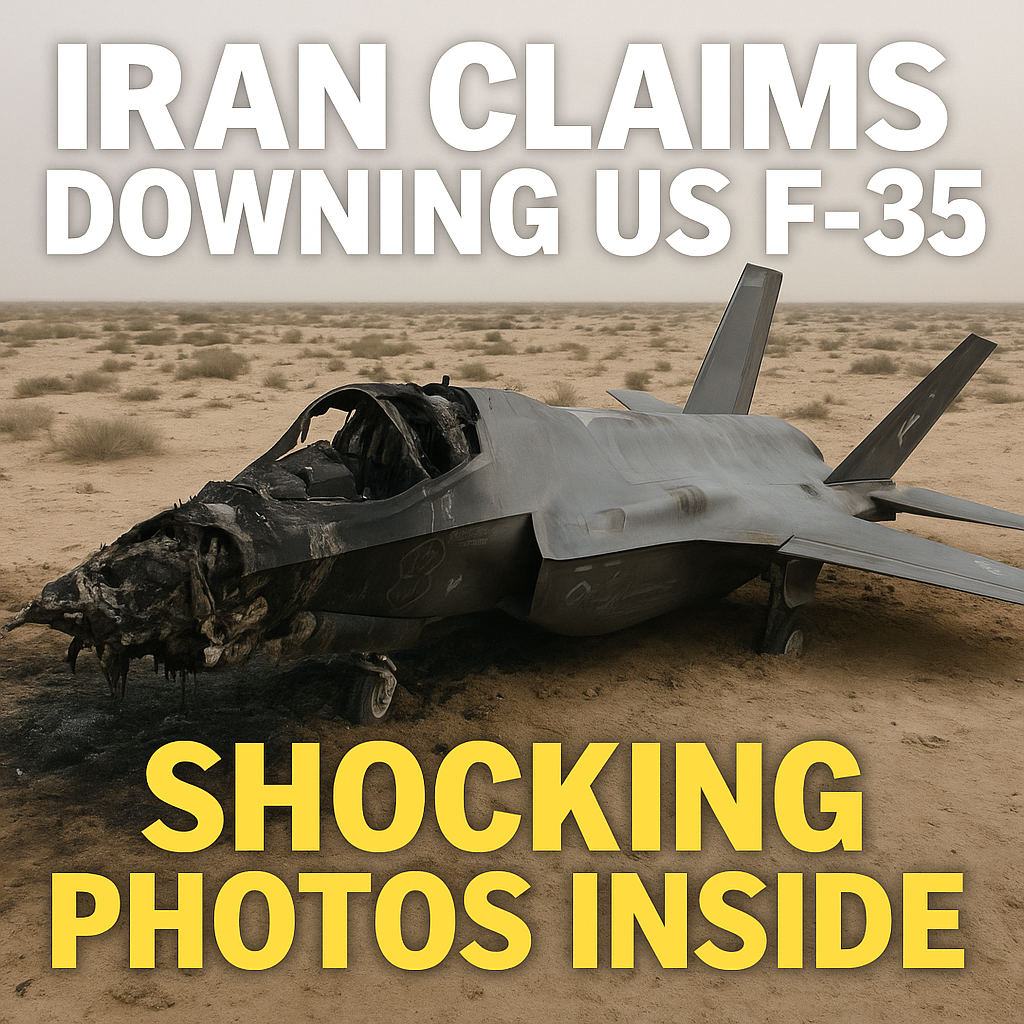
Iran Claims Downing US F-35: Shocking Photos Inside

Iran Claims Downing US F-35: Shocking Photos Inside
Recent reports have emerged regarding Iran’s assertion that it successfully downed a U.S. F-35 fighter jet, a claim that has stirred significant debate within international spheres. This incident brings forth questions about military engagements, geopolitical tensions, and the reliability of such declarations amidst a complex backdrop of U.S.-Iran relations.

The Claim and Its Implications
The Iranian military recently showcased what it described as evidence of downing a U.S. F-35 jet, a boast that has been met with skepticism by various military analysts and geopolitical experts. According to a report from RT, Iran released photos purportedly showing wreckage that they claim belongs to the stealth aircraft. Iranian officials framed this achievement as a testament to their growing military capabilities and used it to bolster national pride against perceived external threats, particularly from the U.S. and its allies.


However, American officials have categorically denied that any F-35s have been lost. They assert that all aircraft in the region are accounted for and that the technology embedded in the F-35 makes it highly difficult to detect or engage in any meaningful manner without highly sophisticated radar systems—capabilities that, according to most assessments, Iran does not possess.


Skepticism and Geopolitical Context
The contrasting narratives highlight the complexities surrounding military engagements in the region. Many experts stress the importance of taking Iran’s claims with caution, especially considering their historical context of exaggerating military successes for domestic consumption. Al Jazeera points out that such announcements often serve to divert attention from internal issues, galvanizing public support during challenging times.
Moreover, the geopolitical landscape is abuzz with tensions. The U.S. has maintained a heavy military presence in the Persian Gulf, and recent maneuvers have included both surveillance flights and joint exercises with regional allies. Given this backdrop, the stakes are high for both sides, and the potential for miscommunication or further conflict looms large.
While some military analysts admit that an engagement with an F-35 could theoretically occur under specific circumstances, they emphasize that it is highly unlikely. The consensus is that Iranian capabilities, while improved, remain limited compared to those of the U.S. military, making the claim of downing such a sophisticated aircraft dubious at best.
Assessing the Evidence
Given the heightened tensions and dramatic context surrounding the claim, it’s essential to dissect the evidence provided by Iran. The photos shared are said to depict debris but have faced significant scrutiny. Experts contend that without verification from independent international observers, these images do little to substantiate Iran’s assertion.
One notable point of contention is the technology involved in the F-35, which is designed to operate in stealth mode. This capability, paired with advanced countermeasures, makes the aircraft less susceptible to detection and engagement. Thus, the mere existence of debris does not unequivocally validate Iran’s claims.
Conclusions and Uncertainties
The episode reflects broader themes in U.S.-Iran relations, characterized by a cycle of mutual distrust and aggressive posturing. While Iran’s claims can serve as a mechanism to assert its military prowess, the international response, particularly from the U.S., underscores a different narrative aimed at showcasing military supremacy and deterrence.
Ultimately, without independent verification, the true details surrounding the alleged downing of an F-35 remain shrouded in uncertainty. As military analysts caution, in the absence of concrete evidence, any claims must be viewed through a critical lens.
As discussions continue, both parties may benefit from addressing underlying tensions with a strategic approach, as the risks tied to military confrontation escalate in an already fraught regional climate. The international community closely watches these developments, understanding that the implications extend far beyond the immediate claims of military success or failure.
In this intricate web of geopolitics, one thing is clear: the situation warrants careful observation, as the truth may remain elusive amidst the noise of conflicting narratives.















