
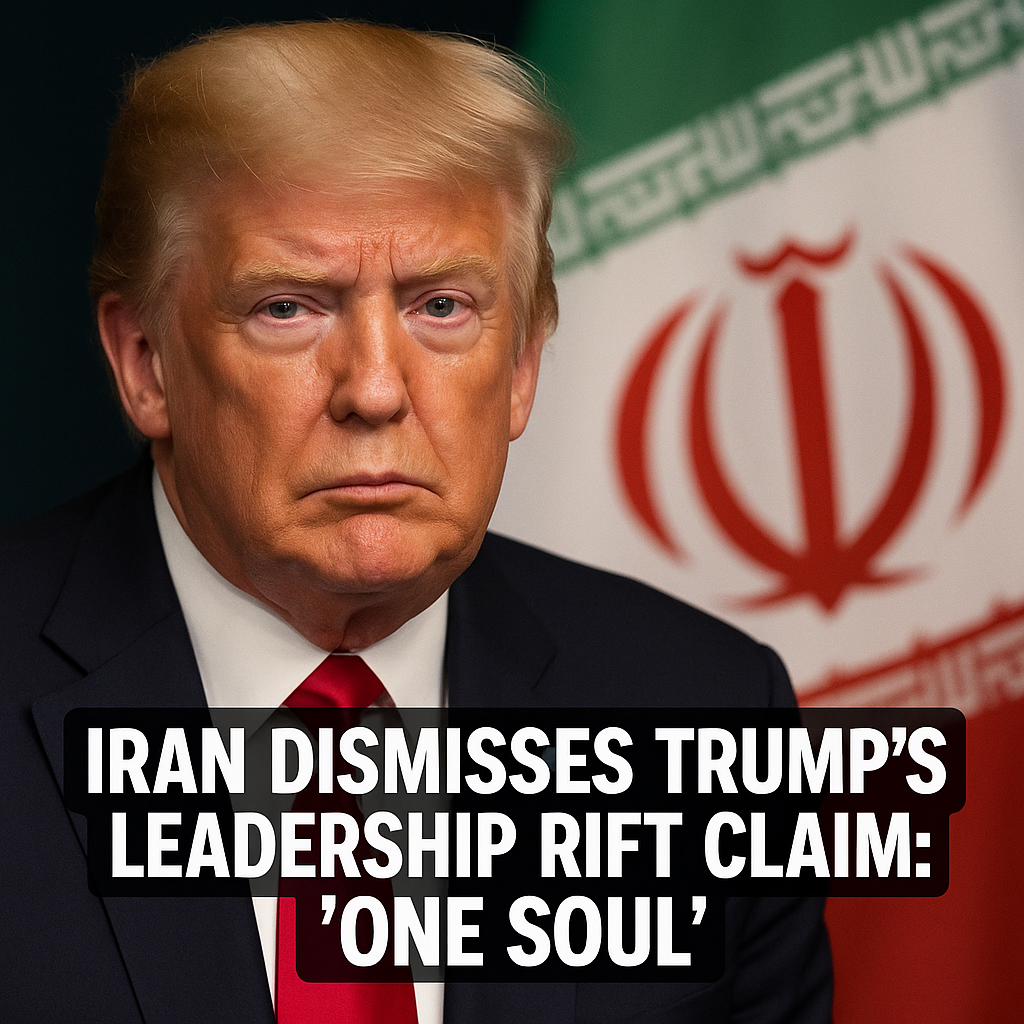
Iran Dismisses Trump’s Leadership Rift Claim: ‘One Soul’

Iran Dismisses Trump’s Leadership Rift Claim: ‘One Soul’
In recent days, Iran has firmly rejected former President Donald Trump’s assertion about a supposed rift within its leadership, emphasizing instead a notion of unity embodied in the phrase “one soul.” This incident not only highlights the complexities of Iranian politics but also underscores the interplay between international perceptions and domestic narratives.

Understanding Iran’s Political Landscape
Iran’s political framework is often viewed through the lens of its Supreme Leader, Ayatollah Ali Khamenei. Trump’s comments suggest a potential fracture in Iran’s leadership, which reflects a broader tendency among external observers to misunderstand the nation’s intricate political dynamics. However, Iranian officials assert that their governance is cohesive and unified, reinforcing their stance against foreign proclamations.


The Iranian Response
In response to Trump’s claims, Iranian Foreign Minister Hossein Amir-Abdollahian stated that the nation operates as “one soul” despite fluctuations in international relations and external pressures. This claim resonates strongly within Iran, especially as it aims to project a strong front amidst ongoing tensions with the West regarding its nuclear program and regional policies.


The Complexity of Iranian Unity
To understand the “one soul” assertion critically, it is essential to recognize the broader context. The Iranian government not only navigates internal factions but also manages a populace marked by diverse opinions and sentiments. While the leadership may publicly maintain a façade of unity, it faces significant challenges, including economic hardships and calls for reform from various segments of society.
Moreover, various sources indicate that while there are divisions within the Iranian political landscape, they are often strategically downplayed to bolster national solidarity against perceived external threats. This duality creates a complex scenario, where internal disagreements exist but are overshadowed by a collective identity when faced with foreign criticism.
International Perspectives
Trump’s comments and Iran’s robust response draw attention to the varied interpretations of Iranian politics by international leaders. Some experts believe that dismissing the potential for rifts overlooks the reality of Iranian governance, especially in light of the 2019 protests against economic mismanagement and government policies. These events suggest that there are factions within the ruling elite that could, under certain circumstances, converge or diverge based on pressing national issues.
Conversely, others argue that the Iranian leadership is more consolidated than ever, particularly in the face of external adversities. They point to the streamlined messaging from Iranian officials as evidence of this unity. As Amir-Abdollahian declared, the external perceptions of discord serve more as a reflection of outsider ignorance rather than a representation of actual divisions within Iranian ranks.
Weighing Evidence and Sentiments
The divergence in American and Iranian narratives raises questions about the efficacy of foreign political analysis. While Western officials often interpret Iranian responses as indicators of instability, Iranians themselves exude a sense of resilience and unified purpose in their public statements. This contrast emphasizes the need for careful consideration of context when interpreting political claims from a distance.
It’s worth noting that while Iranian leadership does project a united front, grassroots movements advocating for change are emerging steadily. There’s a growing desire among segments of the population, especially the youth, for political and economic reforms. This indicates that while the leadership claims unity, public sentiment may reflect a different reality.
Critics argue that the focus on unity may also be a strategic narrative used to distract from internal issues, fostering a dichotomy where external adversities justify domestic shortcomings. Thus, the “one soul” concept can become a double-edged sword, promoting national solidarity while simultaneously quelling dissent.
Conclusion
The discourse surrounding Trump’s comments and Iran’s subsequent dismissal exemplifies the complex interplay of international relations and domestic politics. While Iranian leaders assert a united front in the face of external criticism, unearthing the realities of internal divisions remains a significant challenge for analysts and policymakers alike.
As we move forward, it is essential to acknowledge the multifaceted nature of Iranian society and governance. Observers must remain critical and nuanced in their interpretations, recognizing that the dynamics within Iran are much more intricate than a single narrative may suggest. Whether it is the call for unity or the often-overlooked voices of dissent, understanding Iran requires a comprehensive approach that transcends simplistic dichotomies of unity versus division.















