
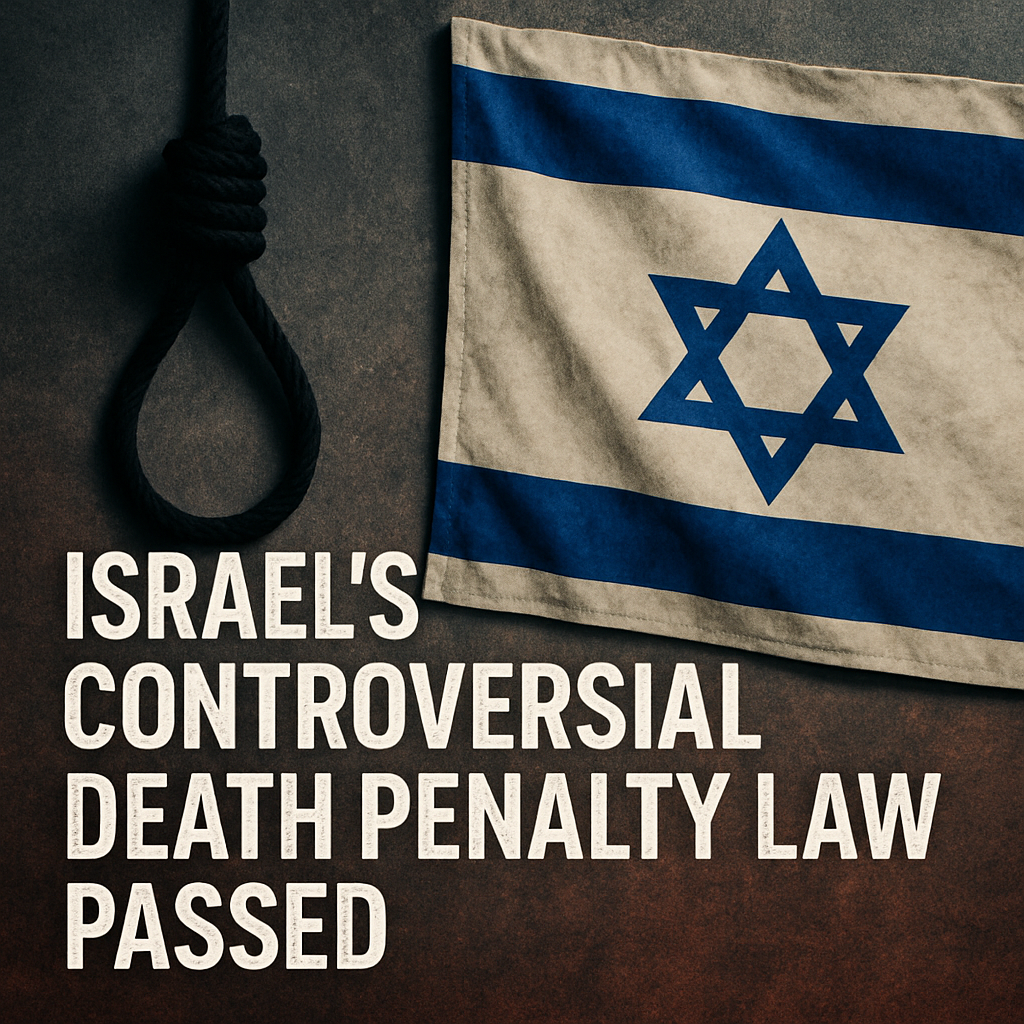
Israel’s Controversial Death Penalty Law Passed

Israel’s Controversial Death Penalty Law Passed
Israel’s recent decision to pass a controversial death penalty law has ignited heated debates both domestically and internationally. The law, which permits capital punishment for certain crimes, has raised significant ethical, legal, and political questions, reflecting broader themes in Israel’s ongoing struggle with security and justice.

Context and Historical Background
Historically, Israel has refrained from utilizing the death penalty, implementing it only once since the establishment of the state in 1948. The previous instance was the execution of Adolf Eichmann in 1962 for his role in orchestrating the Holocaust. As a democratic state, Israel has predominantly relied on life imprisonment for serious offenses, aligning with its legal principles that emphasize human rights.


However, the ongoing Israeli-Palestinian conflict has intensified calls for tougher measures against individuals deemed security threats. Proponents of the new law argue that it is a necessary step in combating terrorism, particularly in light of recent waves of violence. Right-wing factions view the legislation as a means to reinforce national security, suggesting that it could serve as a deterrent against attacks.


Supporters’ Perspective
Supporters of the death penalty law express that it is a critical response to the escalating violence. According to statements from Israeli officials, those convicted of heinous acts against civilians, particularly acts of terrorism, should face the ultimate penalty. Advocates suggest that implementing the death penalty sends a strong message to potential perpetrators that violent actions will result in severe consequences.
Political leaders from parties like Likud have championed the law as part of a broader agenda to toughen responses to violence, illustrating a shift in national sentiment towards punitive measures. They claim that this legislation fulfills a moral and ethical obligation to protect citizens and maintain security.
Critics’ Concerns
Conversely, opponents of the law raise profound concerns about its implications for justice and human rights. Critics argue that capital punishment is inhumane and risks irreversible miscarriages of justice. Human rights organizations internationally condemn the practice, emphasizing that it undermines the sanctity of life and disregards existing legal paradigms emphasizing rehabilitation over retribution.
Notable voices in Israel’s legal community argue that the law undermines the democratic values on which the state was founded. They are particularly concerned about potential abuse and the possibility that these laws could disproportionately affect marginalized communities, especially Palestinians. The existing legal structures, they argue, already provide for stringent penalties for terrorism-related offenses without resorting to capital punishment.
Balancing Security and Justice
The passing of the death penalty law reflects a complex balancing act between national security and human rights. As pointed out by commentators, the law may cater to a political base increasingly frustrated by ongoing violence and perceived inadequacies in the security apparatus. However, the potential for the law to exacerbate existing tensions and conflicts within Israeli society cannot be overstated.
Experts suggest that the focus on punitive measures could detract from addressing deeper societal issues contributing to violence. The controversy surrounding the law highlights a crucial question for Israeli society: how does a nation balance the imperative of security with the principles of justice and human rights? The discussion will likely continue as the law is put into practice and as its consequences unfold over time.
The Way Forward
In summary, the passage of Israel’s controversial death penalty law is emblematic of a society wrestling with its commitment to democratic ideals amid intense security challenges. The law strikes at the heart of debates about morality, legality, and the role of the state in administering justice. As various stakeholders assess its impact, it will be vital for the discourse to remain nuanced and considerate of both the need for security and the fundamental rights of all individuals.
The effectiveness of this law in achieving its intended goals remains uncertain. Observers are keenly watching how it will be implemented and whether it will indeed serve as a deterrent or merely contribute to further polarization within Israeli and Palestinian communities. As this contentious issue evolves, the balance between security and justice will undoubtedly remain at the forefront of national dialogue.















