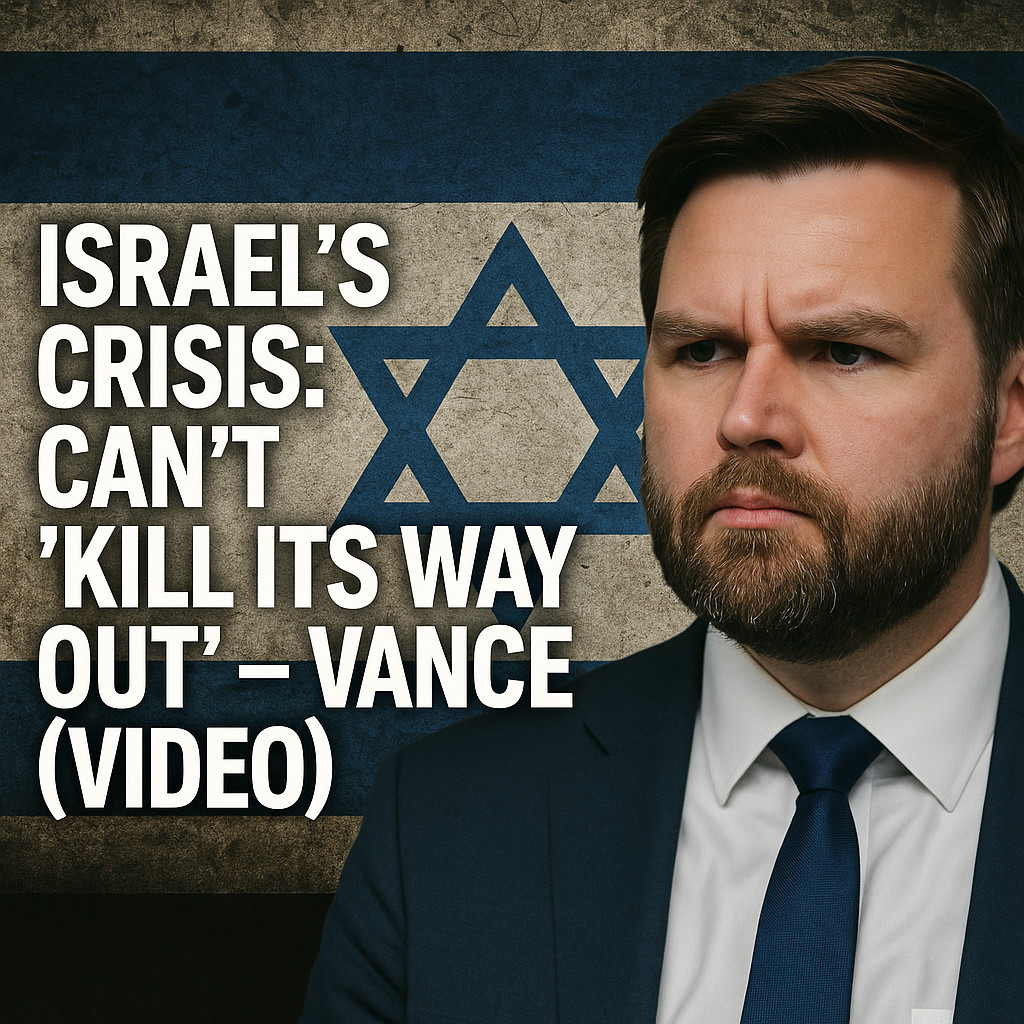
Israel’s Crisis: Can’t ‘Kill Its Way Out’ – Vance (VIDEO)

Israel’s Crisis: A Complex Path Forward
The ongoing crisis in Israel presents a multifaceted dilemma that raises critical questions about the effectiveness of military action in achieving long-term peace. In light of recent statements made by public figures, including Vance, who asserted that Israel cannot “kill its way out” of its current challenges, the discourse surrounding the conflict has intensified. This article adopts a balanced perspective to explore the complexities of Israel’s situation while considering the multifarious viewpoints from various sources.

The Limitations of Military Solutions
In numerous analyses, there is a prevailing sentiment that military action may provide transient solutions but fails to address the root causes of conflict. Vance’s assertion highlights this critical viewpoint: the notion that reliance on force does not equate to security or stability. Observers argue that a military-first policy only perpetuates a cycle of violence, without facilitating dialogue or fostering understanding.


For instance, a report from Al Jazeera underscores that military engagements often lead to humanitarian crises, which further entrench existing grievances among the populations involved. Through interviews with local residents, the report illustrates how bombings and military offensives create a visceral cycle of retaliation, rather than promoting a sustainable resolution. This dynamic suggests that ignoring diplomatic avenues in favor of military responses leads to longer-term despair and instability.


While proponents of a strong military response insist that such actions are necessary for national defense, others within the same discourse call for a re-evaluation of this strategy. Critics argue that escalating violence can diminish both regional standing and international cooperation, effectively isolating Israel in a complex geopolitical landscape.
The Importance of Diplomacy and Dialogue
In stark contrast to militaristic strategies, many advocates stress the significance of diplomatic engagement and dialogue as fundamental to resolving the enduring issues within Israel and Palestine. Engaging in peace talks and developing relationships with neighboring nations may facilitate a pathway toward long-term security, showcasing a different, more constructive approach to conflict resolution.
Some commentators emphasize the role of international institutions in fostering this dialogue. A piece from Sky News points out that entities like the United Nations have often been underutilized in mediating peace processes. By leveraging diplomatic channels, Israel may have the opportunity to reshape its narrative on the global stage. Are negotiations with established political entities, such as the Palestinian Authority, more beneficial than unilateral military actions? Many experts believe that establishing a dialogue is crucial for reaching a comprehensive peace agreement, as it could address the legitimate aspirations of all parties involved.
However, there remains a significant challenge: the internal fragmentation within Palestinian leadership complicates negotiations. As various factions exist with differing agendas, the prospect of a unified approach that responds satisfactorily to their needs appears daunting. This lack of cohesion among Palestinian leaders presents a barrier that must be navigated cautiously.
A Nuanced Perspective Moving Forward
As Israeli society grapples with its identity amid ongoing violence, the population’s voices are increasingly diverse. Public sentiment appears polarized—some citizens advocate for aggressive military responses to perceived threats, while others are calling for an urgent humanitarian approach.
This internal debate illuminates a broader truth: that Israel’s security cannot solely rely on military might but must incorporate elements of diplomacy, social justice, and international cooperation. In listening to the wider spectrum of viewpoints, a balanced approach emerges—one that recognizes the immediate necessity for security while also addressing the long-term needs for peace and reconciliation.
Ultimately, the assertion that Israel cannot “kill its way out” encapsulates a growing realization that sustainable solutions require more than just force. As the discourse evolves, the challenge remains to forge a path that balances security with empathetic engagement—a critical endeavor for the future of not just Israel but the entire region.
In conclusion, the complexities of Israel’s crisis necessitate a critical look at both military and diplomatic strategies. A comprehensive understanding reflects the sentiments from multiple perspectives, paving the way for dialogue and ultimately, the hope for peace.