
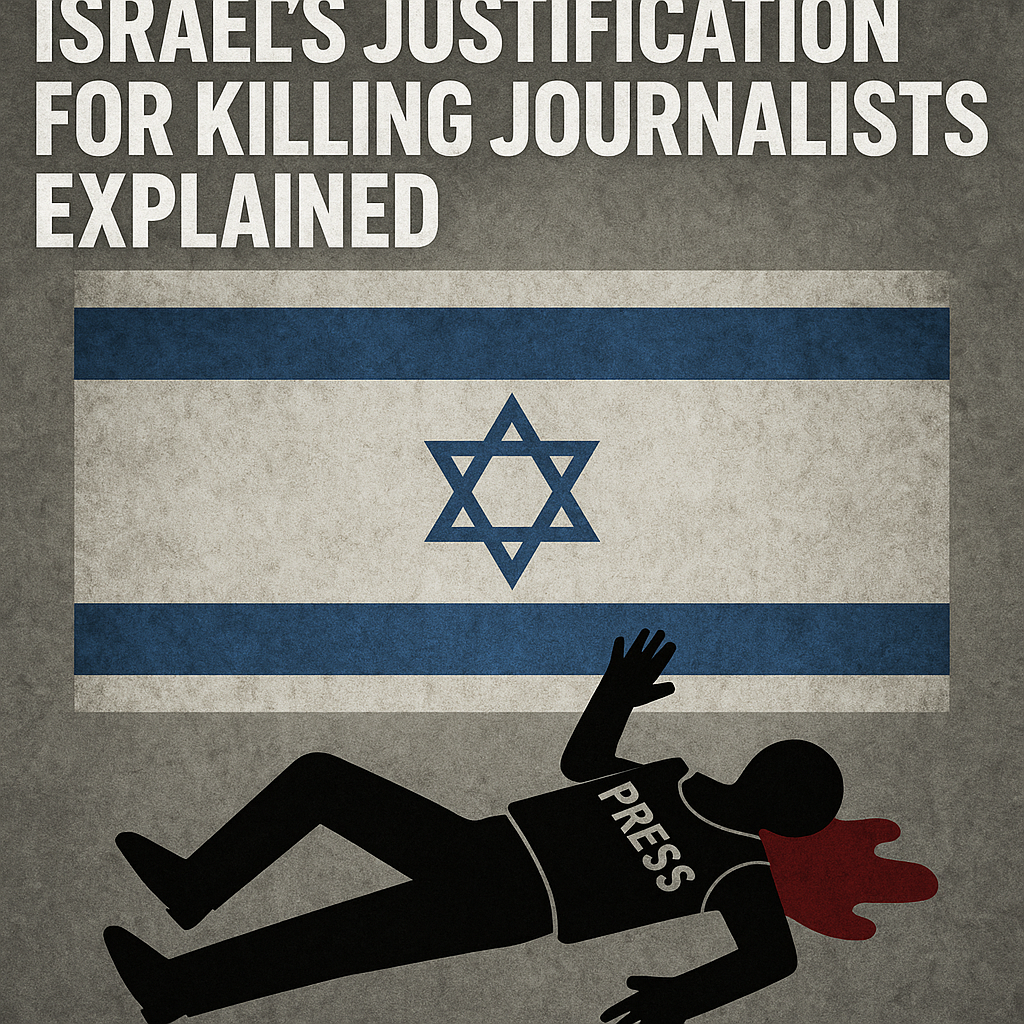
Israel’s Justification for Killing Journalists Explained

Israel’s Justification for Killing Journalists Explained
In recent years, the troubling phenomenon of journalists being targeted in conflict zones has drawn increased scrutiny, particularly in the context of the ongoing Israeli-Palestinian conflict. Israel’s justification for its military actions, especially those resulting in civilian casualties, including the deaths of journalists, has caused a significant divide in public opinion and raised serious ethical questions.

The Complex Landscape of Conflict Reporting
Understanding Israel’s stance on killing journalists requires delving into the complexities of warfare in densely populated areas, where civilians, including media personnel, become collateral damage. Israel maintains that its military operations aim to dismantle terrorist infrastructure, particularly in Gaza, where groups like Hamas operate amid civilian populations.


As articulated in various reports, the Israeli Defense Forces (IDF) have asserted that they take extensive measures to minimize civilian casualties, often warning journalists and civilians before strikes. For instance, during the 2021 Gaza conflict, there were instances where Israel claimed it targeted buildings housing Hamas operatives, which, unfortunately, also contained journalists.


Differing Perspectives on Justification
While the Israeli government defends these military actions within a framework of national security—arguing that Hamas uses civilians as shields—the international community has often criticized these actions as disproportionate and harmful. For instance, Al Jazeera reported that despite Israel’s claims of targeting military objectives, the deaths of journalists in these strikes raised serious ethical concerns about the accountability of the IDF and the overall protection of press freedom in conflict zones.
In contrast, sources like RT present a perspective that emphasizes the justification Israel provides through its narratives. They argue that the ongoing conflict and the threats posed by militant groups necessitate a hardline approach, including military operations that can result in civilian casualties. This viewpoint highlights the entrenched fear within Israel regarding security, suggesting that in the eyes of some Israeli officials, the risks posed by Hamas outweigh the tragic loss of non-combatants, including journalists.
Press Freedom vs. National Security
The watershed moment came when high-profile incidents, such as the killing of Al Jazeera journalist Shireen Abu Akleh, incited global outrage and prompted discussions on the precarious balance between press freedom and national security. Advocates for press freedom argue that journalists should be protected under international law, regardless of the circumstances surrounding their reporting. Conversely, the Israeli government posits that legitimate military operations may inadvertently lead to such losses.
Though no conclusive evidence has emerged from investigations that fully absolve or blame Israel, the carryover sentiment from various media sources suggests an underlying uncertainty about accountability. Some reports cite the IDF’s lack of transparency during investigations into journalist deaths, which fuels skepticism about Israel’s willingness to own up to potential mistakes.
The International Response
Calls for investigations into these journalist deaths have amplified internationally, with human rights organizations pressing for accountability from Israel. Reports indicate that these organizations view the killing of journalists as part of a broader pattern of attacks on press freedom. Conversely, supporters of Israel argue that these claims are politically motivated and that the true nature of the conflict is often obscured.
It’s evident that the intersection of national security and the safety of journalists remains a complicated issue with no simple resolution. The fears regarding terrorism and actual threat landscapes often complicate the narrative surrounding the deaths of journalists.
Conclusion: Navigating Ethical Waters
The reality is that as the Israeli-Palestinian conflict continues, journalists will remain vulnerable to the unpredictable nature of warfare. Israel’s justification for its actions, while understood in the context of its security concerns, does not mitigate the grave implications of targeting media personnel. The challenge moving forward lies in finding a balance between safeguarding lives—both civilian and journalistic—and ensuring that the truth continues to be reported.
In the end, the ongoing discourse about the safety of journalists in conflict zones must acknowledge the complexities and the notion that while nations have the right to defend themselves, the fundamental principles of press freedom should never be compromised. As discussions continue, it becomes crucial for all parties to engage in good faith and seek solutions that honor the role of journalism as a cornerstone of democracy, even amidst the chaos of war.















