
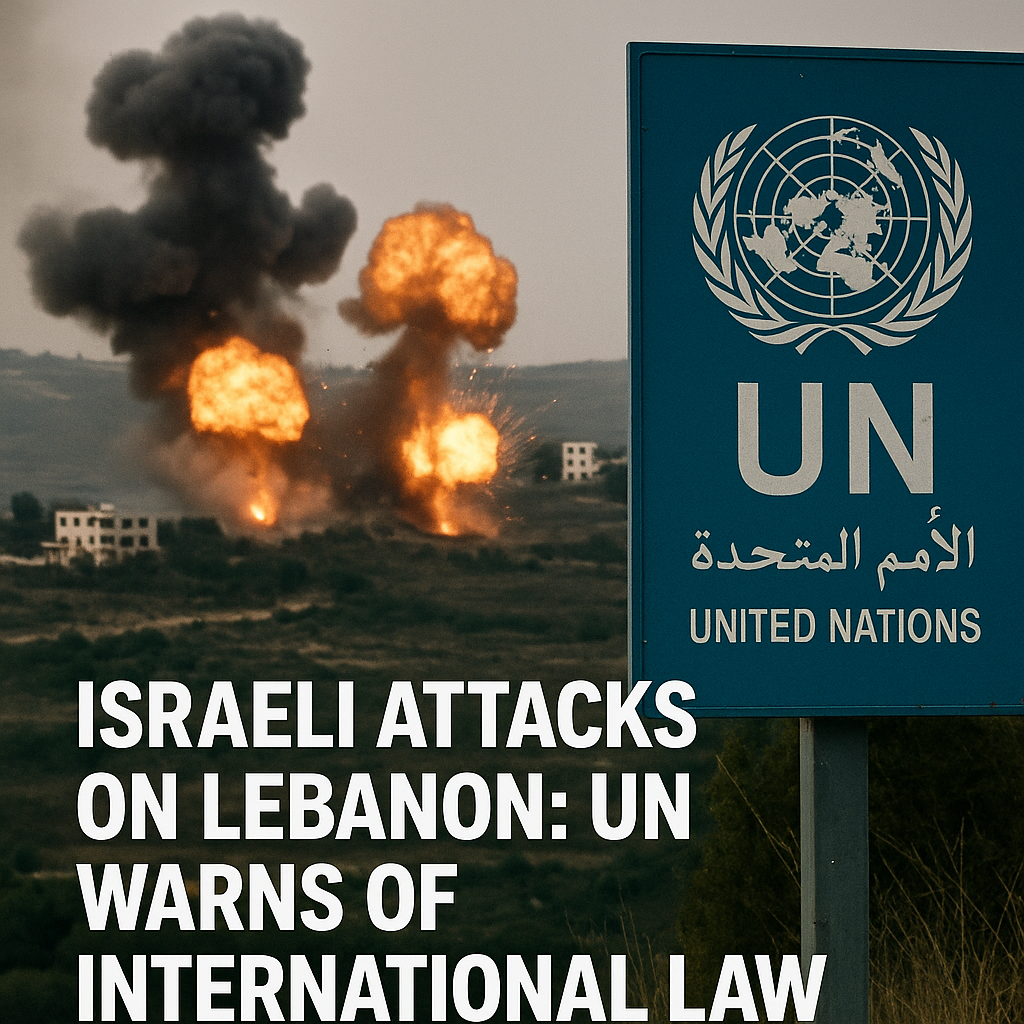
Israeli Attacks on Lebanon: UN Warns of International Law Breach

Israeli Attacks on Lebanon: UN Warns of International Law Breach
Recent Israeli military actions against Lebanon have ignited a heated debate that traverses the boundaries of security, legality, and humanitarian rights. As escalating tensions in the region continue to unfold, the United Nations has raised concerns over potential violations of international law, calling for an immediate review of the circumstances surrounding these attacks.

Context of Conflict: Recent Developments
The ongoing cycle of violence between Israel and Hezbollah, the militant group based in Lebanon, has intensified over recent months. Israeli airstrikes have reportedly targeted sites believed to be associated with Hezbollah, raising alarms about the repercussions this conflict may have not just on Lebanon, but also on regional stability.


Al Jazeera reported that these attacks could potentially be construed as breaches of international law, emphasizing the principle of proportionality in warfare. The UN has reiterated that any military operation must adhere strictly to international legal standards, which include the requirement to protect civilian lives and property.


Conversely, sources like RT have framed the Israeli military’s actions as necessary defensive measures against perceived threats from Hezbollah. This perspective highlights a security narrative that emphasizes Israel’s right to protect its territory and citizens from ongoing attacks.
This clash of viewpoints reveals the complexity of the situation, where security needs seemingly collide with the urgencies of humanitarian law.
Diverging Perspectives on Legitimacy and Consequences
The Legal Framework: A Puzzle of Justification
The UN’s warnings serve to underline how international law attempts to mediate conflicts like these. According to international humanitarian law, all military operations must distinguish between combatants and non-combatants. When Al Jazeera mentioned potential violations, it pointed out documented civilian casualties resulting from these Israeli operations, thus framing the attacks as disproportionate and challenging their legitimacy.
On the other hand, proponents of Israel’s military approach argue that the nation is operating within its right to defend itself against an organization labeled as a terrorist group by various countries, including the United States. They assert that military actions are conducted with precise objectives aimed at dismantling Hezbollah’s capabilities, suggesting that civilian casualties are minimized wherever possible.
Humanitarian Concerns: The Price of Conflict
The humanitarian implications of these military actions cannot be understated. Reports emerging from Lebanon have detailed significant collateral damage, including loss of civilian lives and extensive damage to property. Sky News has noted that these circumstances have put immense pressure on an already fragile socio-economic environment in Lebanon, where the aftermath of conflict adds layers of distress to an ongoing humanitarian crisis.
In this light, while some argue from a standpoint of defense, the growing civilian toll raises ethical questions: at what point do military objectives justify the loss of civilian life? It’s a contentious debate that reflects broader issues of accountability and justice in international relations.
The Way Forward: Seeking Peace Amidst Turmoil
While resolutions to conflicts like this are inherently complex, the hope is that diplomatic avenues will prevail in the long run. The UN’s call for an investigation serves as an important reminder that accountability is fundamental for both sides in any conflict. Moreover, international pressure could facilitate dialogue aimed at de-escalating tensions between Israel and Lebanon.
Numerous analysts assert that lasting solutions will require a multifaceted approach that prioritizes not only security but also human rights and humanitarian welfare. An effective peace strategy may necessitate addressing the root causes of the conflict, rather than merely focusing on military responses.
A Complex Tapestry of Conflict
As the situation develops, the opinions and attitudes surrounding these events will likely transform as well. The paths taken by both state and non-state actors in the region will continue to be scrutinized as global audiences demand accountability and justification for military actions.
In a world where violence often begets violence, it is crucial to recognize not just the immediate outcomes of strikes but also their implications for peace and stability in the region. An ongoing dialogue, supported by international oversight, may be key to breaking this cycle and ensuring both security and compliance with the tenets of international law.
In conclusion, the Israeli attacks on Lebanon are not merely a local concern but a global issue that touches on the principles of justice and morality in warfare. As we navigate this complex landscape, it is imperative to support efforts that aim for both accountability and ultimately, lasting peace.















