
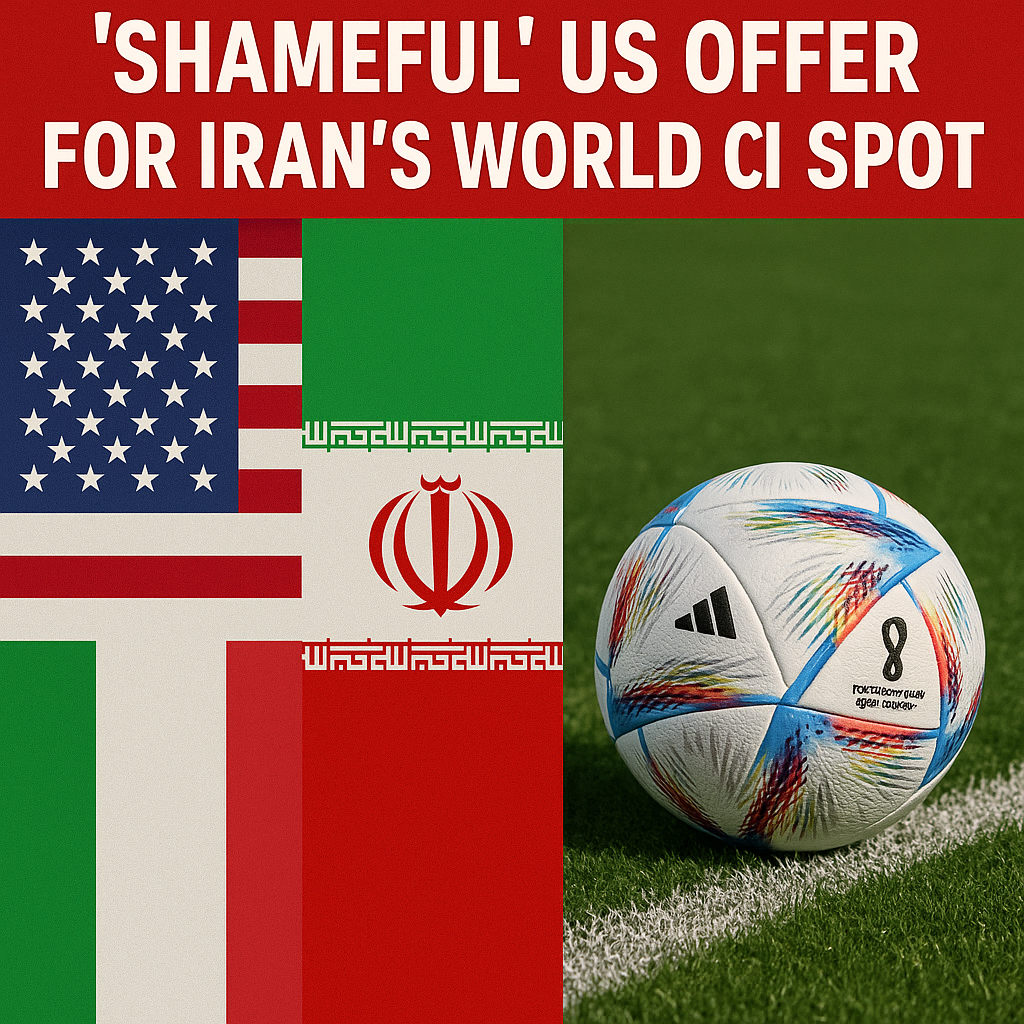
Italy Rejects ‘Shameful’ US Offer for Iran’s World Cup Spot

Italy Rejects ‘Shameful’ US Offer for Iran’s World Cup Spot
In a surprising turn of events, Italy’s national football team has firmly denied a U.S. offer to replace Iran in the upcoming World Cup, a decision steeped in both sporting integrity and international politics. This situation underscores the intricate interplay between sports and geopolitics, raising profound questions about national identity and the implications of global governance in football.

Context of the Controversy
The World Cup, widely criticized for its politicization, has now become a battleground in the ongoing diplomatic tensions surrounding Iran. As Iran faces scrutiny over its human rights record, especially regarding its treatment of women and political dissidents, some supporters and critics alike have called for action, which included expulsion from international competitions. The U.S. proposal, perceived by Italy as a token gesture rather than a genuine commitment to reform, was promptly branded “shameful” by Italian officials.


Voices from Italy: A Stand for Humanity?
Italy’s decision to reject the offer reflects a strong adherence to sporting ethics. Italy’s football federation president, Gabriele Gravina, emphasized that football should not be used as a political tool, suggesting that the sport should promote unity rather than division. This sentiment resonates widely in Italian football culture, where historical references to the sport’s ability to transcend political boundaries play a significant role.


However, this noble stance is not devoid of contradictions. While Italy’s rejection speaks to a commitment to uphold integrity, it also raises the question: is there room for moral considerations in an arena as commercially driven as the World Cup? Additionally, some critics point out the timing of Italy’s decision could be seen as opportunistic, given they themselves did not qualify for this year’s tournament, thus allowing them the luxury of taking a moral high ground without personal consequence.
The U.S. Proposal: A Political Instrument?
On the other side, the U.S.’s intentions behind the offer cannot be overlooked. Some analysts suggest that the United States’ push for Italy to accept the spot was an effort to re-engage a politically strategic ally in the midst of tensions with Iran. The offer might be characterized less as a noble act of sportsmanship and more as a strategic move aimed at facilitating diplomatic dialogue through sport.
Furthermore, this incident throws light on the underlying complexities of FIFA’s governance. With international football increasingly intertwined with political allegiances, decisions around participation often hold a mirror to broader geopolitical dynamics. In contrast to Italy’s immediate rejection, it prompts reflections on whether such positions in the sporting world should be dictated by political realities, or preserved as bastions of pure competition.
The Geopolitical Tapestry of Football
As the controversy unfolds, it highlights how sports cannot be separated from their political contexts. The magnitude of football as a global uniting force often clashes with the stark realities of international relations. This year’s World Cup, held in Qatar, has already been the subject of controversy, from labor rights issues to local governance.
Ironically, the conversation surrounding Iran, while rooted in significant human rights concerns, also has the potential to distract from the pressing issues faced by other nations participating in the World Cup, including labor exploitation in Qatar. Here, the need for a coherent, unified global stance on human rights in sports becomes evident.
A Call for Consistency
Italy’s moral position raises a critical question for the international community: Should we draw hard lines based on ethical standards, or engage through dialogue to promote change from within? Balancing competitive integrity with a commitment to human rights creates a complex ethical landscape.
Many observers urge that football, especially at its pinnacle event like the World Cup, should stand as a symbol of hope and unity amid the fraught realities of international politics. However, walking this fine line between morality and diplomacy requires collective efforts from not just individual nations but from FIFA as a governing body itself to create an equitable space for all.
In conclusion, Italy’s rejection of the U.S. offer goes beyond a straightforward refusal; it beckons readers and fans alike to scrutinize how the world of sports interacts with societal values. While the path of ethical rectitude is fraught with dilemmas, a unified approach advocating for human rights within the arena of global sports remains a powerful narrative that transcends the game itself. The dynamics at play will likely continue to generate vital discussions as we move forward in the upcoming World Cup and beyond.















