
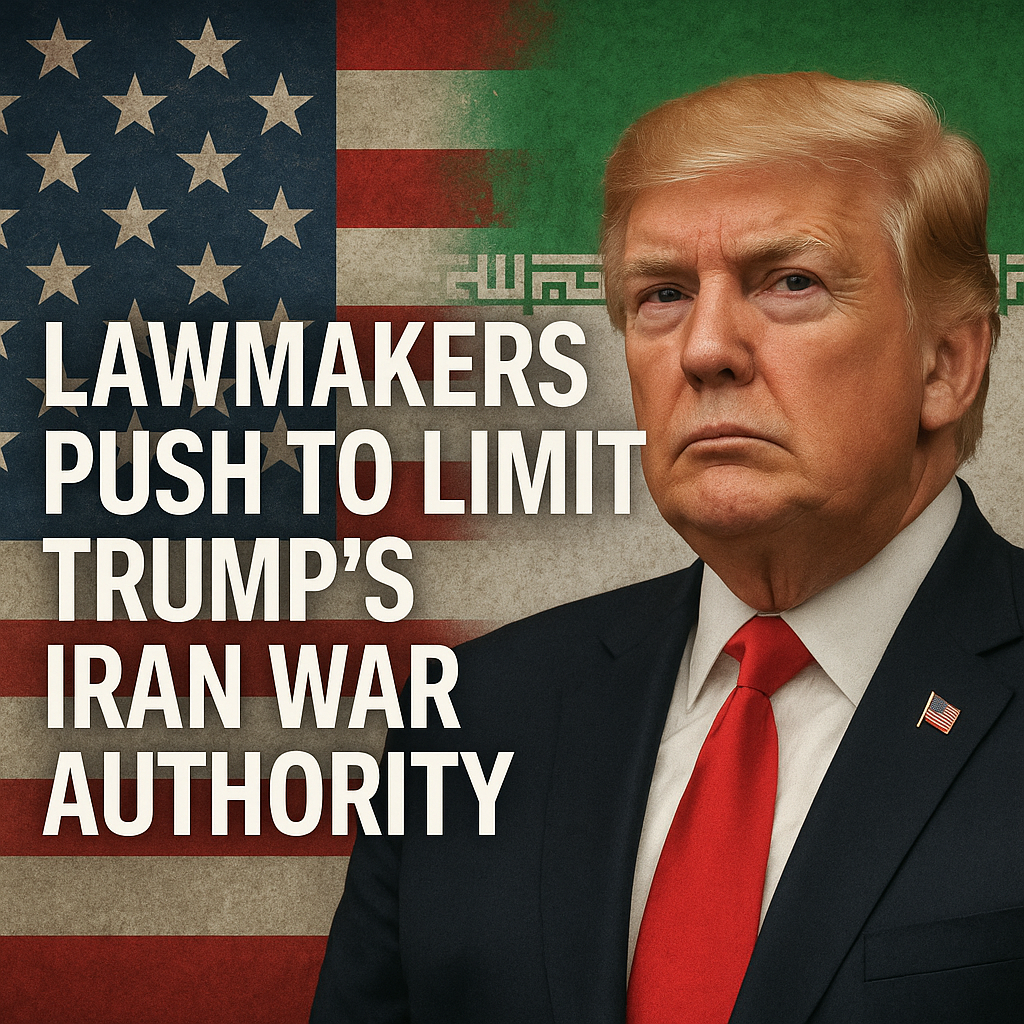
Lawmakers Push to Limit Trump’s Iran War Authority

Lawmakers Push to Limit Trump’s Iran War Authority
In recent months, the debate surrounding U.S. military authority in Iran has resurfaced, with a particular focus on limiting the powers granted to former President Donald Trump. As lawmakers gather in Washington, they are increasingly concerned about the implications of unrestrained military action in the region, especially in the context of heightened tensions between the U.S. and Iran.

Historical Context and Current Concerns
The conversation about war powers is not new; it traces back to the aftermath of the Vietnam War when Congress sought to reclaim its authority from the Executive Branch concerning military engagements. In recent years, Trump’s presidency exemplified this struggle as his administration engaged in actions that many believed exceeded his constitutional authority.


The killing of Iranian General Qassem Soleimani in January 2020 highlights this issue. Critics, including prominent Democrats and some Republicans, argued that this targeted killing could initiate a broader conflict without congressional approval. As Congress aims to navigate these intricate waters, the fear of slipping into open conflict—as well as the associated diplomatic repercussions—has prompted a push for legislation to clarify and potentially limit presidential authority in matters of war.


Bipartisan Efforts to Reclaim Authority
A notable trend has been the emergence of a bipartisan coalition advocating for a more structured approach to military engagement. This coalition contends that a congressional vote is essential before any military action against Iran, ensuring checks and balances intended by the Constitution. Legislation has been introduced to bolster this approach; for instance, several representatives have proposed measures aimed at reinforcing the War Powers Resolution, which requires the president to seek approval from Congress before engaging in significant military actions.
Critically, these discussions have gained additional urgency as geopolitical tensions rise. According to Al Jazeera, some lawmakers fear that an escalation in Iran could inadvertently lead the U.S. into an unwanted war, one that could have severe ramifications not only for American soldiers but also for international relations. Such a view resonates across ideological lines, highlighting a rare moment of unity in a typically partisan landscape.
Divergent Perspectives: Security vs. Diplomacy
While many lawmakers and experts advocate for limiting presidential authority to prevent unilateral military action, others maintain that a flexible executive power is necessary for national security. They argue that the time-sensitive nature of military decisions often requires swift action that may not align with Congressional schedules.
This perspective is echoed by some Republicans who have expressed concerns that restricting the President’s military authority could embolden adversaries like Iran and undermine U.S. interests abroad. They argue that diluting Presidential powers could result in slower, less effective responses to emerging threats, thereby increasing vulnerability in a volatile region.
Furthermore, analysts from Sky News suggest that international dynamics play a role in this debate. Iran’s ongoing nuclear program and regional ambitions pose a challenge and necessitate a strong stance; thus, limiting presidential powers could send mixed signals to both allies and adversaries. The fear of appearing indecisive in a crisis is a potent argument in favor of maintaining some level of executive flexibility.
Looking Ahead: A Complex Legislative Landscape
As Congress begins to deliberate and discuss potential changes to war power legislation, it is evident that the path forward will not be straightforward. Balancing the need for robust national security with the imperative of congressional oversight poses a delicate challenge. Many lawmakers are tentatively considering compromises that might allow for greater oversight without completely stripping the Executive Branch of the ability to act rapidly in emergencies.
As new tensions arise, the political landscape will likely continue to evolve. Lobbying efforts on both sides of the argument will play a significant role in shaping the discussions. With various military engagements ongoing around the world, the urgency to establish clear rules of engagement will remain paramount.
In this complex landscape of national security, diplomacy, and legislative processes, the stakes are indeed high. The discourse surrounding Trump’s Iran war authority reflects broader themes in American governance and its ongoing struggle to balance power, responsibility, and the pursuit of peace.
Ultimately, as lawmakers push to define and possibly limit military authority, they must consider not just immediate implications, but also how their decisions will resonate through the years to come in a world defined by uncertainty and rapid change.















