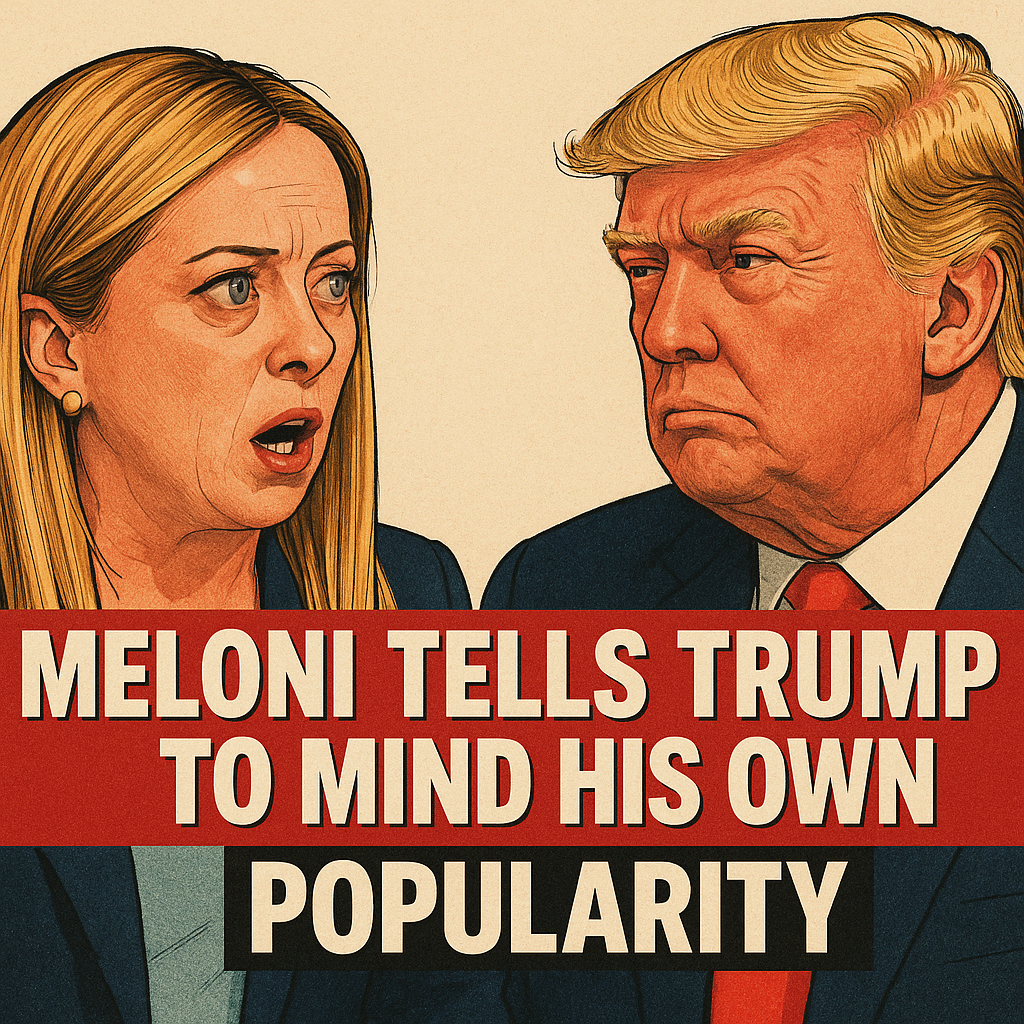
Meloni Tells Trump to Mind His Own Popularity

In a world where political figures often engage in public displays of rivalry, the recent exchange between Italian Prime Minister Giorgia Meloni and former U.S. President Donald Trump has garnered considerable attention. Meloni’s pointed advice for Trump to focus on his own popularity marks a moment of significant political discourse, raising questions about leadership styles and international relationships.

Meloni’s Candid Comments
During a speech in Italy, Meloni took a bold stance, suggesting that Trump should concentrate on his own popularity rather than making critiques directed at her administration. This commentary was not only a response to political discourse but also a reflection of Meloni’s assertive leadership style, which emphasizes nationalist and conservative values. By positioning herself as a strong leader on the international stage, she invites attention but also scrutiny, particularly as she aligns with other right-wing populist figures globally.


Meloni’s comments come at a time of fluctuating popular sentiment towards Trump, who has been experiencing a rollercoaster of political reality amidst ongoing legal challenges and fluctuating approval ratings. While some sources cite a sustained base of support for Trump, Meloni’s remarks suggest a certain skepticism about his ability to influence foreign politics or resonate beyond American borders effectively.


According to various reports, Meloni’s admonition seems to stem from a desire to assert Italy’s sovereignty in its political affairs, especially amid external pressures from prominent international figures. This speaks to a broader theme in modern politics: leaders prioritizing national interests over personal alliances or global popularity.
Diverging Perspectives on Popularity and Leadership
The dynamics of popularity in politics can often be convoluted. While some leaders rely heavily on their public image, others, like Meloni, appear to prioritize policy and national identity. It’s essential to explore how leadership is perceived differently from various quarters.
1. Popularity as a Political Tool: For Trump, maintaining a robust public image has been pivotal throughout his political career. His ability to galvanize supporters through social media and public appearances has played a crucial role in his political narrative. Reports from mediums like Al Jazeera suggest that Trump’s unique style resonates with a segment of the American populace that feels disenfranchised, making his approach effective in its context.
2. Leadership Beyond Popularity: Conversely, Meloni’s rhetoric emphasizes a more traditional view of leadership—one that prioritizes governance and policy-making over mere popularity. Her call for Trump to “mind his own popularity” highlights an increasingly recognized divide in international politics: the balance between appealing to the masses and enacting policy change.
Recent analysis indicates that Meloni’s approach could set a precedent for how political figures navigate their relationships with each other, particularly in an era where populism is on the rise. Observers note that Meloni’s assertive stance might appeal to other conservative leaders seeking to differentiate themselves from the melodrama that often surrounds Trump’s public persona.
Implications of Their Exchange
The exchange between Meloni and Trump signifies more than just a personal spat; it reflects shifting tides in international diplomacy where national politics can sometimes overshadow longstanding alliances. This moment serves as a reminder that personal dynamics between leaders impact broader geopolitical relations.
With the current state of world politics marked by unpredictability, such exchanges can have lasting ramifications. Meloni’s challenge to Trump could symbolize a move away from dependency on personality-driven politics and towards an era where policy and national interest reclaim their primacy in political discourse.
As the global stage continues to evolve, the interplay between popularity and effective governance will remain a critical conversation. Meloni’s assertation that Trump should pay attention to his popularity serves as a cautionary note for international leaders navigating the delicate dance of diplomacy, while also reflecting the nuanced realities of contemporary governance.
Conclusion
In conclusion, the dialogue between Giorgia Meloni and Donald Trump is not merely a clash of personalities but an illustrative episode in the current landscape of global politics. It highlights the varying approaches leaders take towards popularity and governance, inviting further discussion on how these dynamics will shape future interactions on the world stage. With populist sentiments rising internationally, the implications of their words and actions will echo far beyond their immediate contexts, reminding us of the complexity and interconnectivity of today’s political landscape.