
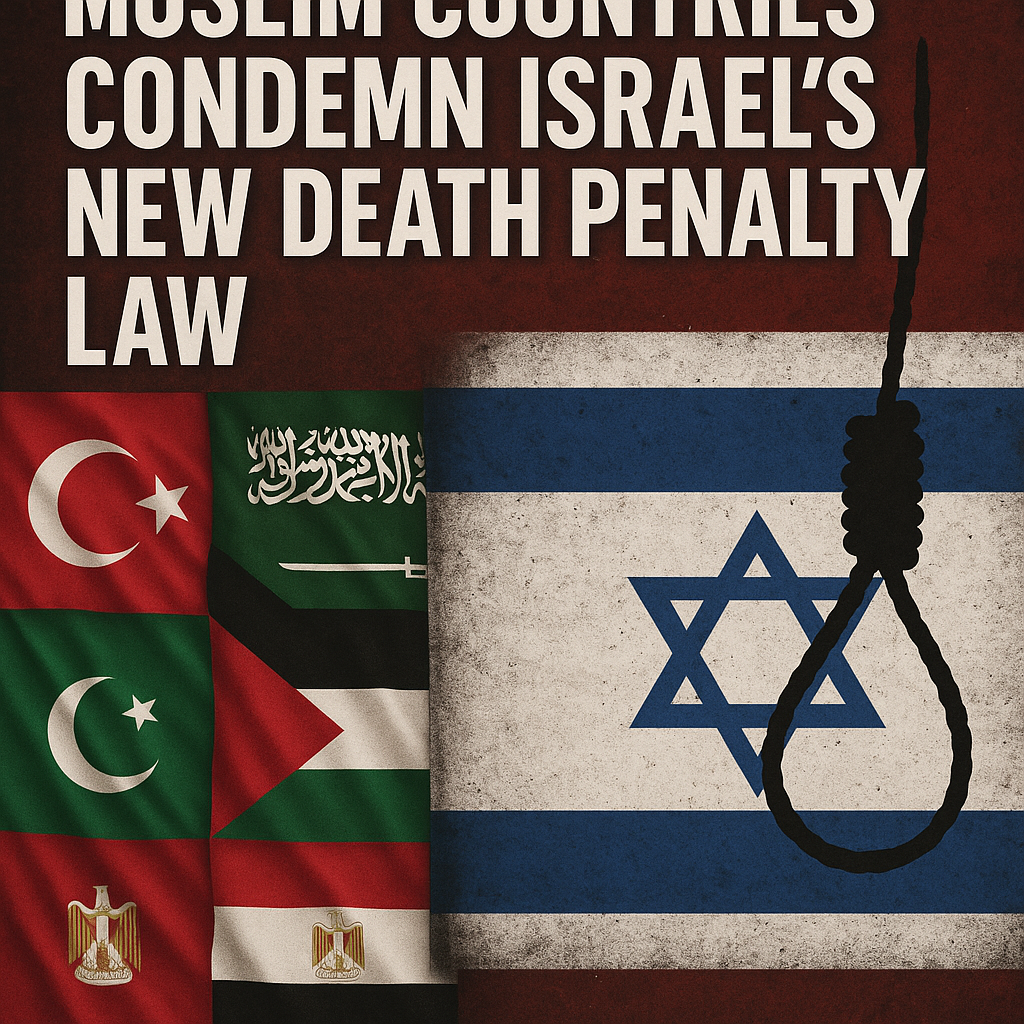
Muslim Countries Condemn Israel’s New Death Penalty Law

Muslim Countries Condemn Israel’s New Death Penalty Law
In recent days, a wave of condemnation has arisen from various Muslim-majority countries regarding Israel’s newly enacted death penalty law. This law has sparked intense debate both domestically within Israel and internationally, highlighting the complex intersections of law, morality, and geopolitics in the region.

The Law and Its Immediate Reactions
Israel’s new law expands the circumstances under which the death penalty can be applied, particularly in cases of terrorism. This legislation is seen by its advocates as a necessary measure to deter violent acts against civilians. However, many critics, including officials from numerous Muslim countries, argue that the law could lead to a greater misuse of judicial power and increased human rights violations.


Eight Muslim-majority countries, including Turkey, Iran, and Saudi Arabia, have publicly condemned the law. Statements from these nations emphasize that the death penalty is not a just solution to the complex issues surrounding terrorism and security. For instance, a spokesperson from Turkey stated that such measures could exacerbate violence rather than alleviate it. They argue that the law fails to address the underlying issues driving terrorism and only serves to inflame tensions further.


Diverse Perspectives on the Law’s Implications
The reactions from Muslim-majority nations reflect a broader concern about how Israel’s legal changes could impact the Israeli-Palestinian conflict and the wider Arab-Israeli relations. Many argue that the law symbolizes a growing authoritarian streak within Israeli politics, which could isolate not just Palestinian communities, but also moderate voices among Israeli citizens.
Geopolitical Ramifications
While many Muslim nations have condemned the law, their motivations aren’t monolithic. Some countries leverage the situation to bolster their own political narratives, employing the condemnation as a way to project strength or solidarity with the Palestinian cause. For instance, Iran’s public statements are often laced with anti-Israel sentiment, which aligns with its predominant foreign policy stance. This raises questions about how genuine such condemnations are and whether they truly stem from a commitment to human rights or a tactical maneuver in regional power dynamics.
Conversely, more moderate voices from the Arab world, such as those from the Gulf states, approach the topic from a place of cautious diplomacy. Countries like the United Arab Emirates have sought to balance their political relations with Israel after normalizing ties through the Abraham Accords, raising questions about why such a law may disrupt ongoing peace efforts. This duality showcases the rifts within the Muslim world itself regarding Israel, emphasizing that condemnation of the law may not translate straightforwardly into concrete actions or policies.
Questioning the Law’s Justification
One of the central debates surrounding Israel’s new death penalty law concerns its effectiveness as a deterrent. Advocacy groups argue that countries with the death penalty often continue to experience high rates of violent crime and terrorism. Furthermore, there are pressing concerns about the fairness of trials that lead to capital punishment. In Israel, as in many countries, the risk of wrongful convictions is a significant ethical dilemma. Critics insist that the justice system must be transparent and not punitive for its own sake.
Human rights organizations, including Amnesty International, have opportunistically taken aim at the law, labelling it a step backward for civil rights in Israel. They present a strong, data-driven argument that the approach fails to address the root causes of violence—such as occupation and systemic social injustices. The implications for legal standards in Israel also pose broader questions about the nation’s democratic ethos: can a country claim to uphold democratic values while implementing a law that arguably represents a regression in justice?
Looking Ahead: The Broader Impact
As this situation develops, it remains crucial for all parties to engage constructively. While the voices of condemnation from Muslim-majority nations serve to highlight the ethical implications of the law, the ramifications affect regional dynamics on multiple levels. Engaging in dialogue that goes beyond mere condemnation may prove to be a more fruitful approach for achieving long-term peace and stability.
The challenge lies in reconciling the urgent need for security with the foundational principles of human rights and dignity. The path forward will require nuanced understandings and priorities that reflect a complex array of interests, shared humanity, and an enduring hope for peace. While strong emotions and positions will continue to define the discourse surrounding Israel’s new law, it is those who choose dialogue over division that may have the best chance of paving a worthy road to resolution.
In conclusion, while the law has undoubtedly ignited widespread condemnation across the Muslim world, the complexities intertwined within these reactions speak to the broader geopolitical challenges of our time. A balance must be struck between security and justice, and only through collaboration and understanding can progress be envisioned.















