
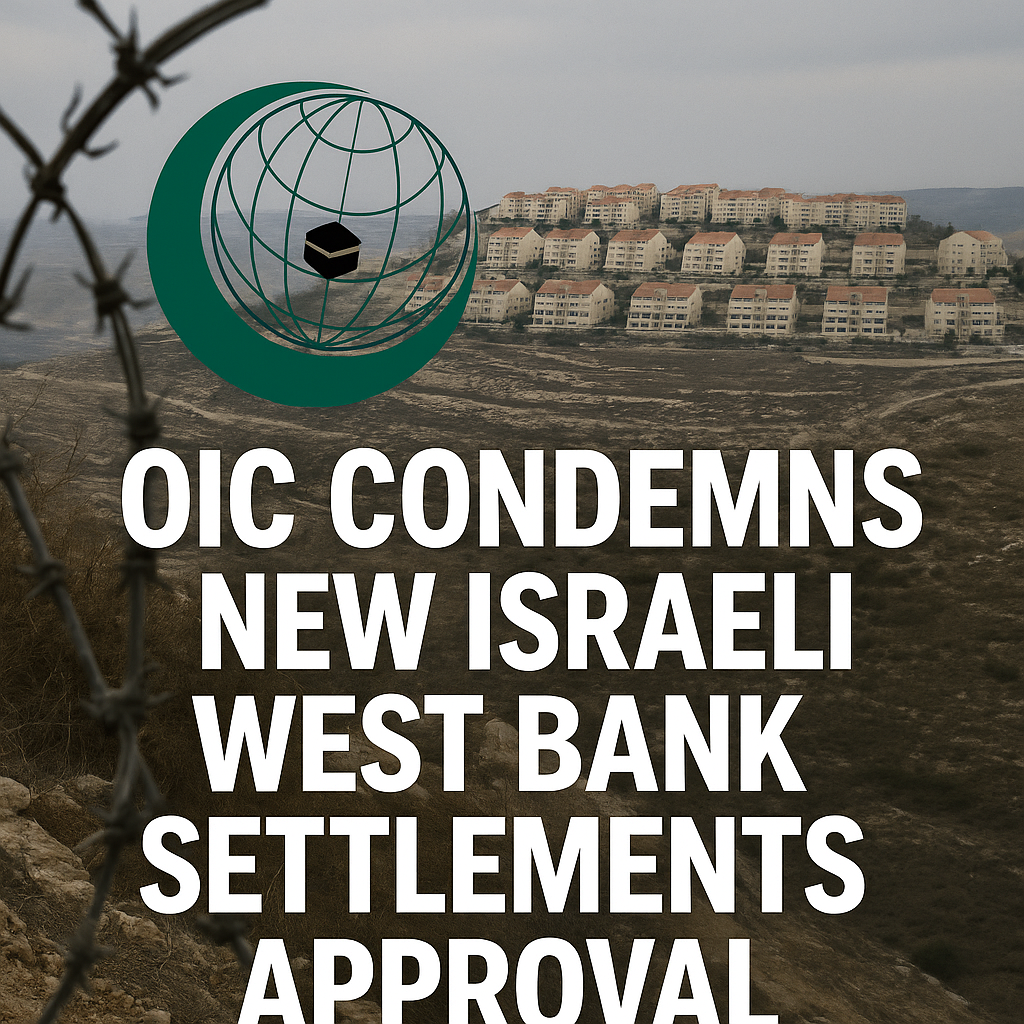
OIC Condemns New Israeli West Bank Settlements Approval

OIC Condemns New Israeli West Bank Settlements Approval
The recent approval of new Israeli settlements in the West Bank has drawn widespread condemnation from various international bodies, notably the Organization of Islamic Cooperation (OIC). This development underscores the ongoing tensions in the region and raises complex questions about peace, security, and international law.

Background on the Israeli Settlements
Israeli settlements in the West Bank have long been at the heart of the Israeli-Palestinian conflict. Established after the 1967 Six-Day War, these settlements are viewed by many as illegal under international law, a perspective supported by various United Nations resolutions. However, the Israeli government disputes this, claiming historical and religious ties to the land.


Recently, the Israeli government approved 34 new settlements, a move that has been met with sharp criticism from the OIC, which represents 57 Muslim-majority countries. In a statement, the organization described the decision as an act that undermines peace efforts and violates Palestinian rights.


OIC’s Response and Broader Implications
The OIC’s condemnation highlights the broader implications of settlement expansions in the West Bank. The organization warned that such actions could further inflame tensions in an already volatile region. As bodies like the OIC call for international intervention, the question arises: what are the potential repercussions of these new settlements on the Israeli-Palestinian peace process?
Many OIC member states express solidarity with the Palestinian cause, asserting that the expansion of Israeli settlements makes a two-state solution increasingly unattainable. This perspective is echoed by multiple analysts and political commentators who argue that the settlements not only disrupt the contiguity of Palestinian territories but also raise concerns about the viability of a future Palestinian state.
Conversely, some observers within Israel argue that the settlements are necessary for security and demographic reasons. They believe that establishing a Jewish presence in these areas serves as a deterrent against potential threats. This viewpoint emphasizes the belief that control over these regions is essential for Israel’s national security, thus complicating any simple narrative about the settlements.
International Reactions and Future Outlook
As the OIC and other international bodies condemn the settlement approvals, reactions from various governments highlight a spectrum of opinions about the issue. The European Union has criticized the expansion, affirming its stance that such actions violate international law and hinder the peace process. Moreover, the United States, which has traditionally supported Israel, has also expressed concern, urging for restraint in settlement activities.
However, some countries, particularly those with strong ties to Israel, have remained more supportive of the Israeli government’s decisions. These countries often argue that the Israeli people have a right to live and build in their historical homeland, citing a connection that dates back thousands of years.
The Role of the International Community
The ongoing situation invites reflection on the role of the international community in addressing these contentious issues. With disputes intensifying and peace efforts repeatedly stalling, the effectiveness of organizations like the OIC and various governments comes into question.
1. Diplomatic Engagement: Enhanced diplomatic measures are needed to mediate discussions and seek a lasting resolution.
2. Public Opinion: Engaging public sentiment can also amplify calls for peace, encouraging broader support for initiatives aimed at resolving the conflict.
As the OIC continues to voice its condemnation, it faces the challenge of translating such statements into actionable steps. The pathway to peace is fraught with uncertainty, and the reality of the situation makes it increasingly clear that consensus may be difficult to achieve.
Conclusion: A Complex Path Ahead
In conclusion, the approval of new Israeli settlements in the West Bank signals deep complexities in the Israeli-Palestinian conflict, which can no longer be viewed through a simple lens of right and wrong. As the OIC and other international entities respond to these developments, the need for a balanced approach that acknowledges both Israeli security concerns and Palestinian rights is paramount.
The future remains uncertain as international dialogues continue to evolve in response to these historical grievances. The challenge lies not only in policy-making but also in fostering mutual understanding, a task that will require unwavering commitment from all parties involved.















