
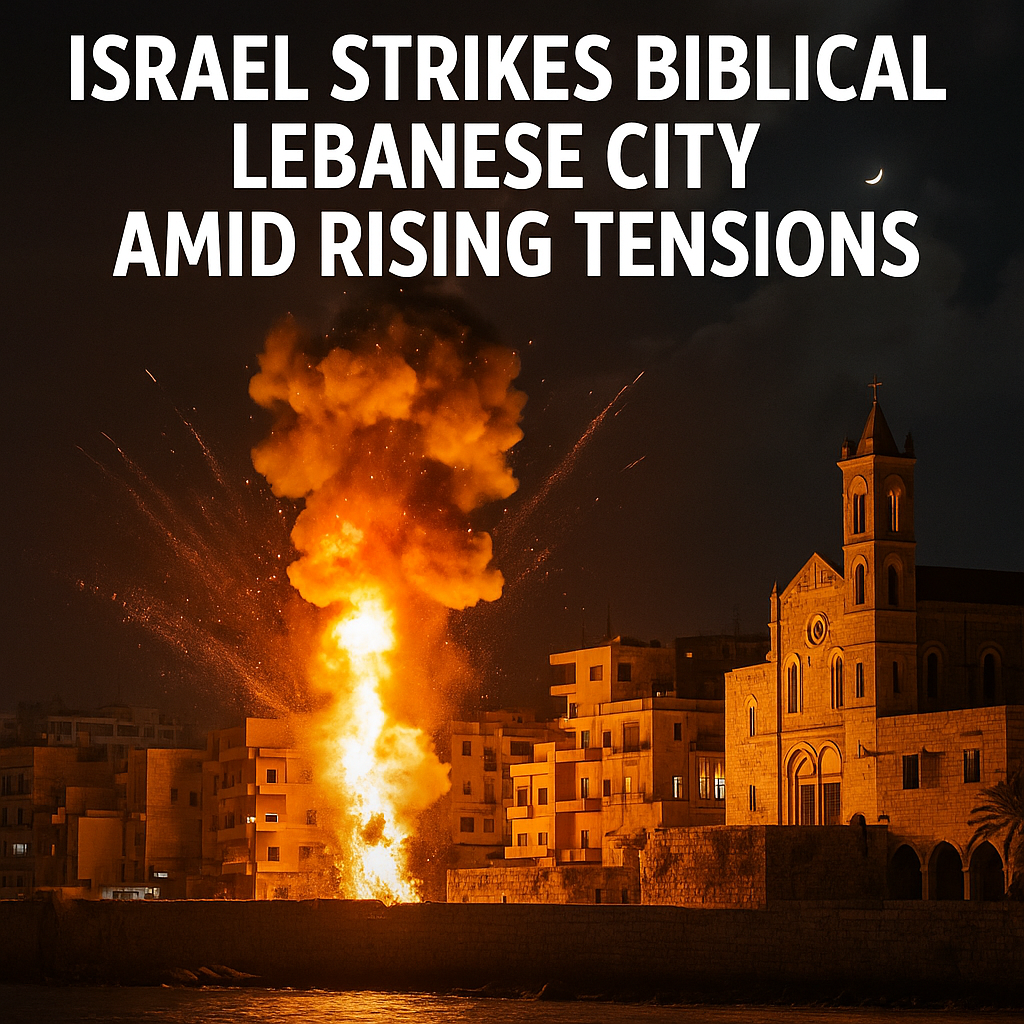
Israel Strikes Biblical Lebanese City Amid Rising Tensions
Israel Strikes Biblical Lebanese City Amid Rising Tensions
Recently, the city of Tyre in southern Lebanon, known for its ancient history and biblical significance, has been thrust into the spotlight as Israel conducted airstrikes in the area. This incident takes place within a backdrop of escalating tensions between Israel and various factions in Lebanon, raising concerns not only about military actions but also about the broader geopolitical implications.

Historical Context of Tyre
Tyre holds a significant place in history, often referenced in biblical texts and celebrated for its rich cultural heritage. The city, a UNESCO World Heritage Site, was an ancient trade hub and has seen various conquests throughout history. Today, it continues to be a strategic location for Lebanon, particularly for groups such as Hezbollah, which has a strong presence in the region.

The recent airstrikes reportedly targeted sites associated with Hezbollah, a group that Israel has long regarded as a major rival. The tensions have their roots in longstanding territorial disputes and ongoing skirmishes along the Israeli-Lebanese border. This latest military action follows a series of provocations, including rocket fire directed toward Israel, which has led to retaliatory measures by the Israeli military.

Rising Tensions in the Region
The Israeli strikes are emblematic of the complex and often volatile dynamics at play in the region. Reports indicate that these strikes were conducted in response to increasing threats perceived by Israel from Hezbollah and its allies. On one hand, Israeli officials argue that such military actions are necessary for national security and deterrence. However, critics question the efficacy and morality of these strikes, particularly in light of the civilian population that resides in the targeted areas.
Both Al Jazeera and RT have reported on the perspectives surrounding these attacks. According to Al Jazeera, the strikes have exacerbated the already strained relationship between Lebanon and Israel, with local Lebanese officials condemning the Israeli military action as an aggression against Lebanese sovereignty.
Conversely, RT highlighted Israel’s stance that these strikes are a direct response to hostile activities launched from Lebanese soil, asserting that national security measures must be taken to defend against potential threats. However, this rationale does not account for the potential loss of civilian lives and the further destabilization of Lebanon, which faces its own economic hardships.
Implications for Lebanon and Israel
The consequences of military actions in Tyre extend beyond immediate military objectives. For Lebanon, the airstrikes could provoke increased hostility and retaliation from Hezbollah, leading to a cycle of violence that is detrimental to regional stability. Furthermore, the situation raises questions about the Lebanese government’s ability to maintain peace and control within its borders.
On the Israeli side, while some may support a strong approach to military threats, the ongoing conflict with Lebanon illustrates a broader dilemma. Continuous military engagements may bolster short-term security but can also deepen animosity and incite further conflicts in the long term. Consequently, Israeli citizens may face heightened vulnerabilities as tensions escalate.
Both countries are undergoing significant internal challenges that complicate their foreign relations. Economic instability, political fragmentation, and a lack of mutual trust between Lebanon and Israel are crucial factors that must be considered. As the situation unfolds, diplomatic efforts may prove essential in navigating these multifaceted issues.
Conclusion
The Israeli strikes on the city of Tyre represent more than just military action; they reflect a deeply rooted historical conflict exacerbated by current geopolitical realities. As tensions continue to rise in the region, the dual narratives around security and sovereignty will need to be reconciled. Without a concerted effort for dialogue and diplomacy, the cycle of violence risks becoming self-perpetuating, with dire consequences for both nations and their people.
The situation remains fluid, with no clear resolution on the horizon. Observers and analysts alike will be keenly watching how these events evolve in the coming weeks, hoping for a path toward peace rather than further escalation.















