
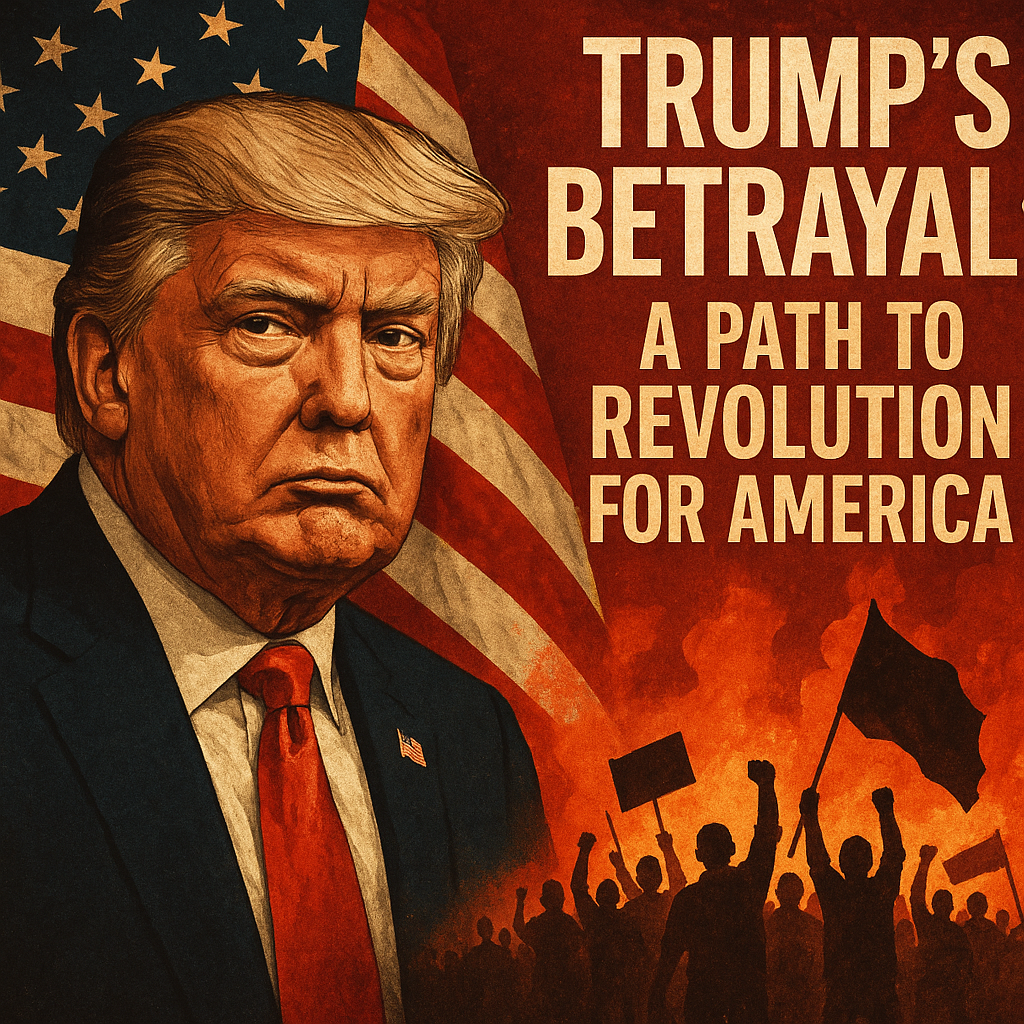
Trump’s Betrayal: A Path to Revolution for America
Trump’s Betrayal: A Path to Revolution for America
The recent discourse surrounding Donald Trump’s actions and his political and personal decisions has ignited a fervor that some are describing as a prelude to revolution in America. While interpretations vary widely, examining these events through diverse perspectives reveals deeper implications for the nation’s future.

The Radical Shift: Perspectives from Supporters
Supporters of Trump see his current predicament as a betrayal not only of the American populace but also of the conservative movement itself. In an exploration of this viewpoint, Tucker Carlson, a prominent commentator, argues that Trump’s influence has naturally shifted from political leader to martyr. He posits that the former president’s ongoing struggles against judicial scrutiny resonate with a faction of the population feeling increasingly disenfranchised.

These sentiments suggest a broader national crisis where significant segments of the electorate perceive their values and interests as under siege. Many Tump loyalists believe that his resilience, despite constant attacks from political adversaries, may catalyze a “revolutionary” spirit among Americans. Carlson’s assertions reflect a sentiment that the current political landscape incentivizes confrontational narratives, transforming discontent into a potential rallying cry for a new political order.

Supporters contend that Trump embodies the resistance against what they define as an overreaching governmental authority that seeks to stifle dissent. His legal challenges, they argue, are not just personal but symbolic battles against political correctness and elitism. This perspective posits that his embrace of victimhood may well unify a segment of the population eager for radical transformation in governance.
Resistance and Contradiction: Opponent Viewpoints
Conversely, critics of Trump highlight that his alleged betrayal lies in his failure to uphold democratic norms and values. Publications like Al Jazeera embrace this narrative, stating that his actions have fractured the trust within political institutions. Trump’s tenure has been marked by allegations of divisiveness and a prioritization of loyalty to himself over the rule of law. For many, this creates an unsettling dichotomy where the “revolutionary” tactics employed are replete with self-interest rather than genuine reform.
This counter-narrative underscores the dangers of mobilizing revolutionary sentiment without ethical foundations. Critics argue that fostering unrest under the banner of betrayal could lead to chaotic outcomes detrimental to democracy. They maintain that any calls for revolution should be steeped in principles of justice and fairness, rather than the incendiary rhetoric that some of Trump’s supporters advocate.
Additionally, analysts have pointed out that while Trump’s narrative may resonate with a rural or more conservative electorate, it risks alienating urban voters who view democratic stability and engagement with mainstream political processes as paramount. This creates a significant fracture within the electorate that complicates the idea of a cohesive revolutionary movement.
Navigating a Complex Landscape
As discussions intensify, it becomes evident that the road ahead is fraught with conflicting ideologies and emotions. The concept of revolution in this context is not merely about overturning the status quo; it represents a moral and cultural schism that challenges the core fabric of American democracy.
Amidst these complexities, it is crucial to recognize that neither side of the political spectrum holds an exclusive claim to the notion of “betrayal.” Instead, a shared responsibility exists for discerning between genuine grievances and disinformation. As differing visions for America’s future clash, the potential for productive discourse remains, albeit precariously balanced on the edge of escalating tensions.
Political analysts urge vigilance against narratives that espouse divisiveness in favor of those that encourage understanding and dialogue. The future undoubtedly remains uncertain, yet amidst this tumult lies an opportunity for a renewed commitment to civic engagement, advocating for revolutionary change grounded in communal well-being rather than individual grievances.
In conclusion, while Trump’s actions may serve as a catalyst for revolutionary sentiment among his supporters, it is essential to consider the broader implications for American society. A path forward may require not just the acknowledgment of betrayal, but a call for unity built on shared values, civic responsibility, and a dedication to the democratic processes that will ultimately define America’s next chapter.















