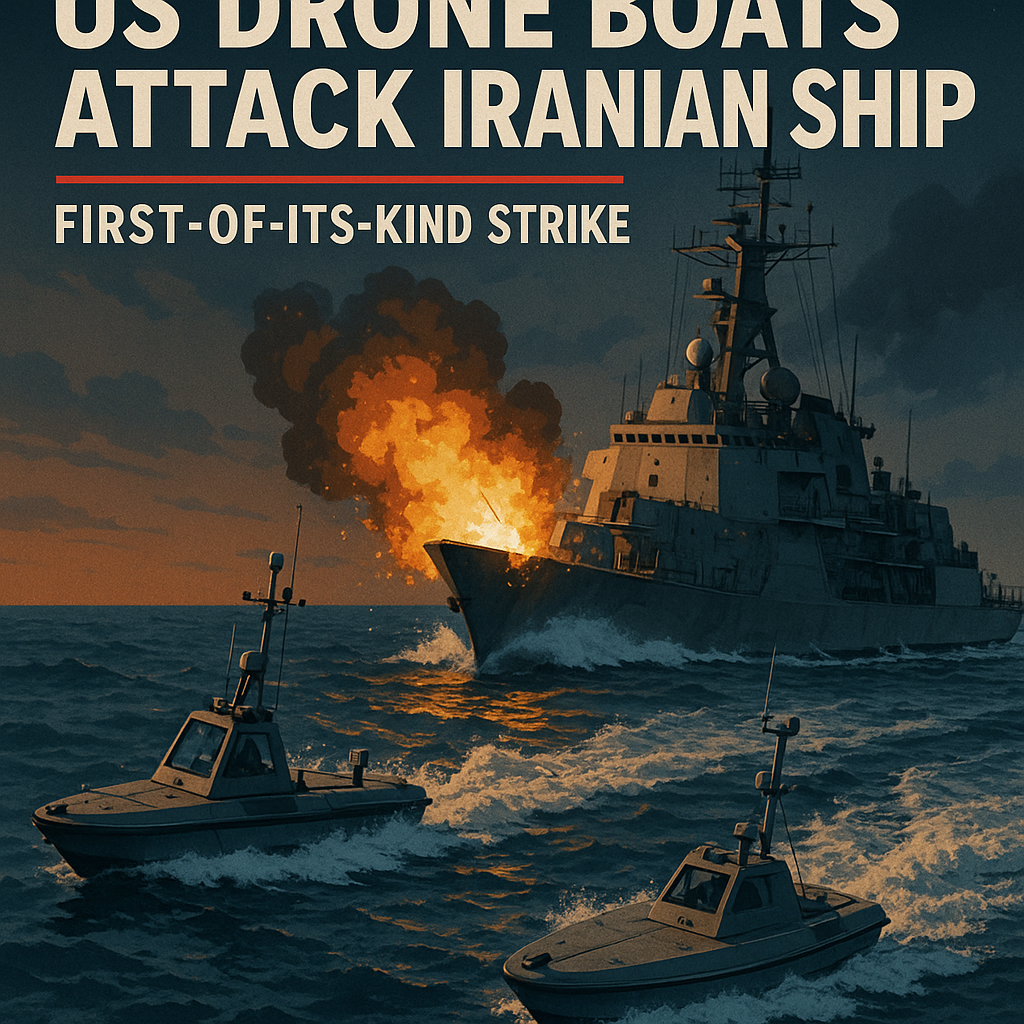
US Drone Boats Attack Iranian Ship: First-of-Its-Kind Strike
US Drone Boats Attack Iranian Ship: Breaking New Ground in Naval Warfare
In a historic move that underscores escalating tensions in the Middle East, the United States executed a drone boat attack on an Iranian vessel—a development reported as a first-of-its-kind military operation. This incident reflects not just military strategy but also the shifting dynamics of international relations in a region deeply entwined with global security concerns.

A New Phase in Military Engagement
The drone strike targeting an Iranian ship marks a significant evolution in naval warfare, as it employs unmanned vessels to engage grounded ships instead of traditional manned military interventions. Al Jazeera reported that this unprecedented attack was part of the U.S.’s broader strategy to counter Iranian influence in maritime regions that are crucial for international trade routes.

This operation has been interpreted by many analysts as a message from the U.S. about its willingness to adopt innovative technologies and tactics in military engagements. The utilization of drone boats not only minimizes risks to human life but also symbolizes the increasing reliance on unmanned systems in modern warfare. Despite its potential for more precise strikes, such technology raises ethical questions about remote operations and accountability in military actions.

Reactions from Global Powers
International reactions to the drone boat attack have been mixed, revealing deep divides in global opinions regarding U.S. military actions in the region. While some countries have expressed support for U.S. efforts to maintain stability and secure shipping lanes, other nations, especially Iran, have condemned the strike as an aggressive act that threatens peace.
According to sources from RT News, Iranian officials have vowed to retaliate against this act, framing it as a violation of international law and sovereignty. They argue that such military tactics only exacerbate tensions rather than alleviate them. The response from Tehran suggests that further clashes may be expected, fueling concerns about potential escalations in the Strait of Hormuz, a vital maritime region through which a significant portion of global oil supply transits.
On the other hand, commentators from Sky News have pointed out that this military action may serve to bolster U.S. credibility among its allies in the region. By showcasing its commitment to confront adversarial forces, Washington aims to reassure partners like Saudi Arabia and the United Arab Emirates, who have long viewed Iran as a destabilizing factor in the Middle East.
Ethical and Strategic Implications
The operational use of drone technology raises pressing ethical considerations. Critics argue that remote warfare often detaches military personnel from the consequences of their actions, leading to a potentially easier approach to warfare. A focus on unmanned systems might encourage further military engagements under the justification of technological superiority rather than sound strategic reasoning.
Moreover, the strategic implications of such actions cannot be understated. The U.S.’s choice to employ drone boats could spark an arms race in naval technology, prompting other nations, including Iran, to enhance their own capabilities. This dynamic could lead to a cycle of provocation and military escalation in an already volatile region.
As each side grapples with the ramifications of this incident, it becomes increasingly clear that the balance of power in the Middle East is in flux. Governments will have to weigh the need for protection and deterrence against the risks of triggering wider conflicts—an especially delicate balance in a region marked by historical grievances and geopolitical rivalries.
Conclusion: An Uncertain Future
The U.S. drone boat attack on an Iranian vessel has set a new precedent in military operations, but also opened a Pandora’s box of uncertainties regarding international military engagements. As tensions rise and retaliatory threats loom, the global community faces challenges that extend far beyond immediate military strategies. The interplay between technological advancement, ethical considerations, and geopolitical interests will shape the future of conflict, particularly in the increasingly contentious waters of the Middle East.
As the situation develops, one thing remains clear: the world will be watching closely to see how both the U.S. and Iran navigate the complexities of this unprecedented military approach.