
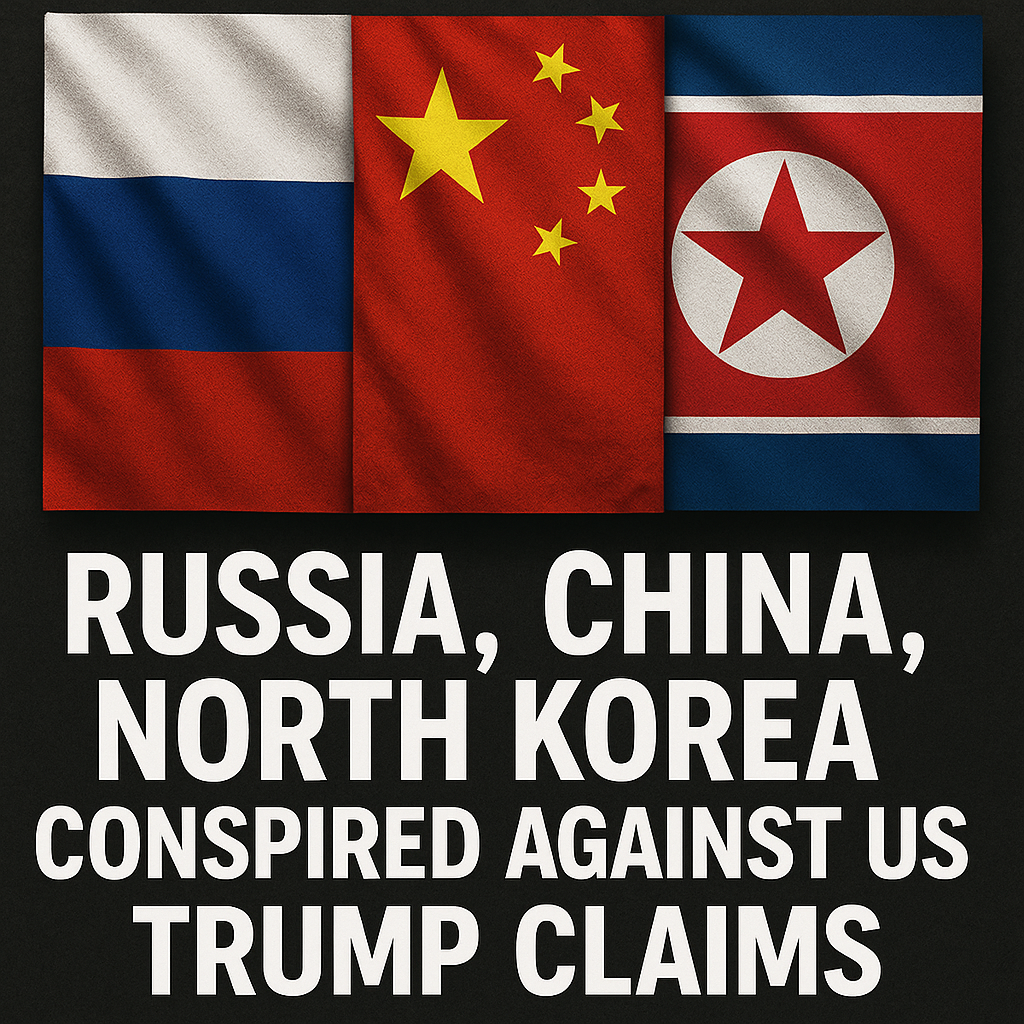
Russia China North Korea Conspired Against US – Trump Claims

Trump’s Allegation: Russia, China, and North Korea’s Conspiracy Against the U.S.
Recent claims by former President Donald Trump that Russia, China, and North Korea have conspired against the United States have reignited discussions around international relations and national security. Trump’s assertions raise critical questions about geopolitical alignments and the troubling complexities of global diplomacy.

Unpacking Trump’s Claims
In a recent statement, Trump suggested that these three nations have formed an unprecedented alliance against the U.S., labeling it a significant threat to American stability. He asserted that these countries are not merely antagonists in isolated diplomatic conflicts but are actively coordinating their strategies to undermine U.S. interests worldwide.


Trump’s narrative draws on growing concerns about the increasing cooperation among these nations. Observers note that Russia and China have developed a closer partnership, particularly in military and economic terms. According to reports from RT, joint military drills and economic collaborations between Moscow and Beijing have illustrated a shift in global alliances, raising alarms about a potential bloc that could challenge Western hegemony. Moreover, North Korea’s missile tests and aggressive rhetoric often coincide with the geopolitical maneuvers of its larger allies, casting further suspicion on Pyongyang’s motivations.


But how accurate are these claims? Analysis from multiple sources offers varying views, suggesting that while there is cooperation among these nations, the extent of their conspiracy remains contentious.
Diverse Perspectives on Geopolitical Alliances
The Case for Alliance
Some analysts argue that Trump’s concerns are not entirely unfounded. Reports from Sky News indicate that the flourishing ties among Russia, China, and North Korea form a counterbalance against what they perceive as Western dominance. These nations often share similar goals: defiance against U.S. foreign policy, territorial integrity, and economic independence.
Furthermore, recent military exercises between Russia and China have raised eyebrows in the West. Al Jazeera reports on increased military preparedness in the region, with joint naval operations and coordinated military strategies aimed at projecting strength. This collaboration, though primarily tactical, can be interpreted as a concerted effort to challenge U.S. influence in Asia and beyond.
Skepticism Regarding a Theoretical Conspiracy
On the other hand, some experts and political commentators express skepticism about framing their relationships as a conspiracy. The complexity of each nation’s interests leads to varying objectives that may not align under a common, coordinated strategy against the U.S. For instance, North Korea’s agenda is distinctly focused on regime survival and national security, often at odds with Russian and Chinese priorities which may emphasize economic development or territorial expansion.
Moreover, alliances between states can be fluid. Historical data has shown that what might appear as collaboration can quickly deteriorate into competition or disarray. The nuances indicate that while there may be cooperation, characterizing it as a deliberate conspiracy could be misleading.
A Complicated Web of Alliances
The interplay among these three nations represents a complex tapestry rather than a simple alliance. While the rhetoric of conspiracy captures attention and fuels political narratives, the reality is steeped in uncertainty. Analysts highlight that while Trump’s assertion underscores real geopolitical tensions, the dynamics are far more intricate.
The Importance of Context
In the broader context, the shifting relationships among these nations are influenced by factors like sanctions, economic dependency, and regional power dynamics. For example, the ongoing U.S.-China trade tensions and the Western sanctions on Russia are likely to shape their diplomatic strategies differently than mere cooperative measures against a common adversary.
As tensions rise, the reaction from the U.S. government will also play a crucial role in shaping these dynamics. The response could foster further isolation of the alleged alliance or inadvertently strengthen it by escalating confrontational rhetoric.
Navigating Future Relationships
Ultimately, the framing of the Russia-China-North Korea relationship is critical in terms of U.S. foreign policy. Engaging in dialogue, understanding distinct national interests, and promoting stability may be more effective than framing these nations as conspiratorial foes. It is about discerning threats from opportunistic partnerships that are often cloaked in ambiguity.
Conclusion: A Call for Nuanced Views
While Trump’s incendiary claims about a conspiracy might capture headlines, it is vital for policymakers and citizens alike to approach this subject with nuance and a clear understanding of international relations’ complexities. A well-rounded approach to diplomacy may yield better long-term outcomes than a polarized view of global politics. As the landscape continues to evolve, staying informed about these shifting alliances will be essential for understanding the future of U.S. foreign policy and national security.















