
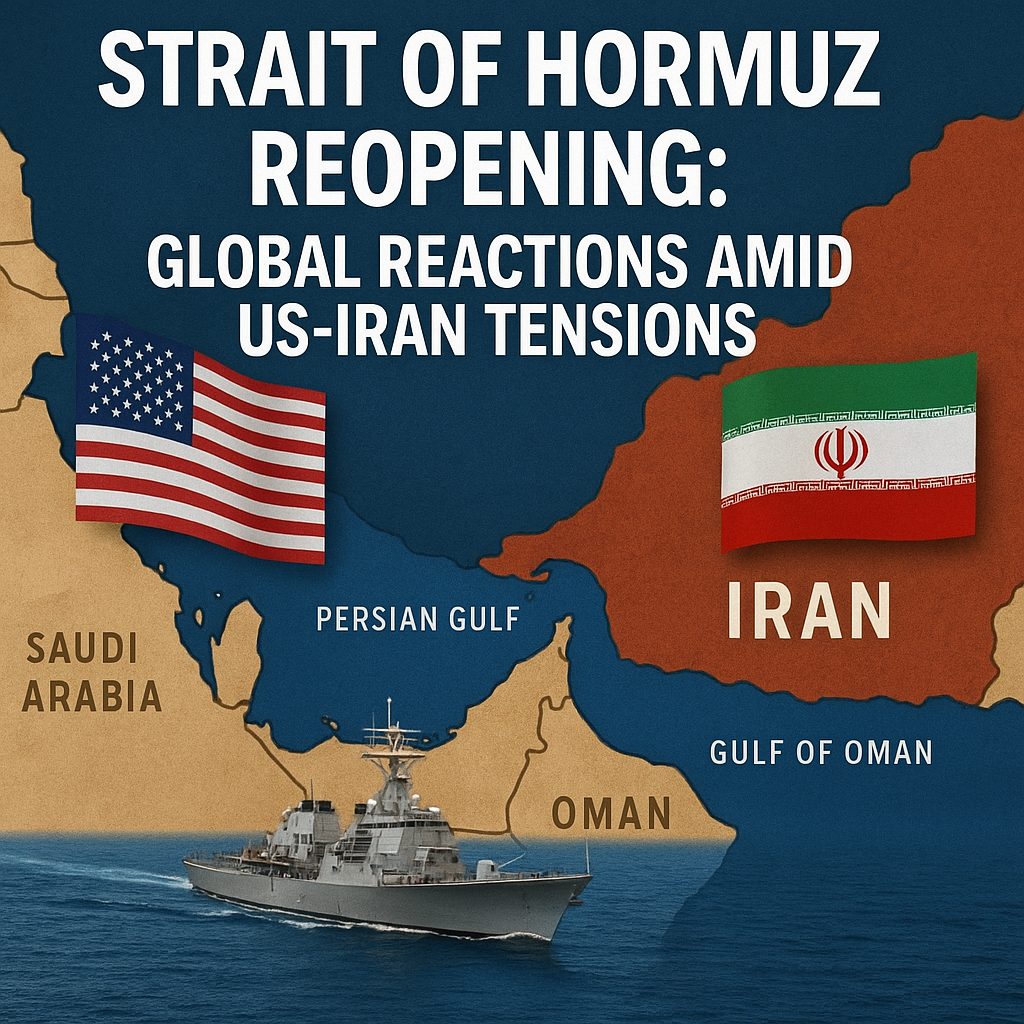
Strait of Hormuz Reopening: Global Reactions Amid US-Iran Tensions

Strait of Hormuz Reopening: Global Reactions Amid US-Iran Tensions
The recent reopening of the Strait of Hormuz has sparked a myriad of global reactions, particularly in the context of escalating tensions between the United States and Iran. This key maritime corridor, responsible for approximately one-fifth of the world’s oil trade, is crucial not only for its economic significance but also for its geopolitical implications. The reopening raises questions about regional stability and the future of US-Iran relations, prompting diverse responses from nations around the globe.

Geopolitical Significance of the Strait
The Strait of Hormuz is undeniably one of the most vital waterways in the world, providing a passage for the majority of the Persian Gulf oil exports. According to Al Jazeera, about 21 million barrels of oil transit through this strait daily, underscoring its importance to the global economy. Consequently, any disruption in the Strait can lead to significant fluctuations in oil prices, affecting economies worldwide.


The Iranian Perspective
Iran has celebrated the reopening of the Strait as a sign of its authority and capability to maintain control over a critical global shipping route. Iranian officials have expressed optimism that this move will enhance regional stability and facilitate enhanced trade flows, particularly benefiting neighboring nations. According to reports from RT, Iran views this as a direct challenge to U.S. sanctions and military presence in the region. The Iranian government hopes to leverage the reopening to assert its influence and challenge Western hegemony in the Gulf.


Responses from the West
In stark contrast, Western nations, particularly the United States, have approached the situation with caution. Following the reopening, U.S. officials have reiterated their concerns regarding Iran’s military ambitions and its alleged attempts to exert undue influence across the region. As highlighted in a Sky News article, the U.S. has deployed naval assets to monitor the Strait and ensure freedom of navigation remains uninterrupted. The U.S. commitment to safeguarding its interests signals an ongoing willingness to confront any perceived threats from Iran, reflecting a deep-seated wariness towards the country’s activities.
Mixed Reactions from Global Powers
The reopening has not only drawn reactions from the U.S. and Iran but also from other global powers with interests in the region. Countries like China and India, which rely heavily on oil imports from the Gulf, have welcomed the reopening. Both nations have underscored the need for stable shipping routes to sustain their economic growth, as they are among the largest consumers of oil passing through the Strait.
Conversely, European states find themselves balancing their energy needs with geopolitical considerations. Leaders from the EU have expressed cautious optimism while calling for diplomatic solutions to mitigate tensions. The European perspective is particularly focused on maintaining a stable and reliable oil supply while preventing an escalation of hostilities that could destabilize the region.
Impact on Global Oil Prices
Initial reports indicate that oil prices have remained relatively stable following the announcement of the Strait’s reopening. However, analysts warn that this calm may be short-lived, contingent on the broader dynamics between the U.S. and Iran. If further aggressive actions are taken by either side, the market could see fluctuations once again. Energy markets are notoriously sensitive to geopolitical events, with potential ramifications felt globally.
Conclusion: An Uncertain Future
The reopening of the Strait of Hormuz presents a complex landscape of opportunities and challenges. While it offers a moment of relief for oil markets and neighboring nations, the overarching tensions between the U.S. and Iran persist, heralding uncertain times ahead. Stakeholders worldwide are left weighing the implications of these developments, which encompass not merely economic considerations but also strategic military and diplomatic factors.
As the world watches closely, it is imperative for nations to engage in dialogue and prevent escalation. The Strait of Hormuz remains a pivotal axis in the global energy map, and its stability is intertwined with the geopolitical fabric of the Middle East. The road ahead necessitates astute diplomatic navigation to foster an environment where both trade and peace can coexist, ensuring that this vital corridor continues to serve its critical role in an interconnected world.















