
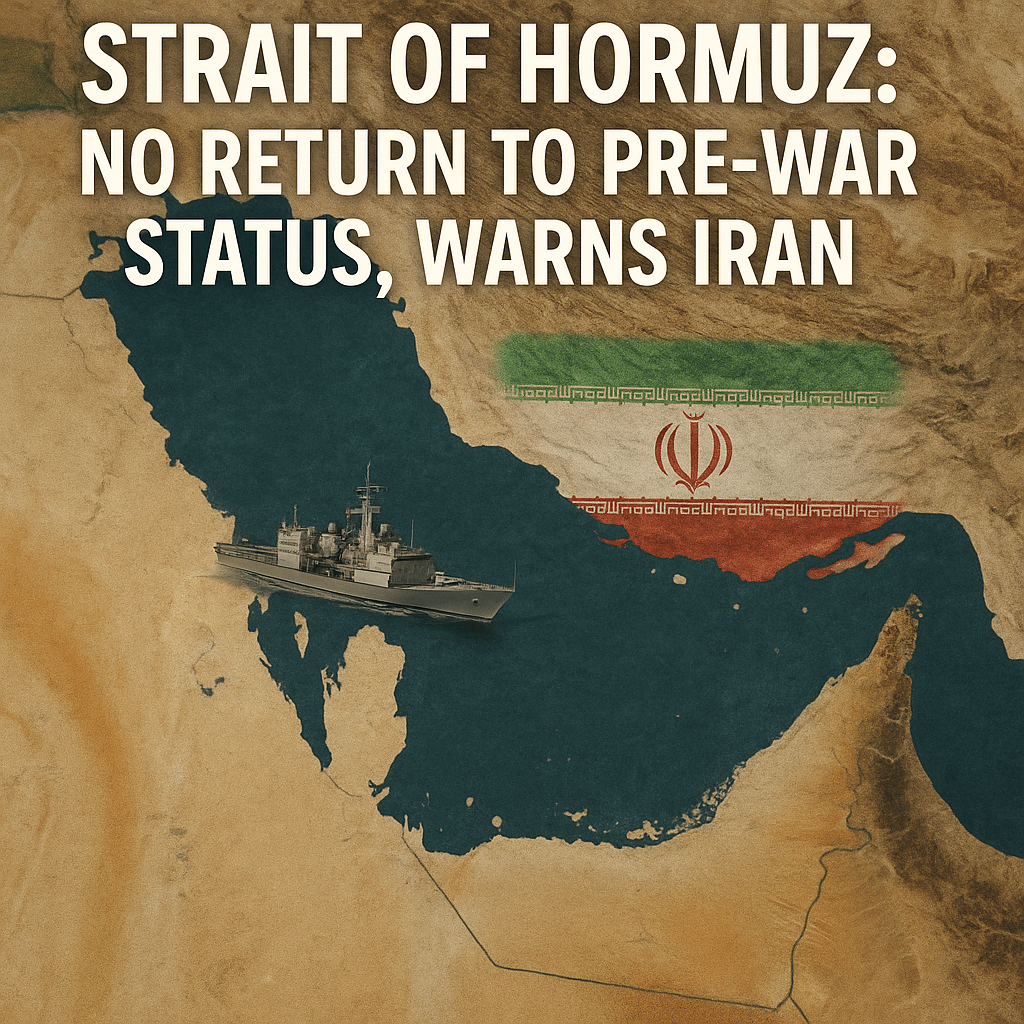
Strait of Hormuz: No Return to Pre-War Status, Warns Iran

Strait of Hormuz: No Return to Pre-War Status, Warns Iran
The Strait of Hormuz remains a focal point of geopolitical tension, especially as Iran recently reiterated its position that there can be “no return to pre-war status.” This statement encapsulates the complexities surrounding regional stability, international shipping routes, and IRan’s assertive posture amidst ongoing hostilities with multiple nations, particularly the United States.

The Strategic Importance of the Strait of Hormuz
The Strait of Hormuz, a narrow waterway connecting the Persian Gulf to the Gulf of Oman, is vital for global oil transport. Approximately 20% of the world’s crude oil passes through this corridor, making it a significant flashpoint in international relations. Recent developments suggest that Iran seeks to reshape the status quo following years of increased military focus and economic sanctions.


Iranian officials, as reported by various sources, assert that the regional dynamics have irrevocably changed in light of increasing military incursions and sanctions. Many observers contend that Tehran’s rhetoric reflects a calculated strategy to strengthen its bargaining position. According to Al Jazeera, Iranian officials view any discussion of reverting to prior diplomatic norms as unrealistic, given the substantial shifts in military and political alignments over the years.


Military Maneuvers and Geo-Political Implications
In recent months, Iran has ramped up its military presence in the region, conducting naval exercises that serve to both intimidate adversaries and bolster domestic support. These actions, according to RT, are not merely a show of strength but part of a broader strategy to ensure that Iran maintains control over its territorial waters and secures its interests amid increasing foreign military presence. The U.S. has continued to patrol the area, and talks of a maritime coalition have emerged, signaling a high-stakes game where both sides are posturing aggressively.
However, contrasting perspectives emerge regarding whether Iran’s military maneuvers genuinely indicate a pathway toward heightened conflict or if they reflect an effort to stabilize its standing in a tumultuous environment. According to Sky News, increased military drills and aggressive posturing by Iranian forces may inadvertently invite more intrusive counter-actions from the U.S. and its allies, potentially escalating tensions to an explosive degree.
The Role of International Relations
The international community is keenly aware that the future of the Strait of Hormuz will hinge on diplomatic negotiations and the evolving geopolitical landscape. The Biden administration has maintained a focus on restoring the Joint Comprehensive Plan of Action (JCPOA), the nuclear agreement that Iran has increasingly distanced itself from. Iranian leaders view their enhanced regional military capabilities as leverage in these discussions, suggesting that their bargaining power has improved in recent negotiations.
Yet, analysts note a lingering uncertainty regarding the timing and sincerity of diplomatic overtures. While some diplomatic channels remain open, Breegan Kohn, a political analyst, opines that the chances of a genuine rapprochement are slim, emphasizing that the entrenched hostilities and mutual distrust complicate any realistic reconciliation process.
Furthermore, the dynamic between Iran and its neighboring nations, particularly Saudi Arabia and the UAE, has tightened, with both parties warily eyeing each other amid competing interests in the region.
Conclusion: A New Normal in Geo-Politics?
As Iran’s leadership signals no intent to revert to previous geopolitical standards, the implications for international trade, oil prices, and regional stability could be profound. The prevailing view suggests that the Strait of Hormuz will serve as an ongoing barometer for Middle East tensions and a crucial flashpoint for international conflict.
While Iran’s warnings are grounded in a newly acquired military assertiveness, the complexities of international diplomacy and local rivalries might lead to both unexpected paths toward peace or heightened conflict. As new negotiations loom, the global community must carefully navigate this precarious landscape, aware that the stakes in the Strait of Hormuz are higher than ever.
The coming months may very well dictate whether there is a paradigm shift towards cooperation or the entrenchment of skirmishes that could engulf the region in wider conflict. For now, it remains clear that returning to a pre-war status is not an option Iran is willing to consider.















