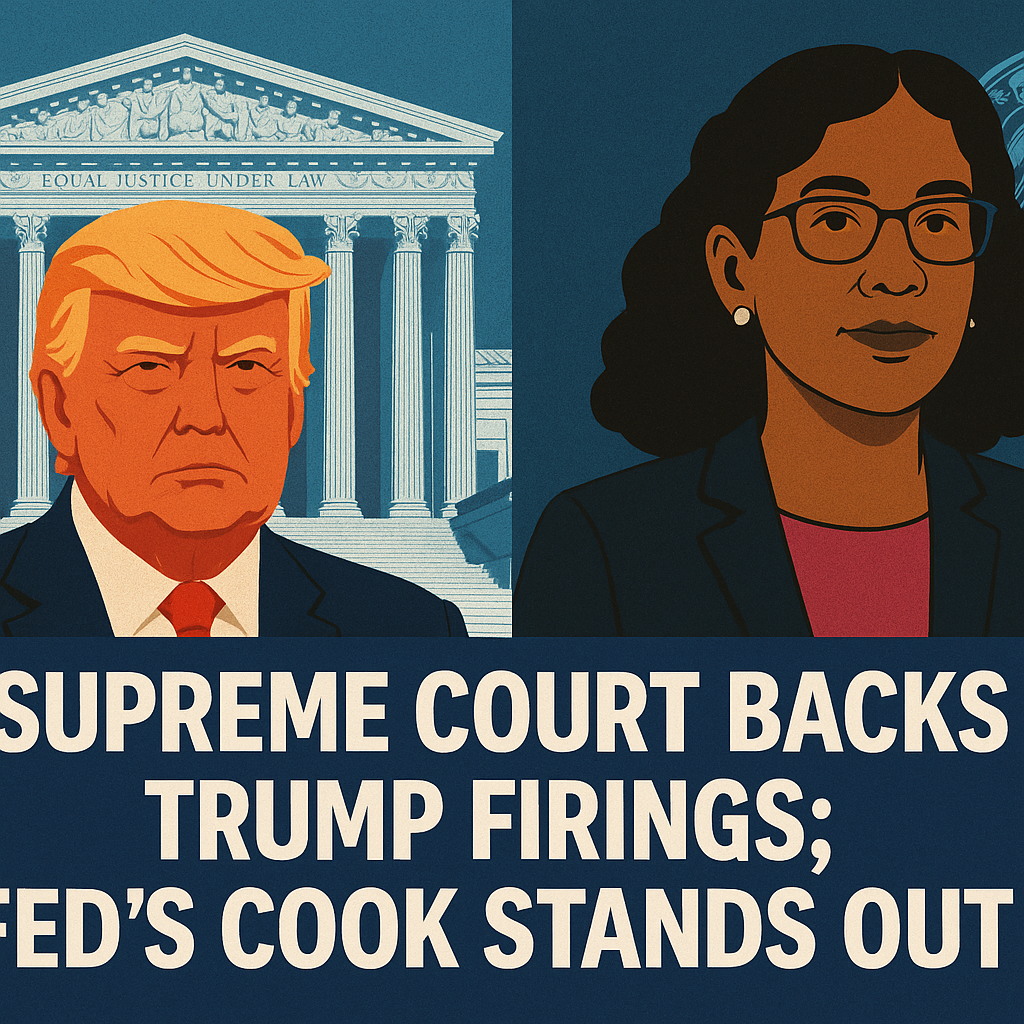
Supreme Court Backs Trump Firings; Fed’s Cook Stands Out

Supreme Court Decision: Implications for Federal Authority
The recent Supreme Court ruling surrounding President Trump’s authority to fire Federal Reserve officials has far-reaching implications that extend beyond the immediate political landscape.

Understanding the Supreme Court Ruling
The Supreme Court has backed Trump’s authority to dismiss certain agency heads but has drawn a significant line with the case involving Federal Reserve Governor Lisa Cook. This decision not only reiterates the President’s power but also emphasizes the unique status of the Federal Reserve as an autonomous body dedicated to economic stability, irrespective of political pressures.


This ruling has created a divide among analysts, with some arguing that allowing a president unrestricted power to dismiss federal officials undermines the independence necessary for entities like the Federal Reserve, which is tasked with critical economic responsibilities. Others, however, contend that a president must have the ability to remove subordinates to ensure accountability and alignment with their administration’s policies.


The Standout Voice: Lisa Cook
Federal Reserve Governor Lisa Cook has garnered attention for her economic insights amidst this political backdrop. Appointed in 2021 and recognized for her expertise, Cook’s position became a focal point in discussions surrounding the delicate interplay between political authority and economic governance.
Supporters advocate for Cook, framing her as a guardian of economic integrity who can withstand political influence, arguing that a politically stable environment is essential for effective policymaking within the Federal Reserve. Critics, however, express concerns that her continued tenure could signify a reluctance within the Federal Reserve to adapt swiftly to changing economic conditions.
Diverse Perspectives on Impact
As various news sources reflect on the ruling and its implications, distinct viewpoints emerge:
– Maintaining Autonomy: Analysts at Al Jazeera emphasized the importance of maintaining independence within the Federal Reserve, arguing that the institution’s primary mandate is to promote stable prices and maximum sustainable employment free from political allegiances. They highlight that Cook’s presence is essential in delivering balanced economic policies that can resist electoral whims.
– Political Accountability: In contrast, some commentators from RT underscore the necessity for political leaders to have the ability to remove officials who may obstruct their policy agendas. They argue that accountability in the federal workforce is crucial, especially as economic challenges evolve. This perspective suggests that a more integrated approach to governance can help in addressing pressing economic issues.
This divergence in interpretation highlights the balancing act between a strong federal authority and the necessity for political accountability. The ongoing discourse around Cook’s role and the Supreme Court’s ruling reveals the complexities of navigating governance within economic institutions.
Conclusion: A Tenuous Balance
As the political landscape continues to evolve, the Supreme Court’s decision illustrates the ever-present tension between presidential powers and institutional independence. The fate of officials like Lisa Cook raises significant questions about who truly holds the reins in economic policymaking.
Ultimately, this ruling does not offer a definitive resolution; instead, it underscores the dynamic and often contentious relationship between political motivations and the demands of effective governance. As voices from both sides of the debate continue to emerge, it will be crucial to observe how these tensions impact the Federal Reserve’s strategic direction and, by extension, the broader economic climate in the years ahead.