
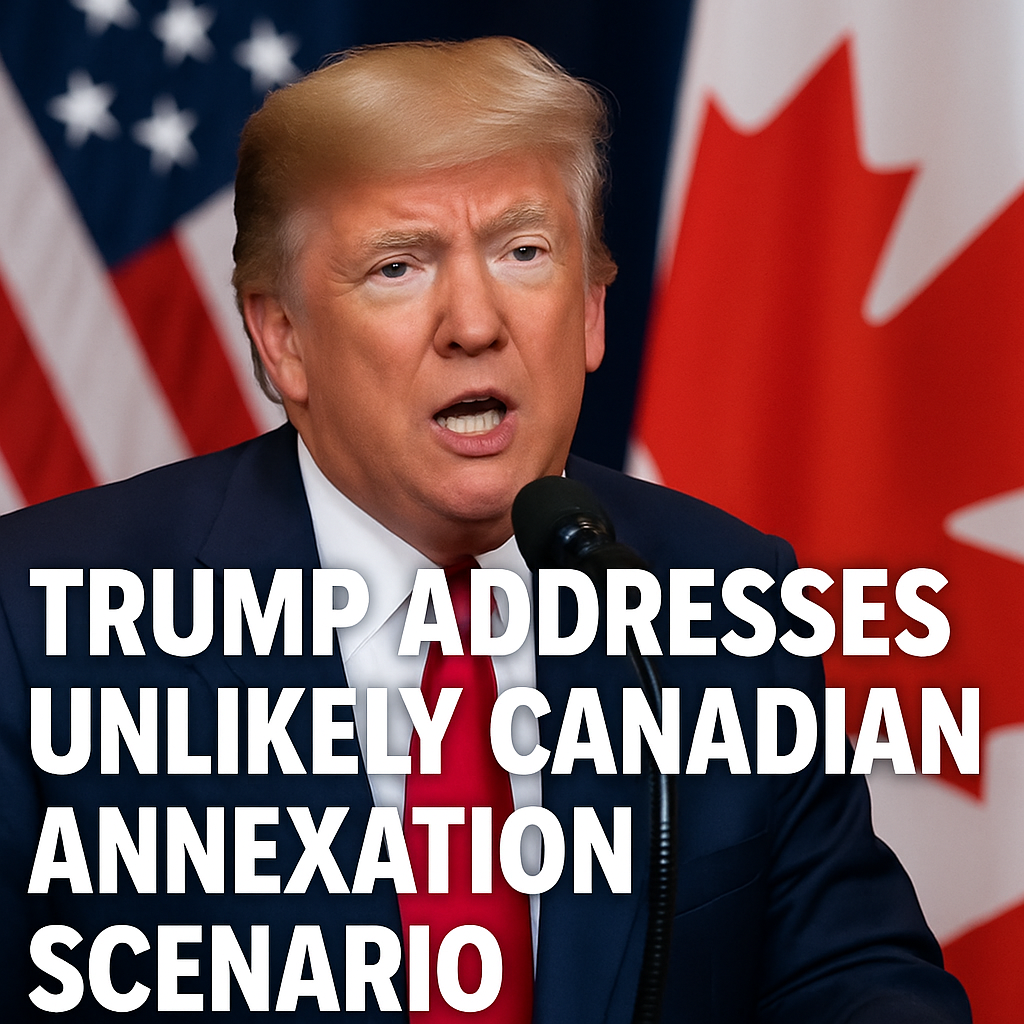
Trump Addresses Unlikely Canadian Annexation Scenario

Trump Addresses Unlikely Canadian Annexation Scenario
Former President Donald Trump’s recent remarks about the possibility of Canada joining the United States have stirred up a range of reactions and opinions, making it a topic worth examining in depth. While many view his statements as tongue-in-cheek, they raise substantial questions about U.S.-Canada relations and the ever-evolving landscape of North American politics.

A Humorous Take or Serious Implications?
In a recent interview promoting his new book, Trump suggested that the annexation of Canada by the U.S. was not entirely off the table. He declared that Canada might be “better off” as part of the United States, using this claim to showcase what he often views as the benefits of American governance. As reported by RT, Trump’s comments aren’t exactly based in serious political policy but rather serve as a flamboyant assertion typical of his public speaking style.


However, viewing this as a mere joke overlooks the historical context. The idea of annexing Canada has historical roots in U.S. manifest destiny rhetoric, which once fueled territorial expansion during the 19th century. Comments such as Trump’s can inadvertently revive discussions that some thought were relegated to the past.


While these ideas may appear lighthearted on the surface, they reveal underlying sentiments regarding national identity and sovereignty. These issues are deeply ingrained in Canadian consciousness and could provoke defensive reactions. For instance, former Canadian Prime Minister Kim Campbell expressed disdain for Trump’s reignition of such discussions, tweeting that Canadian sovereignty is “not a joke.”
Canadian Perspectives: Concerns and Defiance
The prospect of U.S. annexation is met with skepticism and outright rejection across many segments of Canadian society. Many Canadians view their nation’s independence and uniqueness as essential to their identity. A 2021 poll revealed that a significant majority of Canadians reported feeling proud of their country’s autonomy, making the notion of annexation unappealing.
Canadian responses reflect a strong national sentiment. According to a piece from Al Jazeera, many Canadian political leaders have reacted to Trump’s comments with humor, but they also underline a serious commitment to protecting their national sovereignty. This sentiment is particularly heightened given the complicated history of U.S.-Canada relations, which includes periods of tension over trade policies, border issues, and cultural differences.
Contrast in Public Sentiment: Humor vs. Seriousness
A noted contrast arises when comparing responses from American political circles versus Canadian reactions. In the U.S., reactions have ranged from laughter to mockery. Some American commentators view Trump’s remarks as a form of political showmanship, designed to elicit attention rather than provoke genuine concern. For them, the idea of Canadian annexation is less a policy suggestion and more a joke in the grand theater of politics.
Conversely, many Canadians find little humor in the suggestion. As one political analyst pointed out, while Americans may view the comments as outrageous but entertaining, Canadians see them as an affront to their independence. Nationalism does not merely manifest through military might or economic power; it lives in the cultural fabric and social narratives of a country.
Weighing Perspectives: Is It Political Posturing?
While some might argue that Trump’s declarations matter little in substantive political discourse, they should not be dismissed outright. The prominence of his statements may reflect a growing trend among U.S. politicians who entertain extreme ideas to garner attention in an increasingly crowded political landscape. In doing so, they may inadvertently encourage debates around highly sensitive topics, even if they don’t intend to create policy.
On the other hand, some experts caution against oversimplifying these remarks as merely trivial. The strength of social media platforms means that such comments can gain traction quickly, potentially influencing public opinion and political rhetoric over time.
Conclusion: A Complex Tapestry of Views
The conversations surrounding Trump’s remarks on Canadian annexation highlight the complexities and nuances of U.S.-Canada relations. While Trump’s statements were undoubtedly provocative and reflect his larger-than-life persona, the reactions from both sides underscore significant cultural differences between the two neighboring countries.
In a polarized political environment, these discussions could take on lives of their own, generating opinions that range from supportive to scornful. Ultimately, Trump’s remarks serve as a reminder that in political discussions, especially concerning national identity and sovereignty, humor can quickly turn into heated debate.
While the consensus remains that the likelihood of annexation is negligible, the discourse it generates is vital in understanding our interconnected world. The real challenge will not be to dismiss these comments as mere jokes but to engage thoughtfully with the sentiments they provoke on both sides of the border.















