
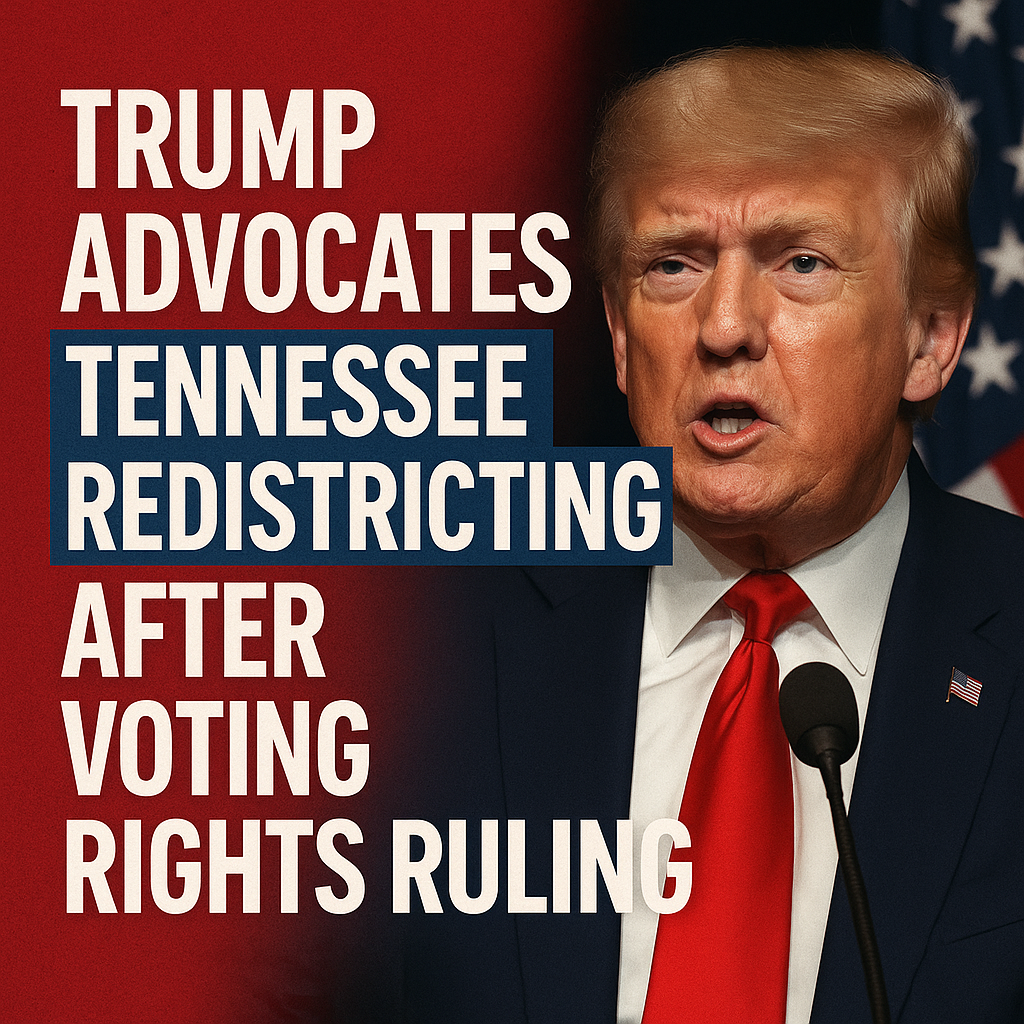
Trump Advocates Tennessee Redistricting After Voting Rights Ruling

Trump Advocates Tennessee Redistricting After Voting Rights Ruling
In the wake of a contentious voting rights ruling, former President Donald Trump has voiced strong support for redistricting efforts in Tennessee. This move has raised questions about the implications for electoral representation and the ongoing debate over voting rights in the United States.

The Context of Redistricting in Tennessee
Recently, a federal court ruled on aspects of the Voting Rights Act, igniting a nationwide discussion on electoral fairness. Trump, seizing on this moment, has urged Tennessee lawmakers to take proactive measures in redistricting, arguing that it is essential to ensure fair representation for all citizens. His call to action highlights the complexity of redistricting, which is often seen as both a political tool and a civic duty.


Diverse Perspectives on Redistricting
Trump’s remarks were met with contrasting views from various stakeholders. Supporters argue that redistricting can revitalize political engagement, promoting representation for historically disenfranchised communities. “The opportunity for redistricting is a chance to correct imbalances,” stated a local political analyst. This perspective emphasizes the potential for revitalizing areas that have been marginalized in the political process.


On the other hand, critics warn that redistricting efforts can be manipulated for partisan gain. Skeptics argue that the former president’s endorsement of the process may serve primarily to consolidate power for the Republican Party. A representative from an advocacy group voiced concern that, “redistricting has too often perpetuated division, rather than fostering unity.” This highlights the dual-edged nature of redistricting—while it can empower communities, it also holds the risk of entrenching partisan divides.
The Historical Implications of Redistricting
To understand the current push for redistricting in Tennessee, it is essential to revisit the historical context. Following the 1965 Voting Rights Act, redistricting was intended to protect minority voters from systemic disenfranchisement. However, over the decades, the practice has frequently been contested. Critics point to instances where redistricting played a significant role in diminishing the voting power of specific groups.
For instance, in 2020, a significant lawsuit arose in North Carolina, where it was claimed that drawing district lines was done to favor one political party over another. This incident underscores the ongoing struggle over the balance between political strategy and logistical fairness in redistricting practices across America.
Trump’s Call for Action: What’s Next?
Trump’s advocacy for Tennessee’s redistricting places significant pressure on state lawmakers to act swiftly. He has called for an overhaul of district boundaries to reflect current demographic realities. This approach resonates with many who believe demographic shifts in Tennessee necessitate a re-evaluation of political boundaries.
However, it remains to be seen how lawmakers will respond to this call. Some are already expressing hesitation, fearing that an overtly partisan approach could lead to backlash. A prominent Tennessee legislator mentioned, “While we need to ensure fair representation, we must also be cautious of the motives driving redistricting efforts.” This sentiment reflects the broader concern about maintaining electoral integrity amidst evolving political climates.
Conclusion: Navigating the Future of Voting Rights and Representation
Trump’s push for redistricting in Tennessee following the voting rights ruling highlights the complexities of electoral politics today. The conversation surrounding redistricting is multifaceted, revealing deep divisions in how stakeholders perceive the practice. While it has the potential to empower communities and enhance political representation, there is an inherent risk of exploitation for partisan gain.
As discussions continue, it is essential for Tennessee lawmakers to weigh the diverse perspectives at play, fostering a fair and honest process that genuinely reflects the needs of its constituents. Whether this redistricting effort will be a boon for fairness or a mechanism for political maneuvering remains to be seen. The outcome will undoubtedly influence not only Tennessee’s political landscape but also the national dialogue surrounding voting rights in years to come.















