
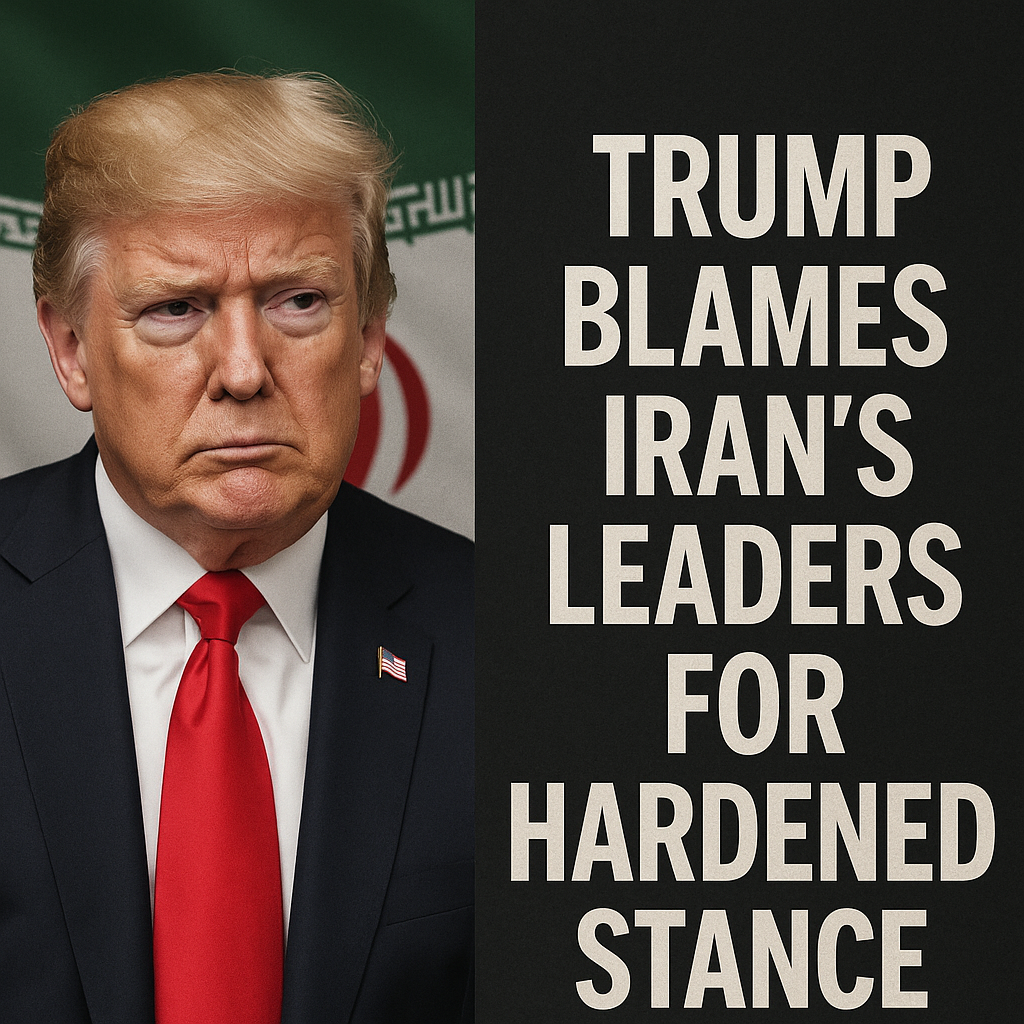
Trump Blames Iran’s Leaders for Hardened Stance

Trump Blames Iran’s Leaders for Hardened Stance
The geopolitical landscape surrounding Iran continues to evolve, especially with recent comments made by former President Donald Trump. His assertions about Iran’s leadership and its increasingly rigid stance towards diplomatic engagement highlight ongoing tensions and diverse perspectives on the matter.

Iran’s Leadership Under Criticism
In a recent interview, Trump criticized Iran’s leaders, claiming their hardline position is a result of their internal policies and governance. He suggested that rather than blaming external pressures, including sanctions and international isolation, the onus lies with the Iranian leadership’s inability to negotiate in good faith. He stated, “They have a choice to make. If they want to engage, they can, but their leaders seem more interested in power than peace.”


Interestingly, Trump’s viewpoint aligns with a larger narrative observed among some commentators who argue that Iran’s leaders are often motivated by a desire to appear resilient against foreign adversaries, particularly the U.S. and its allies. This sentiment is echoed in various news reports, which indicate that the Iranian regime is experiencing internal pressures that may reinforce their hardline approach. For instance, recent protests and economic challenges have reportedly led the leadership to adopt a firmer stance against perceived external threats.


The Iranian Perspective
Contrasting Trump’s assertions, Iranian officials have defended their posture as a necessary response to longstanding hostilities from the West, particularly under the Trump administration. Echoing this viewpoint, government representatives have criticized U.S. policies, including sanctions that they argue have devastated the Iranian economy and undermined the nation’s ability to engage diplomatically.
For example, Ali Akbar Velayati, a senior advisor to Iran’s Supreme Leader, remarked that the U.S. has consistently failed to uphold its commitments, such as withdrawing from the Joint Comprehensive Plan of Action (JCPOA) in 2018. He contended that Iran will not yield to external pressures as long as the U.S. pursues a confrontational policy. This perspective reflects a broader sentiment in Iranian media, which often frames U.S. actions as provocations that justify their resistance.
The dichotomy between Trump’s critique and the Iranian leadership’s justification illustrates the complexities of international diplomacy. While the former president emphasizes accountability from Iranian governance, Iran’s officials point to external factors that perpetuate their rigid stance.
The Search for Common Ground
In light of these conflicting narratives, finding common ground appears challenging but essential for fostering productive dialogue. Various experts argue that a sustained approach involving diplomacy rather than punitive measures could lead to more favorable outcomes. The idea is that engaging Iran through discussions might mitigate some of the hardline tendencies that both Trump and Iranian leaders have criticized.
Moreover, the Biden administration’s recent overtures toward revitalizing negotiations surrounding the nuclear deal demonstrate a recognition of the necessity to navigate these complex waters. By facilitating dialogue rather than solely relying on sanctions, the hope is to encourage a shift in Iran’s stance. The international community has also expressed a desire for a coordinated approach; European powers have been vocal about re-engaging with Iran to salvage the nuclear agreement, signifying a potential path toward de-escalation.
Despite this optimism, skepticism remains prevalent. Critics of any renewed engagement argue that Iran’s track record suggests that merely approaching the table won’t suffice. They contend that assurances and tangible benefits must accompany diplomatic discussions to encourage a more flexible stance from Iranian leadership.
Weighing the Sentiments
Ultimately, these diverging perspectives create a complex landscape where understanding the motivations behind Iran’s hardened stance is vital. Trump’s criticisms resonate with those who advocate for accountability, while Iranian leaders often frame their actions as defensive. The interplay of these various viewpoints underscores the intricacies involved in international diplomacy and the urgent need for constructive dialogue.
While the future remains uncertain, it is clear that both U.S. and Iranian leaders will have to navigate these waters with care. A balanced approach from the international community, characterized by diplomacy and nuanced understanding, may be crucial in fostering a more cooperative environment where progress can be made.
In conclusion, the interplay of leadership attitudes, historical context, and external pressures shapes the current state of U.S.-Iran relations. The path forward requires acknowledging these layers and striving for discussions that prioritize diplomatic engagement over entrenched positions. Only then can there be hope for a resolution that serves both nations’ interests.















