
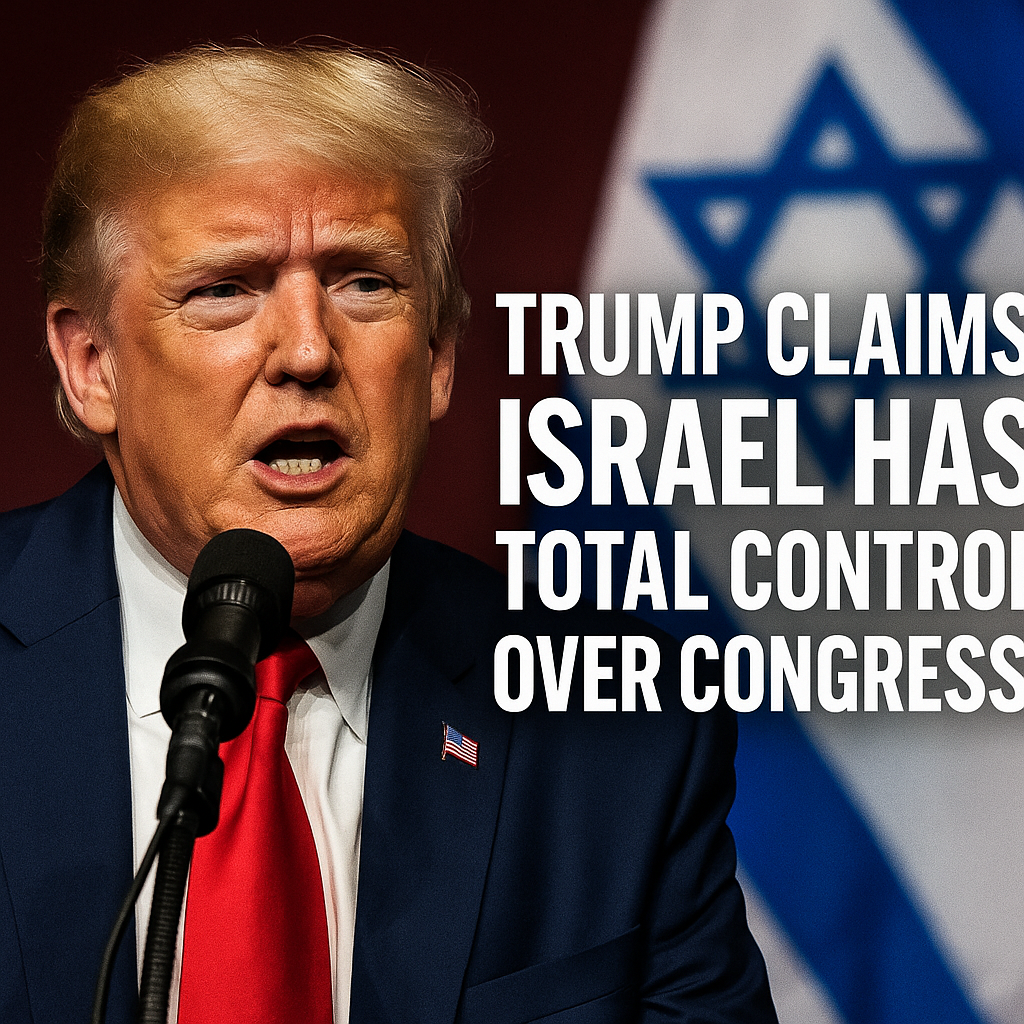
Trump Claims Israel Has Total Control Over Congress

Trump Claims Israel Has Total Control Over Congress
Former President Donald Trump recently stirred significant controversy by asserting that Israel has “total control” over the United States Congress. This statement, which Trump made during a political rally, has ignited a wide array of discussions regarding U.S.-Israel relations and the influence of foreign entities on American politics. The complexity of these claims necessitates a multi-faceted examination of the issue, drawing upon diverse perspectives from reputable news sources.

Historical Context of U.S.-Israel Relations
The relationship between the United States and Israel dates back to the mid-20th century and has evolved through various political climates and administrations. Since the establishment of Israel in 1948, the U.S. has been one of its staunchest allies, emphasizing shared democratic values and strategic interests in the Middle East. The two nations maintain strong military, economic, and cultural ties.


However, some critics argue that this partnership has led to an over-reliance on Israel’s perspectives in Congress, allowing foreign influence to shape domestic policy disproportionately. For instance, an article from Al Jazeera highlights the criticism directed towards American politicians who, in their quest to gain support among pro-Israel constituents, may prioritize Israeli interests over broader American values and policies.


Pro-Israel Lobbying Influence
The pro-Israel lobby in the U.S., particularly organizations like the American Israel Public Affairs Committee (AIPAC), plays a significant role in advocating for policies that align with Israeli interests. Sky News reports that lobbyists often engage with Congress members to facilitate support for measures that benefit Israel. This influence is an integral part of the broader conversation about how lobbying shapes American policy in general.
Yet, other commentators argue that while lobbying is a common practice in the U.S., targeting Israel as uniquely influential detracts from understanding the multi-dimensional nature of political lobbying in the country. A piece from RT News emphasizes that many lobbying groups exist that push various agendas, suggesting that Trump’s remarks might be an oversimplification of a complex reality.
Analyzing Trump’s Claims
Trump’s assertion reflects a longstanding sentiment among some Americans who believe that the U.S. has compromised its sovereignty due to foreign lobbies. However, while the statement might resonate with a subset of the population, opinions vary widely among lawmakers and analysts.
Sources, including Al Jazeera, point out that the claim raises questions regarding anti-Semitism, as suggesting that a single country has “control” over Congress can perpetuate harmful stereotypes. These sentiments were echoed in discussions surrounding Trump’s comments, which some analysts labeled as dangerous and reductive.
While it is critical to analyze the influence of foreign entities on domestic politics, placing undue emphasis on Israel risks ignoring the broader picture of lobbying across multiple sectors. For example, U.S. interests in Taiwan, Saudi Arabia, and other nations have also seen significant lobbying efforts that shape Congressional actions.
A Divided Congress
In examining reactions to Trump’s remarks, it’s evident that Congress is not monolithic in its support for Israel. Some progressive lawmakers have increasingly voiced criticisms of Israeli policies, especially regarding Palestinian rights. This has led to a noticeable shift in dialogues within legislative chambers.
This division is critical; it complicates the notion of a singular influence as many members of Congress make independent decisions influenced by their constituencies and personal beliefs. As reported by Sky News, the diversity of opinions within Congress indicates a more nuanced debate about the U.S.-Israel relationship—one that challenges the idea of “total control.”
Conclusion: Facts, Fears, and Future Dialogues
Trump’s statement about Israel’s significance in Congress serves as a lens through which to explore broader themes of influence, nationalism, and political loyalty. While it underscores concerns regarding foreign lobbying, it can inadvertently promote divisive narratives that may overlook the intricate fabric of American democracy.
Understanding the complexities surrounding U.S.-Israel relations requires a balanced approach that acknowledges various viewpoints without reducing the matter to binary claims. Engaging in open dialogues about these issues is essential for fostering a rationale that appreciates the multifaceted nature of international relations and domestic policy-making.















