
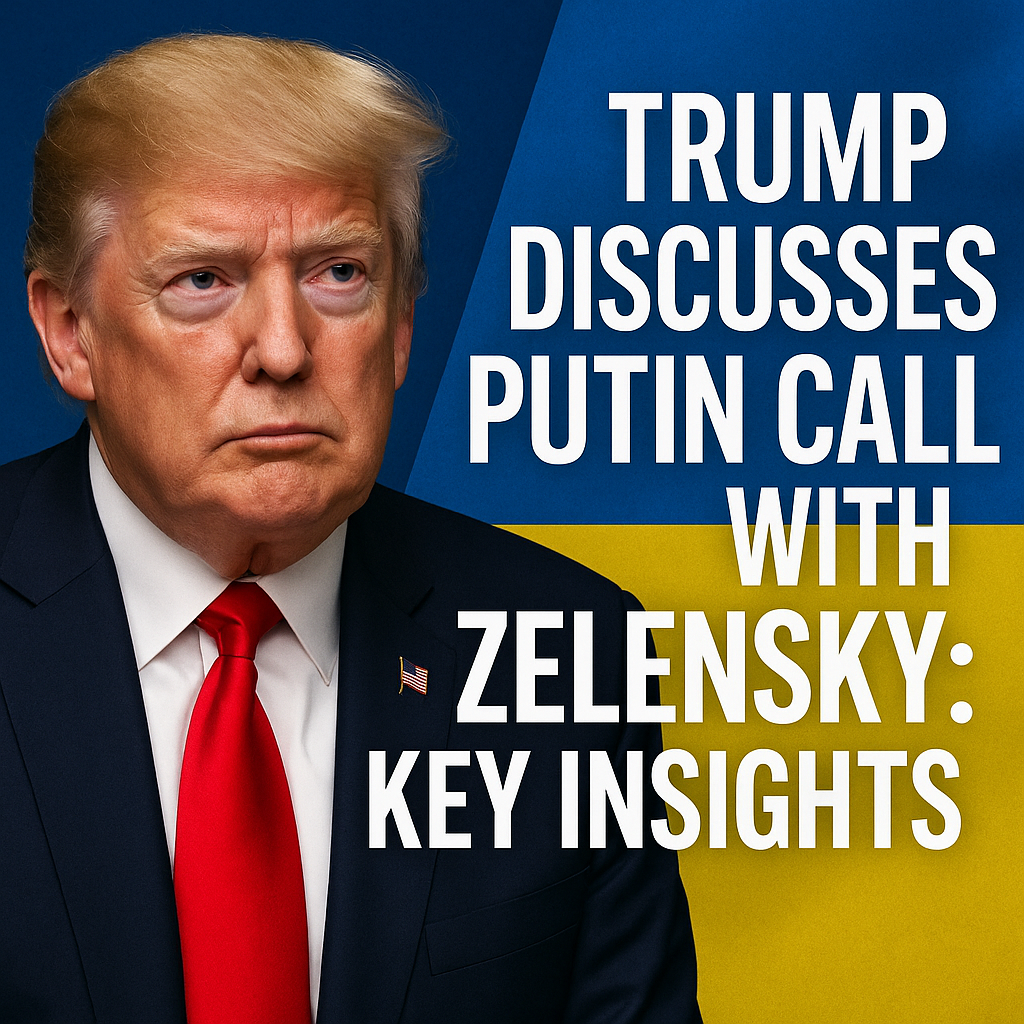
Trump Discusses Putin Call with Zelensky: Key Insights

Trump Discusses Putin Call with Zelensky: Key Insights
The recent discussions surrounding former President Donald Trump’s call with Ukrainian President Volodymyr Zelensky reveal complex geopolitical sentiments. These conversations not only highlight the ongoing dynamics between the U.S. and Ukraine but also bring into focus Trump’s evolving stance on relations with Russia amidst the backdrop of the ongoing conflict in Ukraine.

The Context of the Discussion
The dialogue between Trump and Zelensky comes at a time when geopolitical tensions are peaking. Trump’s comments suggest a nuanced approach to foreign policy that has left some analysts divided. In a recent interview, he appeared to distance himself from the aggressive military support for Ukraine that has characterized the Biden administration’s approach, calling for a negotiation-oriented strategy instead.


Trump emphasized that he believes “talking” is the best method to resolve conflicts, indicating a preference for a diplomatic pathway rather than one defined solely by military assistance. In his view, the current strategy may lead to prolonged conflict rather than a resolution. As he stated, “You have to talk to Putin; that’s how you end wars.”


Divergent Perspectives on Military Support
The former president’s approach contrasts sharply with the sentiments conveyed by other political figures and analysts who argue the importance of maintaining and strengthening military aid. His assertion that the U.S. should halt shipments of weaponry, like Tomahawk missiles, to Ukraine raises critical questions. According to an analysis from Al Jazeera, military support has been deemed essential for Ukraine to maintain its territorial integrity against Russian aggression.
In juxtaposition, Trump’s remarks resonate with a significant portion of the U.S. electorate who are weary of the extensive military conflicts abroad. Many Americans, swayed by sentiments of isolationism and fiscal prudence, urge a reconsideration of the role the U.S. should play on the world stage. For them, Trump’s rhetoric might serve as a refreshing deviation from the prevailing narrative in Washington.
The Complex Role of Diplomacy
Trump’s perspective on diplomacy, advocating dialogue over military engagement, is especially pertinent in light of recent events. His views have generated significant debate, not only within political circles but also amongst the general populace. Many believe that while dialogue is necessary, it must not come at the expense of Ukrainian sovereignty or embolden Russian aggression.
Sky News reported on the critical state of Ukraine’s defense against Russia, pointing to the challenges the nation faces. The hope for negotiations often clashes with the harsh realities on the ground, where territorial integrity is at stake. Critics of Trump’s stance argue that his calls for dialogue risk undermining the Ukraine’s bargaining power in any future discussions with Russia.
Balancing Perspectives
The differing viewpoints surrounding Trump’s approach encapsulate a broader debate on foreign policy in the U.S. context. While Trump frames his view as a pragmatic approach to diplomacy, others echo the sentiment that such views may offer dangerous precedents for dealing with authoritarian regimes.
It is worth considering that Trump’s history with foreign policy has been one of unpredictability. His occasional flares of admiration for leaders like Vladimir Putin have raised eyebrows, leading to concerns about what might happen if he were to return to power. Critics may see his call for diplomacy as an eagerness to cede strategic advantages to adversarial powers.
In the broader scope, the discourse around support for Ukraine underlies the tensions between different American ideological factions—one that favors engagement and global leadership, and another that prioritizes national interests and skepticism towards unwarranted foreign entanglements.
Moving Forward: What Lies Ahead?
As discussions continue, it’s crucial to assess the implications of Trump’s remarks on future U.S.-Ukraine relations. Any pivot towards a less interventionist stance could significantly alter the dynamics of U.S. foreign aid and support for Ukraine. While some populations welcome a re-evaluation of military deployments, the associated risks of such shifts cannot be ignored, especially as Russia consolidates its positions in Eastern Europe.
The discourse surrounding Trump’s insight into the Zelensky call serves as a microcosm of a larger narrative about how the U.S. engages with global conflicts. There remains an urgent need for an informed dialogue that accounts for the multifaceted nature of diplomacy, military intervention, and the on-the-ground realities of international conflicts.
In conclusion, Trump’s discussions surrounding his call with Zelensky bring forth both a contentious re-evaluation of diplomatic norms and a reflection of the American electorate’s varied sentiments on a complex global stage. The path forward will require balancing these diverse perspectives to foster a coherent and strategic foreign policy.















