
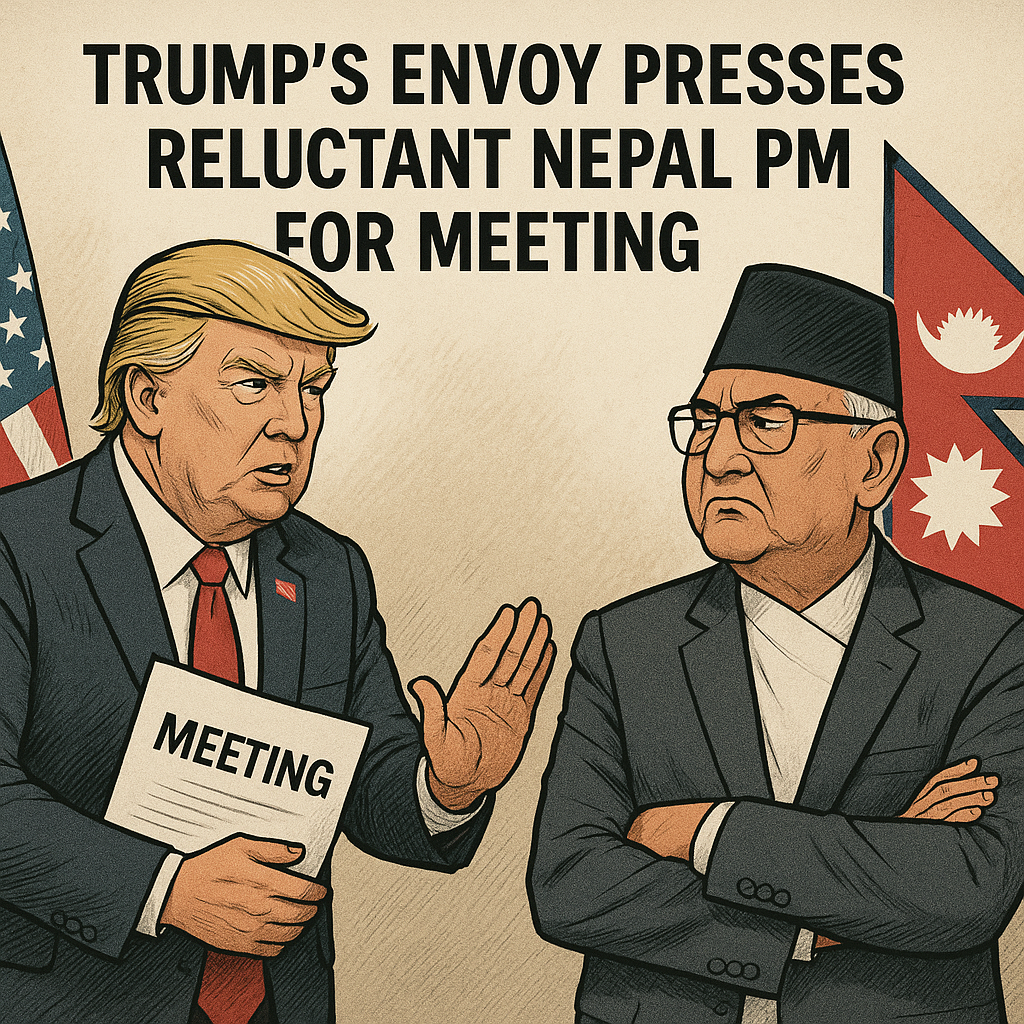
Trump’s Envoy Presses Reluctant Nepal PM for Meeting

Trump’s Envoy Presses Reluctant Nepal PM for Meeting
In a notable diplomatic effort, Donald Trump’s envoy has made attempts to secure a meeting with Nepal’s Prime Minister, a move that reflects the complexities of U.S. foreign relations in South Asia. This initiative has sparked discussions among political analysts, revealing the multifaceted nature of international diplomacy and local governance.

The Context of the Diplomatic Bid
The backdrop of this situation lies in the shifting power dynamics within South Asia, where U.S. interests are increasingly intersecting with regional politics. As highlighted by various news sources, the Trump administration’s envoy has expressed a keen interest in strengthening ties with Nepal, a nation often perceived as pivotal in the geopolitical chess game, especially given its proximity to China and India.


Al Jazeera reported that the envoy’s focus on Nepal symbolizes a broader strategy. The U.S. is seeking to counteract China’s growing influence in the region, which many critics argue is becoming a matter of urgency for American diplomats. By reinforcing ties with Kathmandu, the U.S. aims to present an alternative to Chinese investments and influence in Nepal.


Conversely, RT noted the reluctance of Nepal’s leadership to engage in a meeting with the envoy. This hesitation is telling, reflecting both internal political considerations and the delicate balancing act that Nepal has to perform between powerful neighbors. As Nepal navigates its relationships with both the U.S. and China, the Prime Minister’s cautious approach suggests a desire to maintain strategic autonomy and avoid being drawn into broader geopolitical conflicts.
Inside Nepal’s Reluctance: A Balancing Act
The backdrop of Nepal’s political landscape cannot be overlooked in understanding this reluctance. The country’s recent history of political turbulence makes it particularly sensitive to external pressures. Analysts suggest that the Prime Minister’s hesitance could stem from a fear of backlash from constituents who perceive U.S. involvement as an infringement on national sovereignty.
Furthermore, social sentiment within Nepal leans towards skepticism concerning foreign influence. A past history of foreign interventions has fostered a cautious approach towards any overtures from global powers. This social context complicates the envoy’s mission, as any perceived alignment with the U.S. can provoke a strong nationalist backlash, rallying public opinion against what is often seen as neocolonialism.
In addition, RT’s coverage pointed out the timing of this diplomatic push. With the political climate in flux, it may not be the most opportune moment for such overt diplomatic maneuverings. The Prime Minister could be weighing potential repercussions against any economic or political gains that might come from a meeting with U.S. representatives.
The Broader Implications of U.S.-Nepal Relations
The current diplomatic engagement holds significant implications both regionally and globally. A successful meeting might pave the way for closer economic cooperation, leading to potential investments in infrastructure, education, or health care. However, analysts warn that a failure to secure this meeting could indicate a broader disinterest from Nepal in aligning with U.S. interests, possibly favoring more fruitful relations with China.
This aspect of Nepal’s foreign policy—favoring multi-alignment—poses intriguing questions about the future trajectory of Sri Lanka, Bhutan, and other neighbors. These nations may observe Nepal’s interactions closely, gauging their own responses to U.S. diplomatic efforts and their positioning in relation to China.
While the Trump envoy continues efforts to court Nepal, the question remains whether these overtures will yield significant results. Amidst tales of reluctance and diplomatic pressure, it becomes increasingly clear that the stakes are high for both the U.S. and Nepal. What remains to be seen is how the Prime Minister will reconcile domestic pressures with international diplomacy.
Conclusion
As the world watches, the unfolding drama highlights the intrinsic complexities of managing sovereignty while engaging with powerful global players. The nuanced dynamics of U.S.-Nepal relations underline a significant narrative in the longer-term context of South Asian politics. The desired meeting may signify more than just a diplomatic engagement; it reflects broader ideological battles, economic stakes, and the delicate balance that smaller nations must maintain in a rapidly changing global landscape.
While uncertainties loom over the likelihood of a meeting between the Trump envoy and Nepal’s Prime Minister, the implications of this engagement—or lack thereof—will reverberate beyond the confines of Kathmandu, influencing regional diplomacy for years to come.















