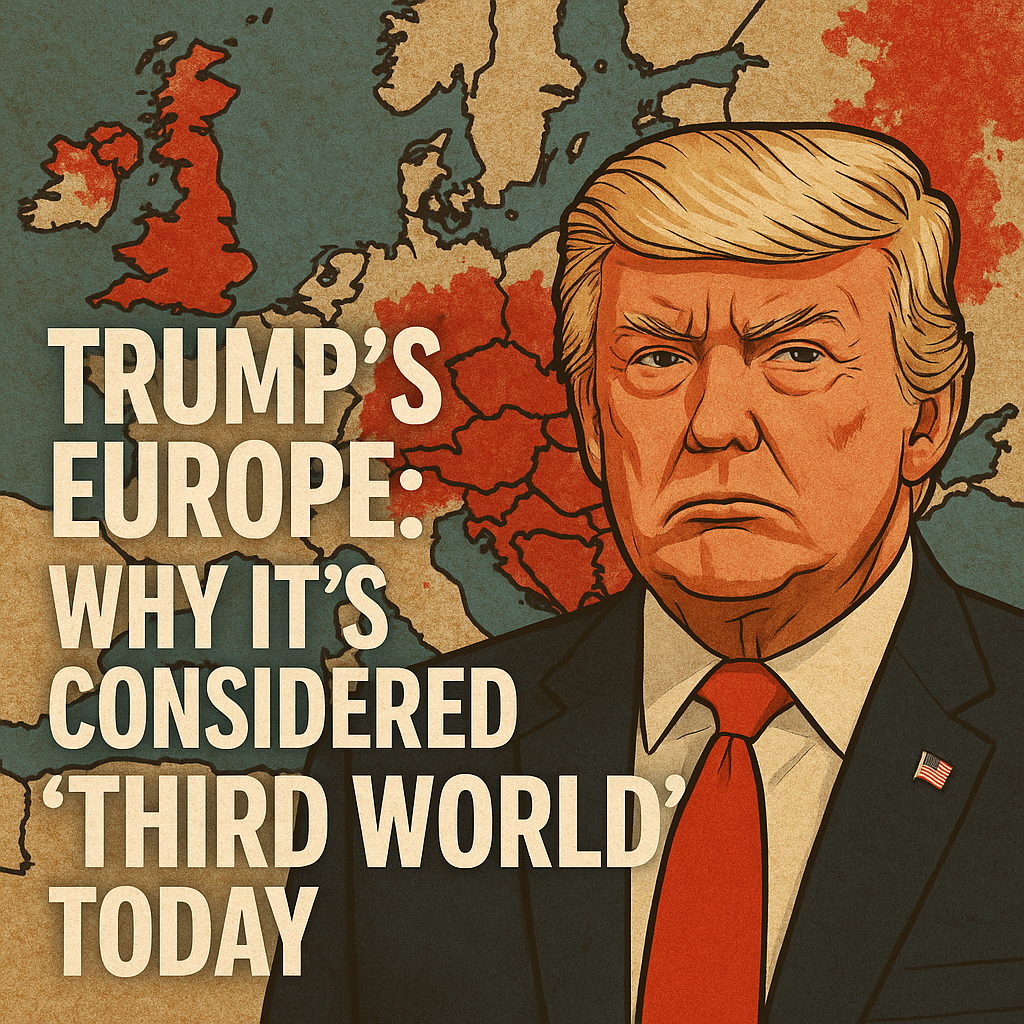
Trump’s Europe: Why It’s Considered ‘Third World’ Today

Trump’s Europe: Understanding the ‘Third World’ Perspective
Donald Trump’s approach to international relations has often stirred controversy, especially regarding his perceptions of Europe. Viewing Europe as a “Third World” entity reflects broader themes in the discourse surrounding migration, economic disparity, and geopolitical shifts. This article delves into the complexities driving this narrative, drawing from various sources to provide a well-rounded understanding.

The Migration Crisis and Economic Disparities
One prominent factor contributing to the characterization of Europe as ‘Third World’ is the migration crisis that has engulfed the continent in recent years. According to sources from RT, Trump has criticized European countries for their handling of refugees, specifically from regions experiencing conflict and instability. He claims that Europe has become a “soft target” for migration, leading to increased crime rates and societal tensions.


Critics argue that this view oversimplifies a multifaceted issue. As reported by Al Jazeera, many European countries are indeed grappling with social integration challenges and economic disparity. The influx of migrants has strained resources, particularly in nations like Italy and Greece, which have borne the brunt of arrivals due to their geographic locations. Furthermore, economic struggles exacerbated by the COVID-19 pandemic have left many regions vulnerable to populist narratives that seek to blame migrants for local issues.


Despite these challenges, it is essential to recognize that the term ‘Third World’ is fundamentally a misleading descriptor in the context of modern Europe. While regions may experience high unemployment rates and growing poverty, many European nations maintain robust economies, advanced infrastructure, and high standards of living, distinguishing them markedly from developing countries.
The Geopolitical Landscape
In examining Trump’s comments regarding Europe, one must also consider the broader geopolitical implications. The former U.S. president’s rhetoric plays into a narrative of decline, positing that Europe is weakening in the face of new global challenges posed by countries like China and Russia. Sky News highlighted that Trump’s administration favored nationalism over multilateralism, which he believed would restore America’s standing on the world stage.
Amidst this backdrop, it’s worth noting that European leaders have attempted to bolster their own international influence to counteract notions of decline. The European Union continues to evolve, improving diplomatic relations and economic partnerships beyond its borders. In fact, as various reports indicate, the EU has been striving for greater strategic autonomy, balancing cooperation with the U.S. against rising powers like China.
These contrasting narratives illustrate a significant divide. Trump’s perspective defines Europe through a lens of failure and chaos, whereas many Europeans view their continent as resilient and evolving. This divergence raises questions about the validity of characterizing entire regions based on particular incidents or political rhetoric.
Conclusion: The Complexity of Identity and Economic Stability
In conclusion, while Trump’s remarks reflecting on Europe as ‘Third World’ may resonate in certain political and media circles, they oversimplify a vastly intricate issue. The European response to migration, economic instability, and geopolitical shifts is neither purely one of failure nor success—it’s a mix of both.
The reality of Europe today is one of adaptation and resilience amid challenges. Economically, while some areas face significant hurdles, others continue to thrive. Likewise, politically, NATO’s defense alliances and the EU’s policies reflect a commitment to maintaining stability and influence. As we ponder the sentiments expressed by Trump, it becomes clear that understanding Europe’s current state requires a nuanced approach, one that acknowledges the complexities rather than reducing them to a singular narrative.