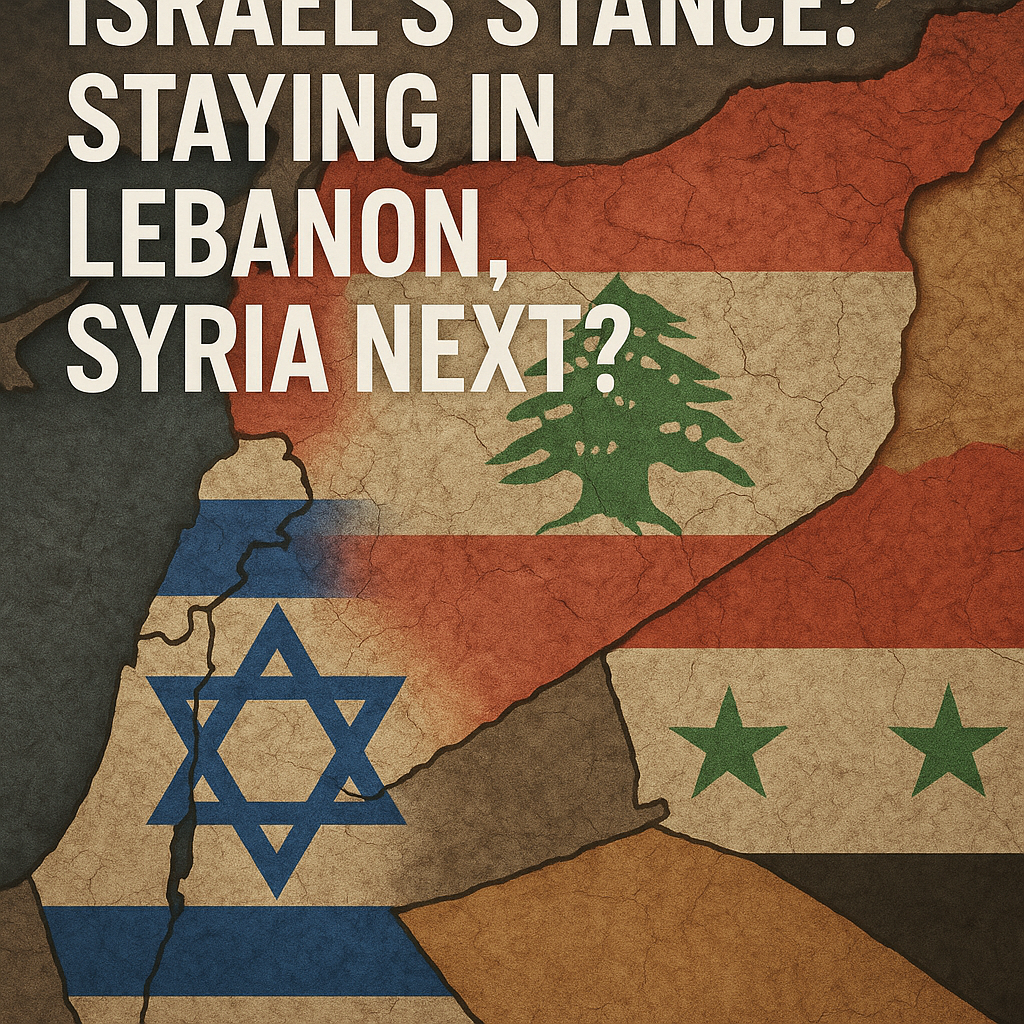
Israel’s Stance: Staying in Lebanon, Syria Next?

Israel’s Stance: Staying in Lebanon, Syria Next?

In the complex landscape of Middle Eastern geopolitics, Israel’s military presence in Lebanon has become a focal point of debate and concern for regional stability. Recent developments suggest that Israel is not inclined to retract its military footprint from Lebanon and may even consider extending its involvement into neighboring Syria. This situation warrants an exploration of multiple perspectives to understand the broader implications of Israel’s strategic choices.


Evaluating Israel’s Military Presence in Lebanon
Israel has maintained a controversial military presence in southern Lebanon since the early 1980s, primarily aimed at countering threats from Hezbollah, a militant group regarded by Israel and several Western nations as a terrorist organization. According to reports from RT and Al Jazeera, Israel recently reiterated its intention to remain in Lebanon, claiming that its military operations are essential for national security and regional stability. The Israeli Defense Forces (IDF) argue that maintaining an operational capacity in Lebanan serves as a deterrent against Hezbollah’s aggressive posturing.


The Israeli government has framed its ongoing presence as a necessary measure to counteract threats not only from Hezbollah but also from the broader Shiite axis supported by Iran. Investigations into public sentiment reveal a mixed reaction within Israel, with some citizens supporting the government’s stance on security, while others express concerns about the long-term implications of prolonged military involvement. This dichotomy reflects a national discourse grappling with the paradox of security versus engagement.
Potential Expansion into Syria
The dark clouds of conflict in Syria present a different yet equally sensitive geopolitical conundrum. Reports suggest that Israel has conducted various strikes against Iranian military targets in Syria, aimed at preempting the transfer of advanced weaponry to Hezbollah. However, some analysts argue that Israel’s intervention in Syria goes beyond mere defense; it indicates a potential shift in strategy toward more direct involvement in the Syrian civil war, especially if control over regions bordering Israel becomes a pressing issue.
The question arises: Is Israel preparing to extend its military presence into Syria? While official sources remain vague, strategic analysts suggest that if Israel perceives an imminent threat from Iranian advancements in Syria, it may take preemptive measures, casting a long shadow over an already tense situation. This shift could destabilize not only the Syrian conflict but also spill over into Lebanese territory, raising concerns about an escalation of conflict across multiple fronts.
Diverse Perspectives on Israel’s Strategy
Opinions regarding Israel’s military approach in Lebanon and potential expansion into Syria vary significantly. On one hand, proponents of the strategy argue that maintaining a military presence is vital for preventing hostile actions from Hezbollah and Iran. They contend that any weakening of Israel’s military stance could embolden these adversaries, leading to more aggressive confrontations.
Conversely, critics argue that this approach may entrench a cycle of violence rather than resolving underlying tensions. Many believe that Israel’s continued military footprint can negatively affect its international standing and exacerbate local grievances, potentially fueling anti-Israel sentiments in both Lebanon and Syria. Several observers express concerns about the humanitarian impact of military involvement, particularly in a region already suffering from the ravages of prolonged conflict.
These contrasting views highlight the intricacies involved in Israel’s strategic considerations. While some believe that a strong military presence is necessary for regional deterrence, others warn of the risks associated with an endless military engagement that could lead to greater instability.
Conclusion: Uncertain Future Ahead
As Israel navigates its role in Lebanon and contemplates deeper involvement in Syria, the complexities of these geopolitical dynamics cannot be overstated. Although some factions within the Israeli government advocate for a robust military presence as a protective measure, the long-term consequences of such decisions remain uncertain. The ongoing dialogue within Israel and across the region reveals a tense atmosphere as the potential for expanded military operations lingers on the horizon.
Ultimately, while Israel’s military strategy is shrouded in the need for security and deterrence, the repercussions of these actions may ripple far beyond its borders, influencing regional alliances and conflicts. With uncertainty prevailing, it becomes crucial for policymakers to weigh immediate security needs against potential long-term ramifications, fostering a broader dialogue that prioritizes stability over sporadic military intervention.