
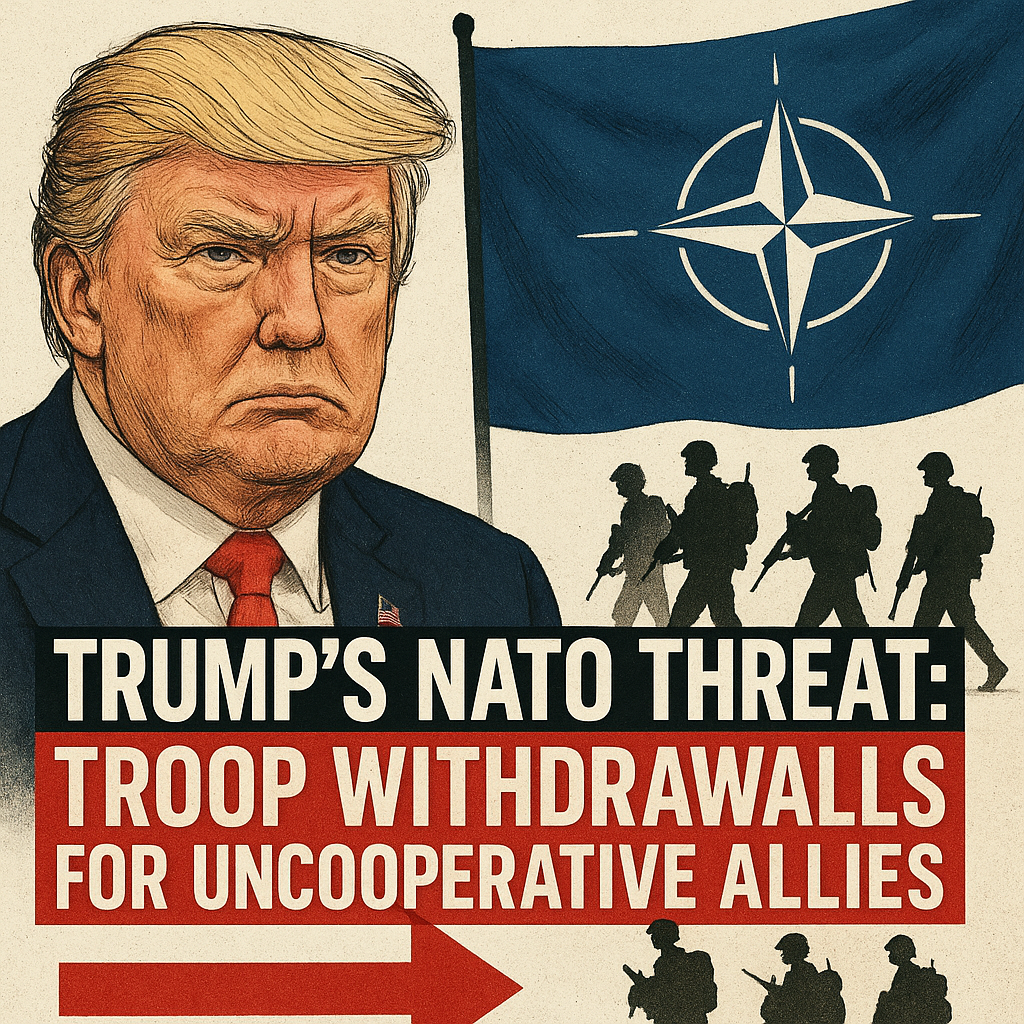
Trump’s NATO Threat: Troop Withdrawals for Uncooperative Allies

Trump’s NATO Threat: Troop Withdrawals for Uncooperative Allies
Former President Donald Trump has reignited discussions around NATO’s role and its funding, with a particular focus on troop withdrawals from member countries that he deems “uncooperative.” His stance raises critical questions about America’s commitment to its allies and the implications of such threats on global security.

Understanding Trump’s Position
Trump’s perspective on NATO isn’t novel; he has long criticized the alliance for what he perceives as inequitable financial contributions. He argues that many European nations do not meet NATO’s defense spending guideline of 2% of GDP. In a recent statement, Trump reiterated his warning to withdraw U.S. troops stationed in countries like Spain and Italy, claiming these nations fail to honor their financial commitments to the alliance. This approach suggests a transactional view of international relations, wherein military support is contingent upon monetary contributions.


From the Trump camp, the rationale is clear: bolstering American interests. A significant passage in Trump’s recent commentary emphasized, “We need to take care of our taxpayers,” indicating that troop withdrawals could be a mechanism for enforcing compliance among NATO allies.


Diverse Reactions Among NATO Allies
Responses from NATO member nations have varied significantly. Some leaders express concern about Trump’s emphasis on financial obligations over collective security. For instance, a high-ranking official from Germany stated, “Security cannot be reduced to a mere financial transaction. Our defense against external threats relies on unity.” This sentiment aligns with the broader consensus among European leaders that the strength of NATO lies in its solidarity, not merely in its budgetary arithmetic.
Conversely, certain factions within these nations echo Trump’s sentiments, advocating for increased defense spending. In Italy, a political analyst remarked, “Trump’s position has resonated with portions of our populace that feel we must invest more in our own security rather than rely solely on American support.” This reflects a growing awareness and discussion about the sustainability of defense spending entering the political discourse in various European countries.
Implications of Troop Withdrawals
The implications of a potential U.S. troop withdrawal from NATO countries extend beyond financial ramifications. Such a move could embolden adversaries, notably Russia, which has previously expressed intentions to exploit divisions within NATO. Political analysts warn that an American retreat could create a power vacuum, prompting aggressive maneuvers in Eastern Europe and beyond.
Moreover, reduced troop presence may complicate NATO’s operational capabilities. An article from Al Jazeera notes that U.S. troops play a vital role in intelligence-sharing and joint military exercises that enhance readiness across the alliance. The withdrawal of forces, therefore, could undermine not only individual country defenses but also the collective strength of NATO.
The Path Forward
A balanced approach may involve NATO nations reevaluating their spending commitments while maintaining the alliance’s core principles of mutual defense and collective security. European nations are increasingly aware of the need to bolster their defense capabilities independent of U.S. influence. The recent shifts in military strategies across the EU, presented in several Sky News reports, indicate a significant turning point: Europe must prepare for a future where unity transcends mere financial transactions.
It’s essential for the Biden administration to tread carefully. While reaffirming commitment to NATO, including addressing concerns about financial contributions, there should also be an emphasis on collaborative strategies that strengthen the alliance’s main purpose: mutual defense against common threats.
Conclusion
Trump’s threats to withdraw U.S. troops from NATO member states pose a complex challenge that tests the alliance’s resolve and unity. The mixed reactions among European leaders highlight a diverse range of sentiments regarding defense spending and strategic autonomy. As nations negotiate their positions, the overarching requirement remains clear: fostering unity is crucial in overcoming the pressing security challenges of our time. While financial contributions are important, the very essence of NATO is rooted in collective security—not merely a calculation of costs.















