
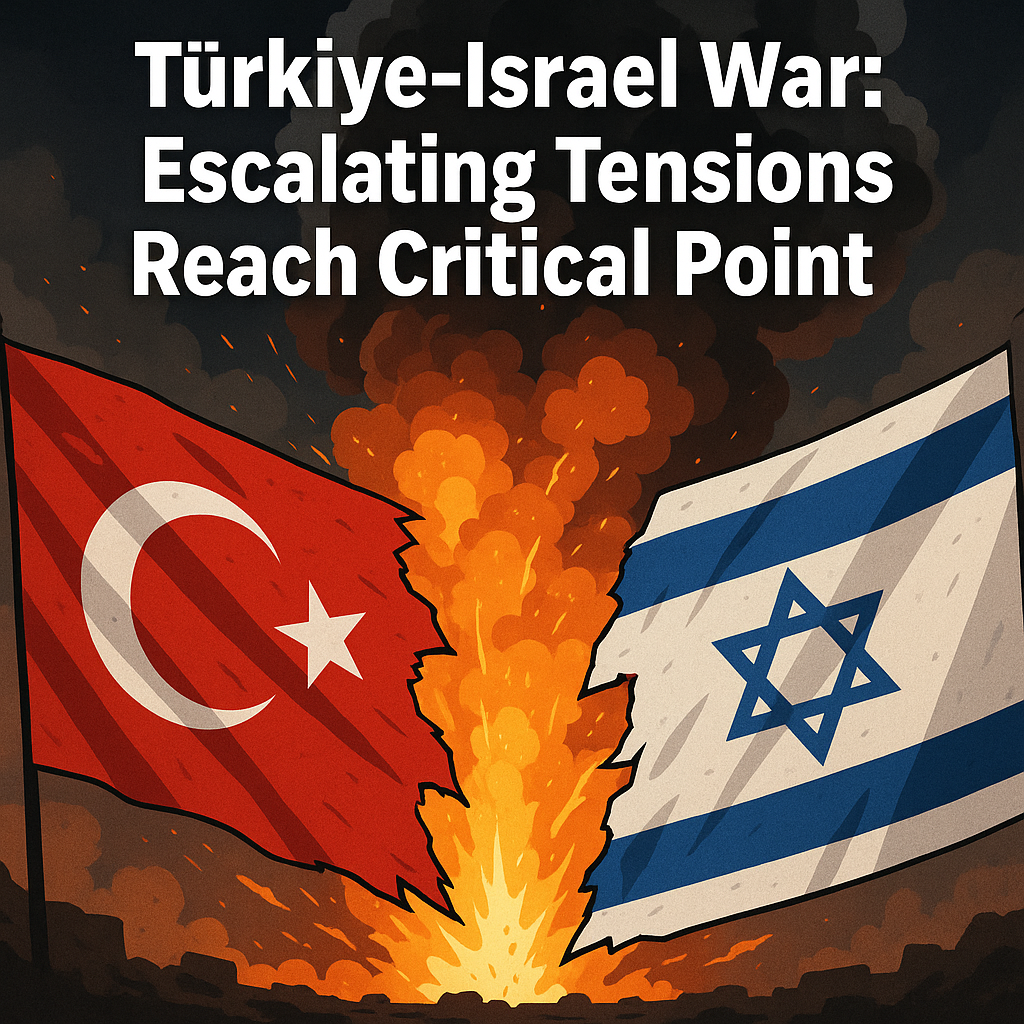
Türkiye-Israel War: Escalating Tensions Reach Critical Point

Türkiye-Israel War: Escalating Tensions Reach Critical Point
Recent developments in the Türkiye-Israel conflict underscore the intensity of a situation that has escalated dramatically in recent months. As both nations grapple with a mix of historical grievances and contemporary geopolitical maneuvering, the looming threat of war appears more tangible than ever.

Historical Context and Underlying Issues
The roots of the Türkiye-Israel conflict run deep, tracing back to the establishment of Israel in 1948 and subsequent regional tensions. Türkiye has often positioned itself as a supporter of Palestinian rights, leading to strained diplomatic relations with Israel. The events of the past few years, including the U.S. recognition of Jerusalem as Israel’s capital and Türkiye’s growing ties with Palestinian factions, have only exacerbated this divide.


Current Tensions: A Multi-Faceted Perspective
Reports detail that recent military exercises and aggressive rhetoric from both sides have contributed to rising tensions. An article from RT highlights concerns from Israeli officials that Türkiye’s military actions in neighboring regions could escalate further. Conversely, a report from Al Jazeera emphasizes Türkiye’s perspective, wherein government officials claim they are acting in defense of their sovereignty and their role as a guardian for Palestine.


The contrasting narratives highlight a fundamental divergence in how both nations perceive the crisis:
– Israeli Viewpoint: Analysts suggest that Israel sees Türkiye’s military expansions as a direct threat, potentially destabilizing the already volatile region. Israeli foreign ministry officials urge for a strong diplomatic response to counteract Türkiye’s military buildup.
– Turkish Perspective: From Türkiye’s standpoint, its military presence is portrayed as essential to maintain regional stability and protect national interests against perceived Israeli aggressions. Turkish officials argue that they are engaging in proactive measures to ensure their national security, reiterating their commitment to supporting Palestinian autonomy.
The Role of International Players
International dynamics complicate the Türkiye-Israel conflict significantly. Major powers, including the United States and Russia, have vested interests in the region, making their involvement both a potential source of resolution and further conflict. Recently, the U.S. has attempted to mediate between the two nations, though its effectiveness remains debatable.
The Impact of Global Opinions
Public opinion also plays a critical role in shaping each nation’s approach to the conflict. For Israel, maintaining its image as a secure and democratic state is paramount, especially in the face of mounting criticism over its policies regarding Palestinians. Türkiye, under President Erdoğan, capitalizes on regional support for Palestinian rights, portraying itself as a defender against Israeli actions.
Social media has amplified these sentiments on both sides, often resulting in misinformation and heightened emotions, which further complicates diplomatic efforts. The potential for misunderstandings and escalated conflicts grows as narratives are swiftly shaped by public reactions to ongoing events.
Conclusion: The Road Ahead
The path forward for Türkiye and Israel is fraught with uncertainty. While both nations may benefit from diplomatic negotiations, entrenched positions and historical grievances complicate the prospect of peace. As reports indicate, the stakes are high, not just for Türkiye and Israel but for the broader Middle East.
With military posturing increasing on both sides, the potential for a miscalculation or accidental engagement remains a persistent threat. Observers argue that without robust diplomatic intervention, the situation could deteriorate further.
In a world already burdened with geopolitical strife, the Türkiye-Israel conflict serves as a stark reminder of the complexities that define international relations today. The implications of this escalation will undoubtedly echo far beyond their borders, influencing geopolitical stability in the region for years to come. As events unfold, maintaining a keen awareness of the evolving dynamics will be essential for understanding the intricate tapestry of Middle Eastern politics.















