
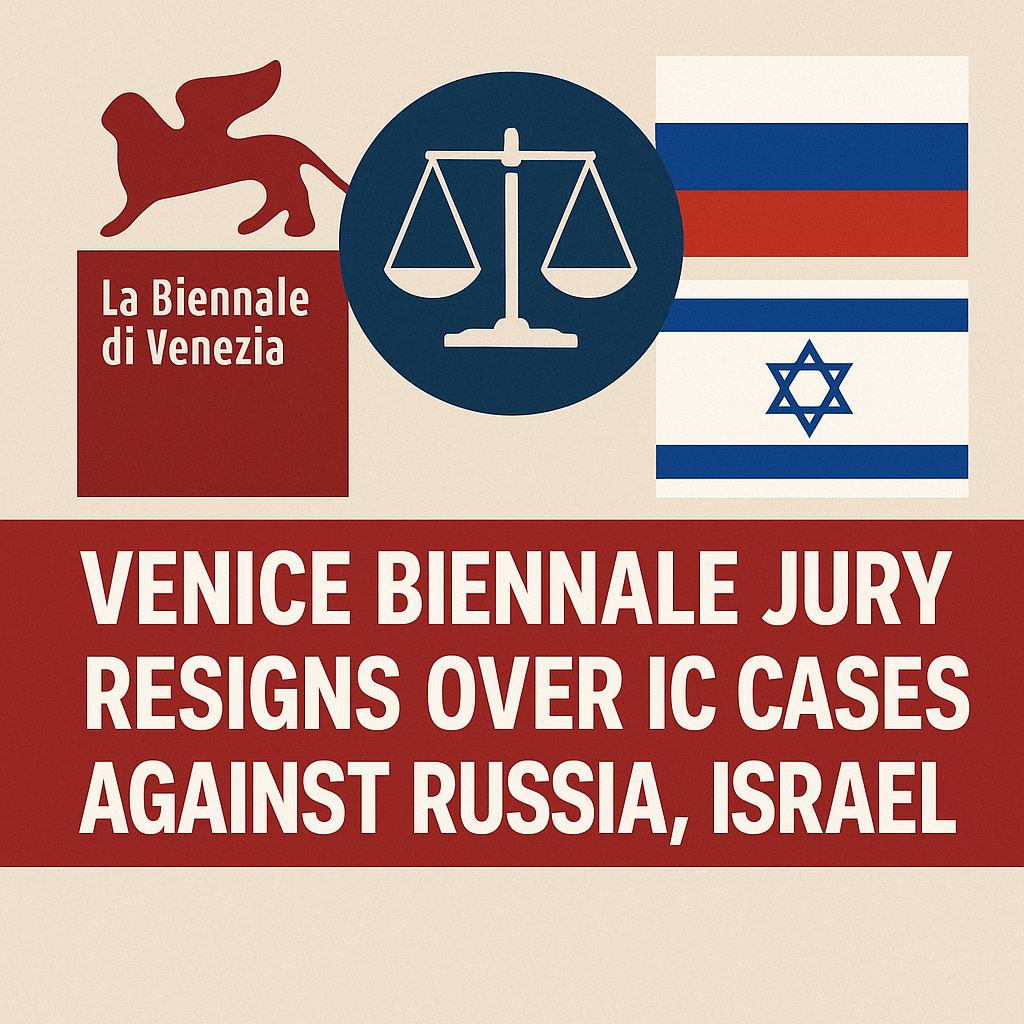
Venice Biennale Jury Resigns Over ICC Cases Against Russia, Israel

Venice Biennale Jury Resigns Over ICC Cases Against Russia, Israel
The recent resignation of the Venice Biennale’s international jury has ignited discussions around the intersection of art, politics, and international justice, particularly concerning the ongoing International Criminal Court (ICC) cases against Russia and Israel. This move has sparked a variety of perspectives on the implications of politicizing art and its institutions.

Understanding the Resignation
The Venice Biennale, a prestigious art exhibition that occurs every two years, has drawn attention not just for its artistic displays but also for its role in shaping global conversations. The jury’s sudden resignation is tied to the ICC’s investigations into war crimes involving Russia in Ukraine and Israel in Palestine. Members of the jury expressed frustration over the exhibitions’ perceived silence on these critical issues, which they felt undermined the moral integrity of such a globally significant event.


Conflicting Perspectives
The response to the jury’s resignation has not been uniform. On one hand, advocates for political engagement in the arts argue that the Biennale should reflect global injustices, especially given its international platform. This perspective is supported by various art critics and political commentators, who maintain that art cannot exist in a vacuum divorced from pressing societal issues.


“The arts should challenge and provoke,” a prominent critic asserted, emphasizing the responsibility of artists and institutions to engage with the realities of war and conflict. In this view, the jury’s resignation can be seen as a call to action, pushing future exhibitions to confront uncomfortable truths.
Conversely, others within the art community argue that the Biennale’s primary purpose is to celebrate creativity and foster dialogue among artists from diverse backgrounds without being mired in political controversies. They warn that injecting overt political agendas into artistic spaces could dilute the essence of artistic expression. As one art enthusiast pointed out, “The Biennale should be a sanctuary for creativity; politicizing it risks alienating audiences.”
Artistic Integrity vs. Political Responsibility
This rift over the role of politics in art illustrates a broader philosophical debate. On one side lies the belief that art ought to serve as a mirror, reflecting societal issues and injustices. This belief is supported by historical precedents where artists have played pivotal roles in social movements through their work.
However, there is a strong counterpoint—that art is also about interpretation, experience, and emotional resonance that can transcend immediate political contexts. Critics of politicizing art argue that focusing solely on current events risks misrepresenting the artists’ intentions and reducing complex narratives to mere political statements.
A Call for Balance
The Venice Biennale jury’s resignation serves as a reminder of the delicate balance that must be struck between artistic integrity and political responsibility. Both perspectives offer valuable insights into how global art institutions can navigate complex international issues while supporting artists’ diverse voices.
The ongoing discussions surrounding this resignation extend to questions about what role art should play in society. Should it provoke change, raise awareness, or remain a space for personal and aesthetic exploration? Ultimately, the answer may lie somewhere in the middle—a recognition that while art can awaken political consciousness, it also holds the capacity to offer solace and escapism.
Conclusion
In the wake of the international jury’s resignation, the Venice Biennale finds itself at a crossroads. Amidst the backdrop of serious human rights concerns, the challenge remains for cultural institutions to define their roles in relation to global politics. As dialogue continues, it is essential for both artists and audiences to engage thoughtfully with these pressing issues, navigating the complexities inherent in expressing dissent and advocacy through art.
With the evolving discourse around the intersection of art and politics, the Venice Biennale will likely face renewed scrutiny in future iterations—reflecting not only the state of international relations but also the enduring power of art in shaping our understanding of the world.















