
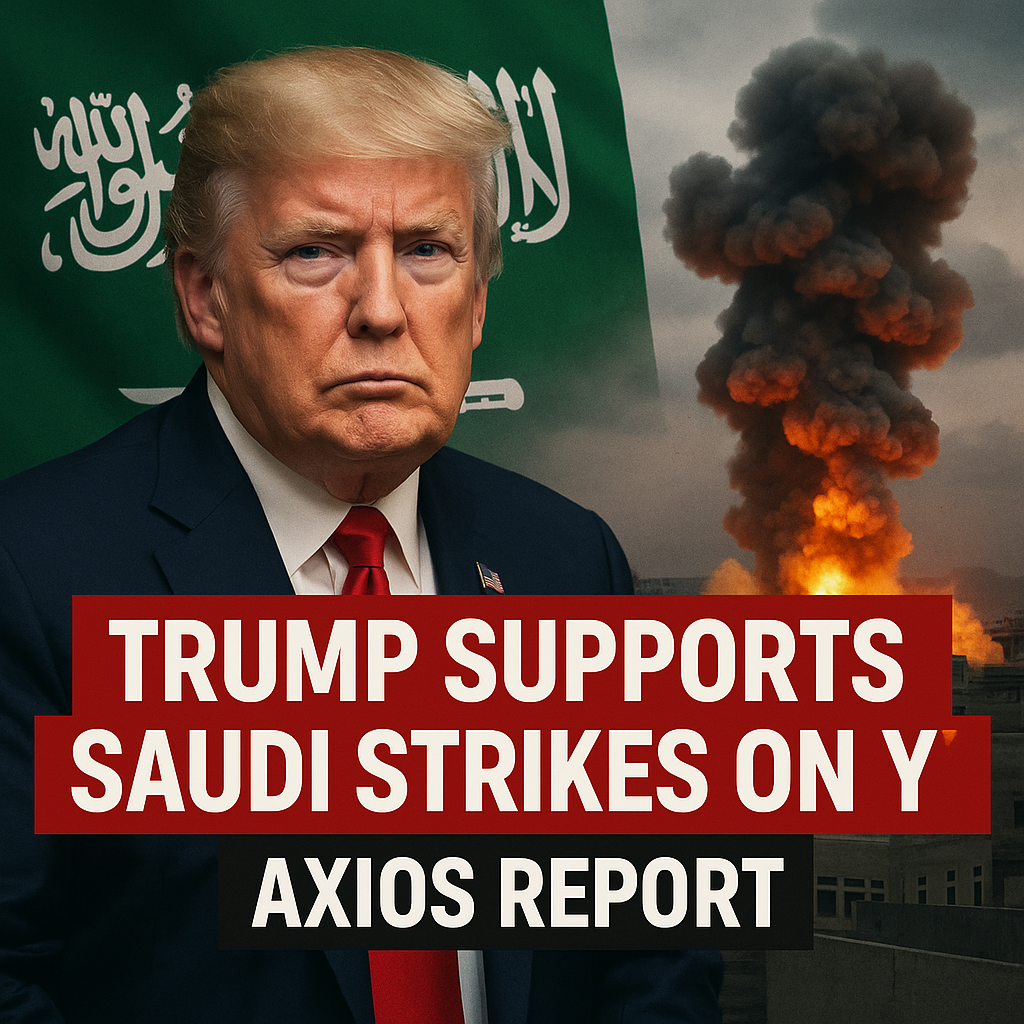
Trump Supports Saudi Strikes on Yemen – Axios Report
Trump Supports Saudi Strikes on Yemen: A Complex Geopolitical Position
The recent report indicating that former President Donald Trump supports Saudi Arabia’s military strikes against Houthi positions in Yemen brings into focus the intricate dynamics of Middle Eastern geopolitics. Trump’s backing suggests a strategic alignment with Riyadh, reflecting ongoing tensions and the broader implications for regional stability.

The Context of the Conflict
Yemen has been embroiled in a brutal civil war since 2014, primarily between the internationally recognized government and the Houthi movement, which is supported by Iran. This conflict has not only created a humanitarian crisis but has also attracted international attention and intervention. Saudi Arabia, leading a coalition, has launched significant military operations against the Houthis, asserting its right to defend its borders and interests.

In a recent statement, Trump echoed support for Saudi actions, emphasizing the importance of combating Iranian influence in the region. His remarks reflect a continuation of the U.S. stance during his presidency, where military and political support for Saudi Arabia was often framed as a bulwark against perceived Iranian aggression.

Divergent Views on U.S. Involvement
The endorsement from Trump has sparked varied reactions. On one hand, supporters of this approach argue that backing Saudi Arabia enhances U.S. interests in the Middle East and curtails Iranian expansion. A report from Sky News highlights that many view the Houthis as a destabilizing force in Yemen, with close ties to Iran, which supports the rationale for external intervention.
Conversely, critics argue that U.S. support for Saudi-led strikes exacerbates the ongoing humanitarian disaster in Yemen, where millions face famine and disease. Al Jazeera’s coverage emphasizes that despite foreign involvement, a political solution is essential to address the root causes of the conflict. Many humanitarian organizations have raised alarms about the consequences of continuous military operations, arguing that the civilian population bears the brunt of such escalations.
Weighing the Evidence
As the situation unfolds, it is crucial to weigh both perspectives to understand the nuances involved. Supporters of Trump’s endorsement underscore the potential for stabilizing the region by containing Iran’s influence, citing the necessity of a tougher stance against groups perceived as threats to U.S. allies. Yet, the overwhelming humanitarian crisis raises serious ethical questions about the implications of military support.
According to a report from RT, Trump’s stance aligns with a broader pattern of U.S. foreign policy that favors military solutions over diplomatic talks. Critics point out that this could perpetuate a cycle of violence that may ultimately destabilize not just Yemen, but the region as a whole.
While opinions diverge, a crucial point remains unaddressed: the potential for a long-term solution. Many experts advocate for increased diplomatic efforts, arguing that military action without a clear political framework tends to prolong conflicts rather than resolve them.
A Call for Balanced Policy
Given the complexity of the situation in Yemen and the various stakeholders involved, it is paramount for both U.S. and Saudi leadership to consider the broader consequences of military engagement. Could continued support for strikes ultimately worsen conditions for civilians? And, might it inhibit the possibility of negotiation and peace talks that are sorely needed?
In conclusion, while Trump’s support for Saudi strikes against the Houthis may resonate with certain geopolitical strategies, it also carries significant ethical and humanitarian implications. The path forward should ideally blend military strategies with robust diplomatic efforts aimed at achieving a lasting peace in Yemen—an approach that balances the immediate security concerns with the long-term need for stability and humanitarian relief.















