
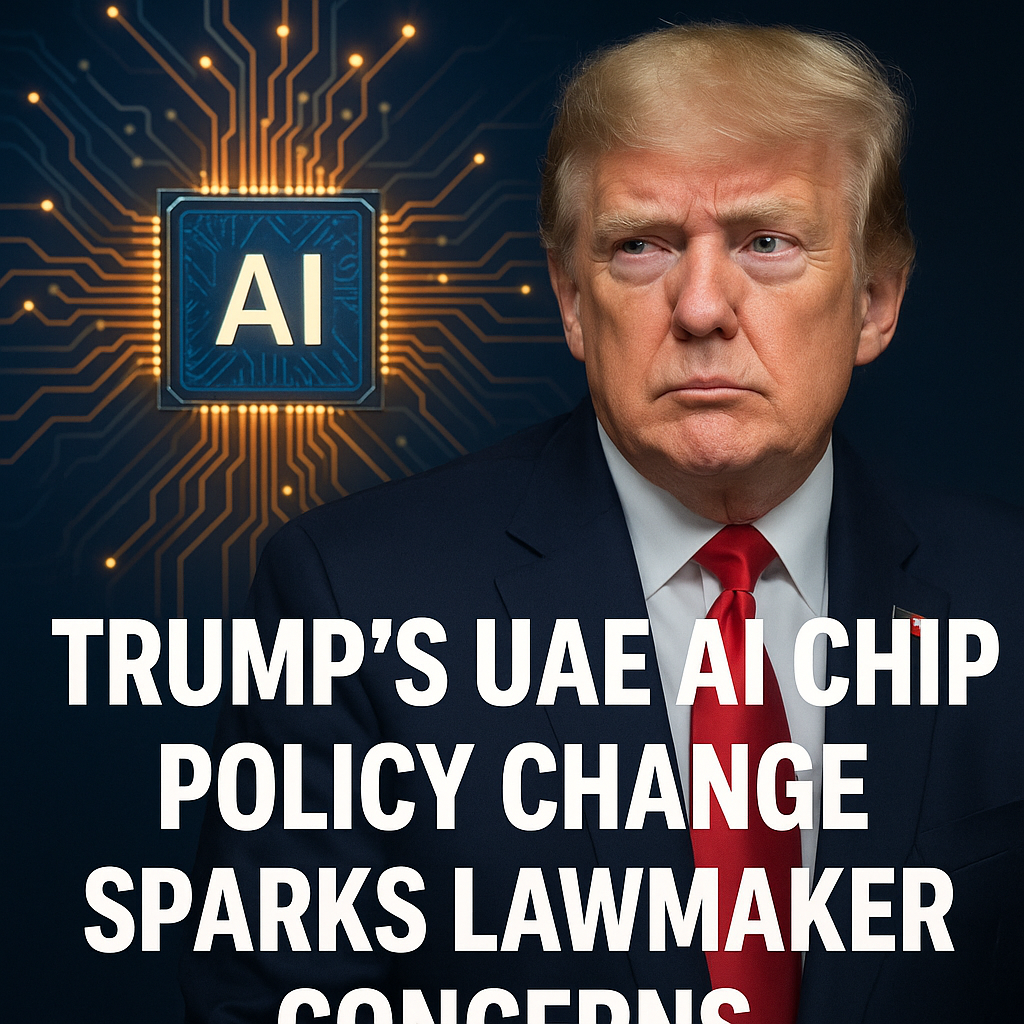
Trump’s UAE AI Chip Policy Change Sparks Lawmaker Concerns
Trump’s UAE AI Chip Policy Change Sparks Lawmaker Concerns
The recent policy shift regarding the United States’ approach to artificial intelligence (AI) chip exports to the United Arab Emirates (UAE) has ignited substantial debate among lawmakers. This new direction under the Trump administration raises questions about national security, trade relations, and technological advancement, reflecting complex geopolitical dynamics.

The Policy Shift: What Changed?
The Trump administration’s decision to loosen restrictions on AI chip exports to the UAE aligns with broader strategic interests aimed at strengthening ties with Gulf nations. Historically, the U.S. has been cautious about exporting advanced technologies, particularly those with potential military applications, to countries perceived as regional adversaries or those with less stringent regulatory environments.

Reports suggest that this policy change is part of a larger effort to counteract the influence of China in the Middle East, providing allies like the UAE with advanced technological capabilities. Proponents of this decision argue that it fosters a stronger alliance through shared technology and innovation, which is essential for maintaining regional stability and countering threats.

However, critics of the policy warn that relaxing export controls could lead to the proliferation of sensitive technologies, potentially enabling adversarial actors to access capabilities that pose risks to U.S. interests. This concern is heightened by the UAE’s connections to various regional players, some of whom are at odds with U.S. foreign policy objectives.
Lawmaker Reactions: A Divided Front
The announcement has drawn sharp reactions from lawmakers on both sides of the aisle. While some Republican members see this as a pragmatic move to enhance U.S. influence in the region, many Democrats view it as a reckless gamble that could endanger national security.
Senator Elizabeth Warren articulated her concerns, emphasizing the need for stringent oversight on the transfer of high-tech capabilities. She argues that “we must ensure that our cutting-edge technologies do not end up in the hands of countries that may undermine our security or values.” This sentiment is echoed by several defense experts who warn that advanced AI technologies could be weaponized, presenting unfamiliar challenges to U.S. defense strategies.
Conversely, some lawmakers advocate for the potential economic benefits. They highlight that engaging the UAE in technological partnerships can boost U.S. exports and encourage investment opportunities for American tech firms. These proponents argue that collaborative ventures in AI and related fields could generate significant economic growth and create jobs domestically, a narrative increasingly appealing in the wake of ongoing economic recovery efforts.
Balancing National Security with Economic Interests
The juxtaposition of national security concerns against potential economic benefits illustrates the complexities faced by policymakers. The intricate nature of global technology markets means that every decision has ramifications that extend beyond borders. It also raises ethical questions regarding the responsibility of tech companies in the exportation of advanced technologies.
Given that the UAE has positioned itself as a key player in AI development, attracting foreign investments, and fostering innovation, the U.S. can benefit from a strategic partnership. Yet, the risks associated with exporting advanced chips—including potential usage by adversarial entities—complicate the narrative.
Critics argue that the U.S. should maintain a firm grip on advanced technologies, suggesting that a failure to do so could lead to an arms race in AI capabilities. Some experts caution against viewing technology solely through a commercial lens, urging lawmakers to consider the broader implications for global security, ethics, and governance.
Conclusion: Seeking Clarity Amid Uncertainty
As the debate over Trump’s policy change continues, lawmakers face the challenge of navigating a landscape fraught with rapidly evolving technological and geopolitical realities. While the intention to strengthen alliances through technological cooperation is commendable, the potential consequences of such actions warrant a more thorough examination.
The question remains: Can the U.S. effectively balance its national security interests with the need for economic growth and technological collaboration? Moving forward, it will be crucial for policymakers to engage in transparent discussions that incorporate diverse viewpoints and address both the risks and rewards associated with AI chip exports. Only through careful consideration can the United States foster responsible innovation while protecting its foundational national security interests.















