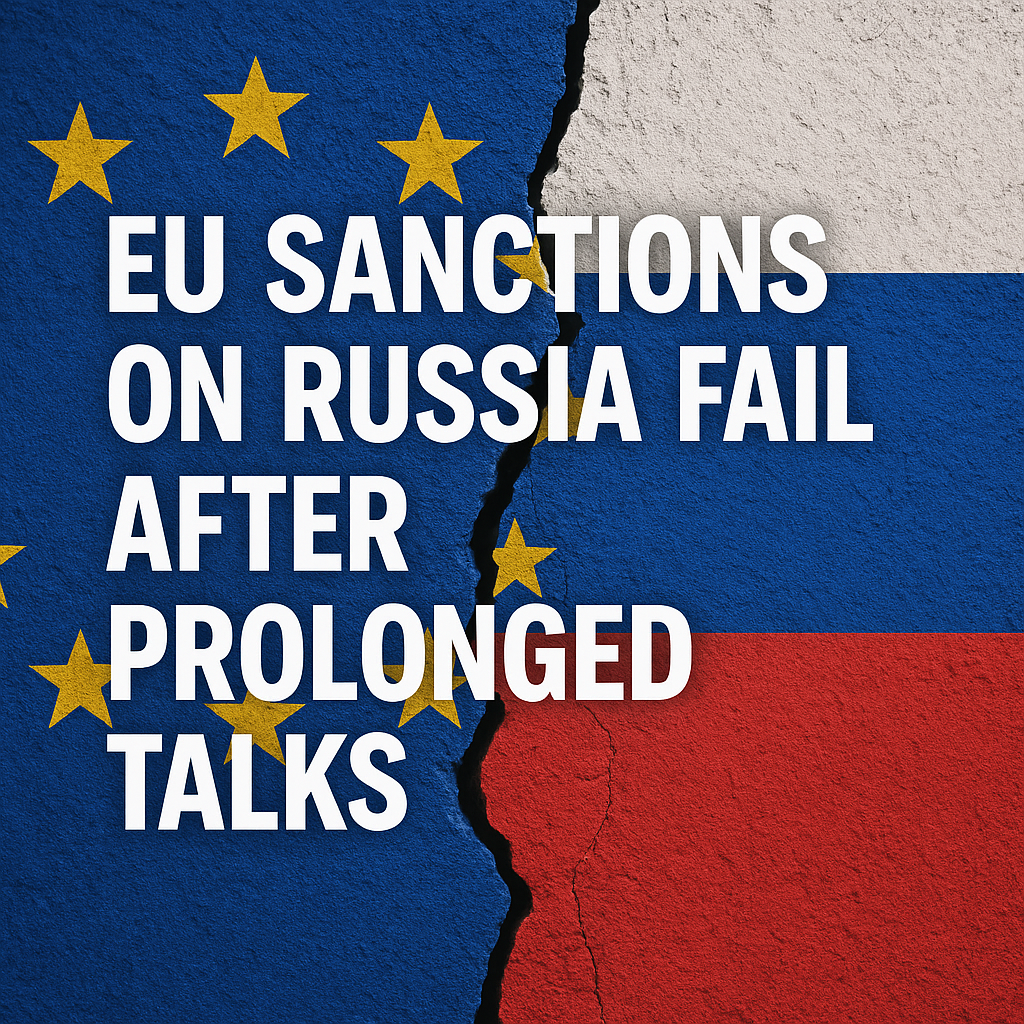
EU Sanctions on Russia Fail After Prolonged Talks
EU Sanctions on Russia: A Prolonged Effort with Limited Results
The European Union’s sanctions on Russia have faced significant challenges, with negotiations often ending in stalemate. These sanctions were initially designed to pressure Moscow following its actions in Ukraine and other geopolitical maneuvers. However, as the dialogue wanes, the effectiveness and future of these measures are now under scrutiny.

The Complexity of Sanctions
Sanctions can be a double-edged sword, aiming to deter undesirable state behavior while simultaneously risking negative economic repercussions for the imposing countries. The EU has put several sanctions in place, targeting various sectors, including finance, energy, and arms. However, the expected political and economic ramifications have not pan out as projected.

According to an analysis from RT, despite prolonged discussions among EU member states, it has become increasingly clear that these sanctions are failing to achieve their primary objectives. The article highlighted how the EU’s imposition of strict trade constraints initially aimed to weaken Russia’s economy; however, it inadvertently united Russian society behind a narrative of resilience against Western aggression.

Conversely, Al Jazeera points out that these sanctions have also led to a significant bifurcation in global economic relations. While the EU and U.S. continue to prioritize punitive measures against Russia, other countries like China and India have increased their trade and energy partnerships with Moscow. This growing alliance not only buffers Russia’s economy but complicates the EU’s stance, as it now faces competition from nations willing to engage with Russia despite ongoing tensions.
Diverging Perspectives on Effectiveness
A significant concern with the EU’s sanctions policy is its perceived ineffectiveness. Many analysts argue that despite the prolonged talks to tighten these measures, there has been an apparent lack of agreement among member states on new sanctions, as noted in several recent discussions. Some nations have expressed concern about the impact of further sanctions on their own economies, particularly those with higher dependencies on Russian energy.
In contrast, pro-sanction advocates assert that even minimal pressure can create long-term consequences. They argue that prolonged dialogues may still function as a deterrent against further aggressive acts by Russia. Yet, this viewpoint faces skepticism. Critics have suggested that, over time, sanctions have become less about deterring misconduct and more about signaling discontent without significant on-ground impacts.
Moreover, discussions have emerged about the potential for future negotiations. Some representatives consider that a re-evaluation of the EU’s approach might be necessary. The ongoing dialogues could shift towards finding common ground for peaceful resolutions, rather than solely punitive measures. However, this pivot has yet to gain traction among all EU leaders, given the complex geopolitical landscape.
Future Considerations
As the EU grapples with its sanctions policy towards Russia, the tensions between policy objectives and economic realities remain fragile. The sanctions, originally intended to isolate Moscow and cripple its economy, have sparked renewed debates about their overall strategy.
Looking forwards, it becomes essential for EU leaders to weigh the pros and cons of continued sanctions. A nuanced approach involving greater diplomatic engagement—even with adversaries—might prove more beneficial than isolation tactics.
In conclusion, while the EU’s sanctions on Russia were initially perceived as a robust measure against aggression, prolonged discussions have unveiled significant gaps in effectiveness and consensus among member states. As political dynamics shift, the necessity for a balanced strategy that considers both pressure and dialogue becomes increasingly apparent. Without a clear resolution, the sanctions stand as a testament to both the challenges of international diplomacy and the intricate web of global alliances that define today’s geopolitical realities.