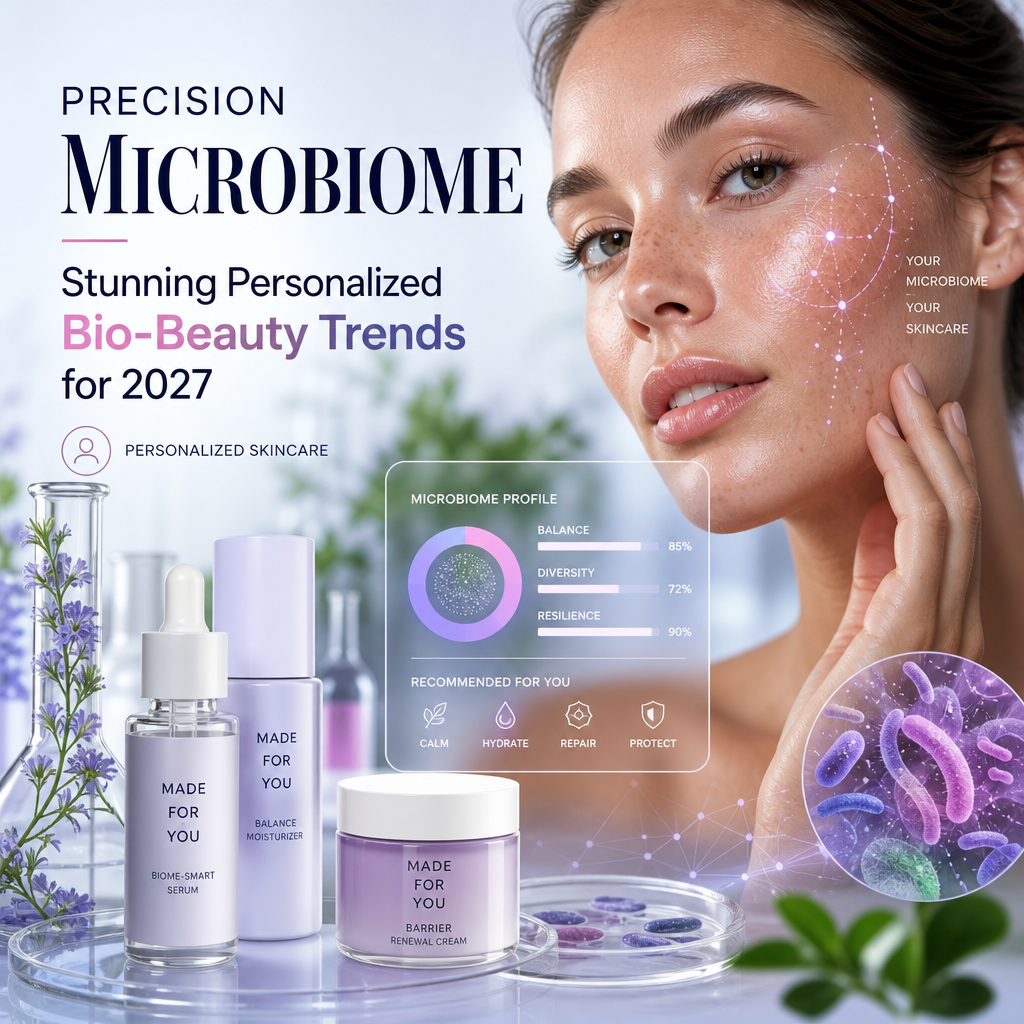
Precision Microbiome: Stunning Personalized Bio-Beauty Trends for 2027
The Precision Microbiome is moving from a niche scientific concept to the center of next-generation skincare, and by 2027 it is poised to reshape how people think about beauty, prevention, and treatment. Instead of relying on broad formulas designed for “normal,” “dry,” or “oily” skin, personalized bio-beauty will focus on the unique ecosystem living on each person’s skin: the bacteria, fungi, viruses, enzymes, and metabolites that influence barrier health, inflammation, hydration, and visible aging. This shift is not just about adding probiotics to creams. It is about using data, diagnostics, and bioengineered ingredients to create skincare that responds to a person’s actual skin biology in real time.

What the precision microbiome means for skincare
At its core, the skin microbiome is the community of microorganisms that live on the skin’s surface and within its upper layers. These microbes are not harmful intruders by default. Many are essential partners that help maintain balance, regulate pH, support the skin barrier, and communicate with the immune system. When that balance is disrupted, problems such as acne, eczema, sensitivity, redness, dryness, and uneven texture can become more likely.

The “precision” part of the Precision Microbiome refers to tailoring skincare to that unique microbial profile rather than applying one-size-fits-all solutions. In practice, this could mean assessing a person’s microbiome through at-home skin swabs, app-connected diagnostics, or in-store testing, then using those results to recommend a custom cleanser, serum, moisturizer, or treatment protocol. The goal is no longer simply to cover symptoms, but to correct underlying imbalances.

By 2027, this approach will likely become more sophisticated as consumer biotech tools improve and skincare brands gain access to richer skin data. What was once available only in clinical research may become part of everyday beauty routines.
Why personalized bio-beauty is gaining momentum
Several trends are pushing personalized bio-beauty into the mainstream.
First, consumers are increasingly skeptical of generic claims. They want proof that a product works for their skin, not just for an average model in a campaign. This demand for relevance is driving interest in personalization across wellness, nutrition, and beauty.
Second, skin concerns are becoming more complex. Pollution, stress, sleep disruption, over-exfoliation, climate changes, and heavy ingredient layering can all influence the microbiome. Many people who once used simple routines now experience sensitivity or barrier damage from too many active ingredients. Personalized bio-beauty offers a more measured, biological approach.
Third, advances in biotechnology are making customization more practical. Better sequencing methods, improved AI analysis, and fermentation-based ingredient production are helping brands create products that can be tuned to specific skin conditions and microbial patterns. In other words, the beauty industry is becoming more like precision medicine.
How the Precision Microbiome could work in 2027
In 2027, the customer journey may look very different from today’s standard skincare quiz.
A person might begin with a skin scan that measures oil distribution, redness, hydration, and barrier function. They may then submit a microbiome sample for analysis. An AI system could compare those findings with a database of skin profiles and suggest a personalized regimen. That regimen might include:
- A cleanser formulated to preserve beneficial microbes
- A serum containing postbiotics to support barrier repair
- A moisturizer adjusted for pH, lipid content, and hydration needs
- A treatment active designed to reduce overgrowth of certain microbes associated with breakouts or irritation
- Dietary or lifestyle recommendations that support the skin from within
This is where personalized bio-beauty becomes more than just marketing. Instead of simply choosing between “acne-prone” and “sensitive,” consumers could receive a plan based on their microbial diversity, inflammatory markers, and environmental exposures. The result could be skincare that feels more accurate, more efficient, and less trial-and-error driven.
The role of postbiotics, probiotics, and prebiotics
The Precision Microbiome will likely accelerate interest in microbiome-friendly ingredient categories, especially prebiotics, probiotics, and postbiotics.
Prebiotics are compounds that feed beneficial microbes. In skincare, they may help create an environment where good bacteria can thrive. Probiotics, when used topically, introduce live beneficial microorganisms or microbe-derived materials, though product stability and effectiveness remain technical challenges. Postbiotics are the byproducts of microbial fermentation, such as enzymes, peptides, and acids, which can offer skin benefits without requiring live bacteria.
By 2027, postbiotics may become especially important because they are more stable and easier to formulate into skincare. They can help support the barrier, calm irritation, and promote a healthier microbial balance. The real shift, however, will be that these ingredients are no longer used as broad wellness add-ons. They will be selected based on a person’s specific microbiome needs.
What consumers may experience differently
The most visible change for consumers will be a move away from overtreated skin. For years, skincare trends encouraged people to exfoliate more, layer more actives, and chase faster results. But the precision microbiome model suggests that skin often performs best when it is supported, not constantly pushed.
Consumers may notice:
- Less reliance on harsh stripping products
- More emphasis on barrier repair and microbial balance
- Customized routines that evolve with seasons, stress, or hormonal shifts
- Better matching between product strength and skin resilience
- Fewer wasted purchases from experimentation and product hopping
This approach may also change how people understand skin concerns. Acne, for example, may be viewed less as a simple oil problem and more as an ecosystem imbalance involving microbial diversity, inflammation, sebum, and barrier stress. Sensitivity may be seen not as a skin type alone, but as a state of dysregulation that can be measured and improved.
Challenges facing personalized microbiome skincare
Despite its promise, the Precision Microbiome also faces important challenges.
One major issue is standardization. Skin microbiomes vary widely depending on age, ethnicity, geography, climate, diet, and lifestyle. Building universal rules from such complex data is difficult. Brands will need robust testing and strong scientific validation before making claims.
Privacy is another concern. If skincare companies collect microbiome and skin health data, consumers will want clear protections around how that information is stored and used. Personalized beauty relies on data trust just as much as it relies on scientific accuracy.
There is also the question of accessibility. Personalized bio-beauty could be expensive at first, limiting it to premium consumers. For the technology to truly transform skincare, it will need to become more affordable and scalable.
Finally, the industry must avoid overpromising. A microbiome-based product is not a cure-all. Skin health still depends on sleep, stress management, sun protection, nutrition, and consistent routines. The best future formulas will complement those fundamentals rather than replace them.
Why 2027 could be a turning point
By 2027, the beauty industry may reach a point where microbiome testing, AI-powered personalization, and bioengineered formulations become mainstream enough to influence everyday skincare choices. This would mark a major change from the era of mass-market categorization to an era of biological specificity.
The significance of this shift is not just scientific. It is cultural. Personalized bio-beauty reflects a larger movement toward self-knowledge, preventive care, and customized wellness. People increasingly want products that recognize their individuality, not flatten it into a category.
The Precision Microbiome will likely redefine skincare by making it more intelligent, adaptive, and evidence-led. Instead of asking, “What skin type do you have?” the future may ask, “What does your skin ecosystem need right now?” That question could become the foundation of beauty in 2027 and beyond.
As science, technology, and consumer demand continue to converge, skincare will evolve from a routine of correction into a system of precision support. The result may be healthier skin, smarter products, and a more personal relationship between beauty and biology.