Lab-Grown Botanicals and Zero-Waste Synthetics: Stunning, Effortless Future
Beyond clean, the beauty and personal care industries are entering a new era where performance, transparency, and environmental responsibility are no longer competing priorities. Consumers are increasingly looking past “natural” and “clean” labels to ask harder questions: Where did this ingredient come from? How was it made? What happens after it’s used? In response, brands and formulators are turning to lab-grown botanicals and zero-waste synthetics—two innovations that are reshaping what sustainable product development can look like.

For years, the clean beauty conversation centered on removing questionable ingredients and replacing them with plant-based alternatives. That shift mattered, but it was only the beginning. Today, the next wave of innovation is focused on creating ingredients that deliver the desirable qualities of botanicals and synthetics without the environmental costs of traditional sourcing and manufacturing. Lab-grown actives can reduce dependence on land, water, and seasonal harvests, while zero-waste synthetics aim to maximize yield and minimize byproducts at every stage of production. Together, they are pushing the industry beyond clean and into something more precise, scalable, and accountable.

The New Meaning of “Clean”
The word “clean” once meant a formula free from certain ingredients. Over time, it became associated with safer, gentler, or more environmentally aware products. But that definition has limits. A formula can be free from controversial additives and still rely on resource-intensive farming, long-distance transport, or waste-heavy extraction methods.

That’s why many manufacturers are redefining clean to include lifecycle impact. This broader view considers how ingredients are sourced, how much energy and water are used, whether biodiversity is protected, and whether the final product is designed with circularity in mind. In this framework, lab-grown botanicals and zero-waste synthetics are not just trendy alternatives; they are practical tools for making cleaner products in a deeper sense.
What Are Lab-Grown Botanicals?
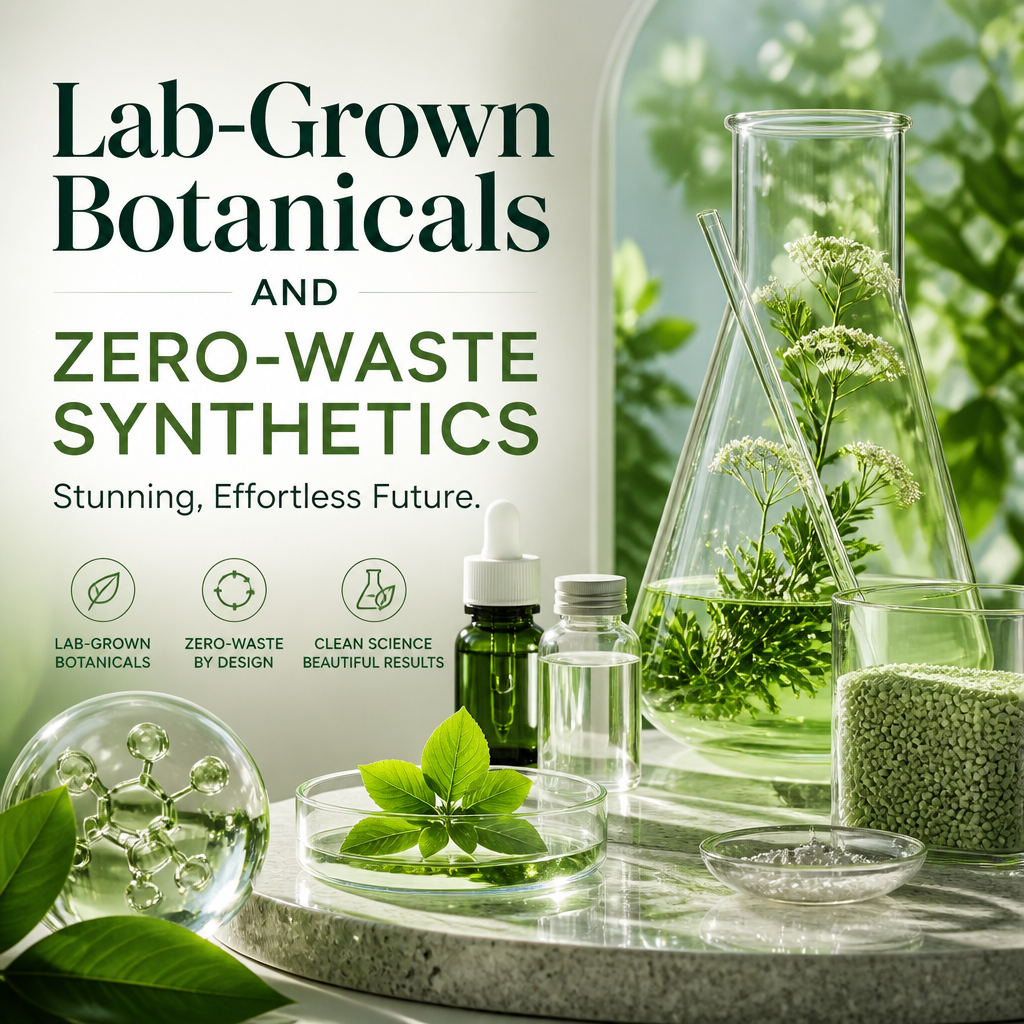
Lab-grown botanicals are ingredients produced through controlled scientific processes rather than harvested directly from fields or wild ecosystems. Depending on the method, they may be cultivated from plant cells, produced through fermentation, or created using biotechnology that replicates the structure and function of naturally occurring compounds.
This approach offers a major advantage: it preserves the desirable properties of botanical ingredients while reducing the pressure on farmland and fragile ecosystems. Rare flowers, slow-growing roots, and hard-to-source herbs often face supply challenges and ecological strain. Lab-grown versions can offer consistency, purity, and traceability without depending on large-scale cultivation.
For formulators, that consistency is valuable. Plant-derived ingredients can vary depending on weather, soil quality, harvest timing, and geography. Lab-grown botanicals, by contrast, can be standardized for potency and composition, which makes product development more reliable and performance easier to control.
Why the Industry Is Investing in Them
The growing interest in lab-grown botanicals is driven by several factors:
- Supply chain stability: Ingredient availability is less vulnerable to droughts, crop failures, and geopolitical disruptions.
- Reduced land use: Products no longer require large areas of farmland for ingredients that can be synthesized in compact facilities.
- Lower ecological impact: Less harvesting pressure helps protect biodiversity and vulnerable species.
- Consistency: Controlled production improves quality and makes it easier to meet strict formulation requirements.
These benefits matter not only for luxury skincare or niche wellness brands but also for mass-market products that need dependable performance at scale.
The Promise of Zero-Waste Synthetics
Synthetics have long been misunderstood in sustainability conversations. In reality, synthetic ingredients are not inherently unsustainable; the issue is how they are made. Traditional chemical manufacturing often produces excess waste, relies on energy-heavy processes, or leaves behind difficult-to-manage byproducts. Zero-waste synthetics challenge that model.
Zero-waste synthetics are designed with efficiency at the molecular level. The goal is to convert as much raw input as possible into the final ingredient, while reducing solvents, emissions, wastewater, and material loss. This can involve greener chemistry, closed-loop systems, renewable feedstocks, or catalytic processes that increase yield.
In many cases, these synthetics can outperform their natural counterparts in stability and function. They may require less preservative support, last longer in formulations, and offer greater precision in texture, scent, or skin feel. When built responsibly, they can combine high performance with lower environmental impact.
Why Sustainability Needs Performance
A common mistake in product innovation is assuming consumers will sacrifice results for sustainability. In practice, most shoppers want both. They want moisturizers that absorb beautifully, serums that deliver visible benefits, and fragrances that remain elegant over time. If a sustainable ingredient cannot deliver, it will struggle to replace conventional options.
This is where lab-grown botanicals and zero-waste synthetics stand out. They are often created specifically to solve the old tradeoff between ethics and efficacy. A lab-grown antioxidant may offer better purity than a harvested extract. A zero-waste emollient may provide the luxurious slip of a traditional silicone alternative without the same manufacturing burden. The result is a new generation of ingredients that are not just better for the planet, but also better engineered.
Transparency Is Becoming a Competitive Advantage
As ingredient innovation advances, transparency is becoming just as important as performance. Consumers are more informed than ever, and they increasingly expect brands to explain not only what is in a product, but why it is there and how it was made.
This creates an opportunity for companies that can communicate clearly. Brands using lab-grown botanicals can discuss traceability, resource savings, and consistency. Those working with zero-waste synthetics can highlight cleaner chemistry, reduced emissions, or circular manufacturing. But the messaging must be careful and credible. Broad claims without evidence can undermine trust.
Third-party testing, lifecycle assessments, and certifications can help support these claims. So can plain-language storytelling that avoids jargon. In a crowded market, the brands that speak honestly and specifically about their ingredient choices are the ones most likely to earn loyalty.
Challenges on the Road Ahead
Despite their promise, lab-grown botanicals and zero-waste synthetics are not a cure-all. Scaling these technologies can be expensive, and some methods still depend on complex infrastructure or specialized expertise. Regulatory frameworks may lag behind innovation, making it harder for brands to classify or market certain ingredients. There is also the challenge of consumer perception, especially among buyers who associate “synthetic” with artificial or harmful.
Another issue is accessibility. If these ingredients remain concentrated in premium products, their broader impact will be limited. For the shift beyond clean to be meaningful, innovations must eventually become cost-effective enough for mainstream adoption. That will require investment, partnerships, and continued advances in manufacturing efficiency.
A More Mature Approach to Sustainable Beauty
What makes this moment different is maturity. The conversation is no longer about choosing between “natural” and “synthetic” as though they were moral categories. Instead, it is about understanding systems: how ingredients are produced, what they replace, and what kind of footprint they leave behind.
Lab-grown botanicals and zero-waste synthetics represent a more nuanced and responsible model. They acknowledge that nature is valuable, but not infinite. They recognize that chemistry is not the enemy when it is designed thoughtfully. Most importantly, they show that sustainability is not just about subtraction—removing ingredients, reducing packaging, or lowering claims. It is also about invention.
The future of clean beauty and personal care will likely belong to products that are traceable, efficient, and high-performing from the start. Lab-grown botanicals can help preserve ecosystems while delivering botanical benefits. Zero-waste synthetics can reduce manufacturing waste while offering refined functionality. Together, they point toward an industry that is moving beyond clean and toward something more durable: ingredients designed for both people and the planet.