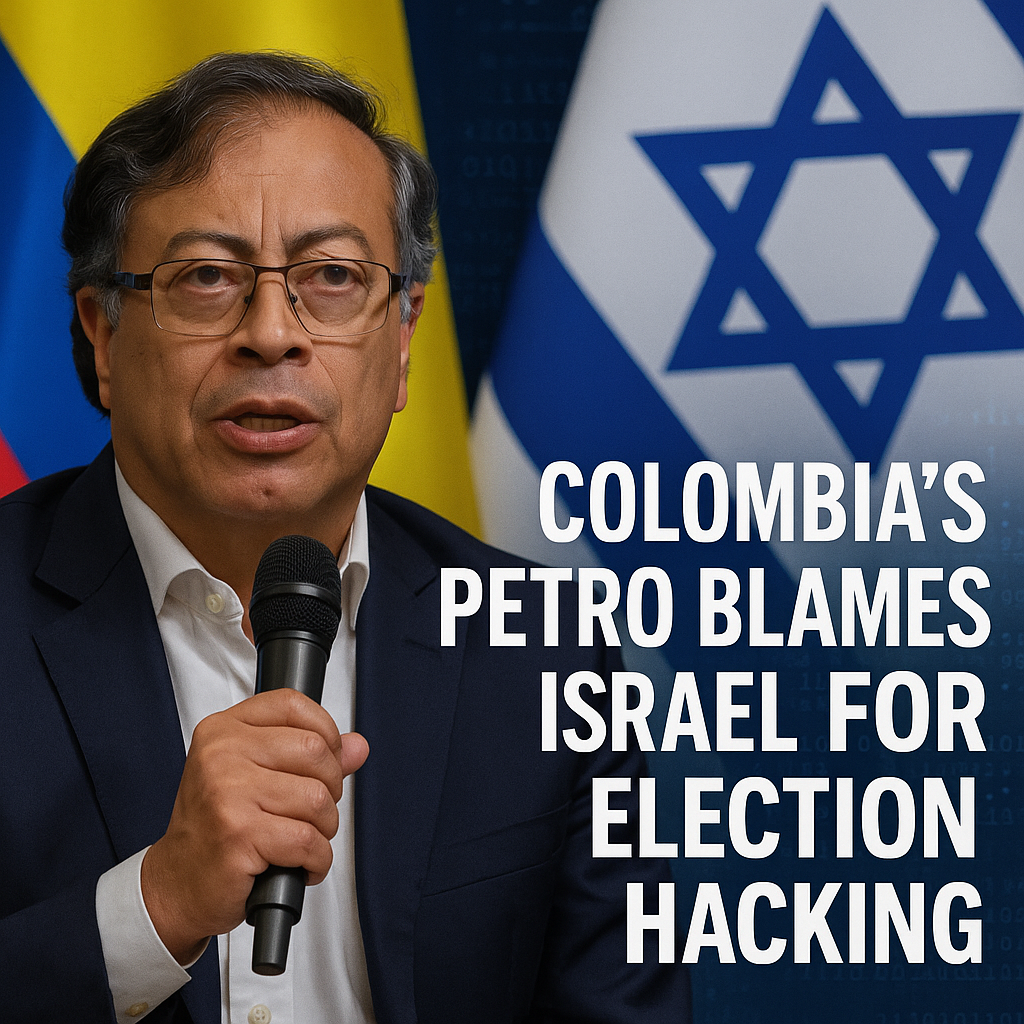
Colombia’s Petro Blames Israel for Election Hacking

Colombia’s President Gustavo Petro has recently made headlines by accusing Israel of being behind cyber attacks aimed at disrupting his election campaign. This allegation has sparked debate and raised questions about foreign interference in domestic politics, particularly in Latin America. While Petro’s claims appear to be firmly rooted in his analysis of recent electoral irregularities, the complexities of cyber warfare and international relations add layers of nuance to the discussion.

Unpacking the Allegations
Petro’s assertion comes amid rising concerns regarding cyber security worldwide. According to reports, he indicated that the attacks orchestrated against him were designed to destabilize his political ambitions, especially during crucial moments in the electoral process. He pointed to a pattern of cyber intrusions that coincided with important political milestones, suggesting a deliberate effort to sway public opinion against him.


Supporters of Petro believe that these claims are justified, especially given historical precedents of international meddling in Latin American politics. For instance, the 2013 revelations by Edward Snowden highlighted how the U.S. government engaged in extensive surveillance activities across the continent, raising fears that Colombian politics could similarly be vulnerable to external influences.


Conversely, skeptics of Petro’s claims argue that attributing accountability to Israel without substantial evidence could undermine his credibility. They caution against jumping to conclusions based solely on a few cyber incidents. The reality of cyber warfare involves complex networks that make it increasingly difficult to trace attacks back to a specific state actor definitively. These critics suggest that attributing such activities to Israel, a close ally of the U.S. with extensive cyber capabilities, without direct evidence might be more about domestic political maneuvering than it is about actual espionage.
Historical Context of Foreign Interference in Colombia
In attempting to understand the validity of Petro’s claims, it is essential to consider the historical relationship between Colombia and foreign powers. The nation has a notable history of foreign involvement, particularly from the United States, which has long engaged in Colombia’s internal affairs, primarily through counter-narcotics efforts and support of various governments deemed favorable.
Various political analysts point out that while the potential for foreign interference is indeed present, the specific targeting of Petro raises questions. His administration has adopted a starkly different approach to international relations, aiming to foster closer ties with other Latin American nations and reducing alignment with traditional powers like the U.S. which could make him a target for those seeking to protect their interests.
Adding further complexity, some experts posit that Israel’s interest in Colombia may also stem from defense cooperation and arms sales. This can complicate the narrative, suggesting that claims of cyber attacks could arise from complicated trade dynamics rather than outright malicious intent.
Navigating the Complexity of Cyber Warfare
The allegations against Israel reflect broader anxieties about cybersecurity and electoral integrity across the globe. Given advancements in technology, the capacity for state actors to undertake covert operations has increased, leading to growing fears about manipulation and deception.
Cyber attacks can manifest in various forms, including disinformation campaigns, hacking, and data breaches. The line between a governmental attack and an independent hacking group often becomes blurred, emphasizing the need for rigorous investigation before assigning blame. In Colombia’s case, the potential ramifications of the accusations could either strengthen Petro’s political standing by rallying his base or alienate moderates who may see his explanation as lacking substantiation.
In conclusion, the allegations of Israeli interference in Colombia’s elections have opened a can of worms, shedding light on the complicated nature of international relations in a digitally connected world. While speculation abounds, both supporters and critics of Petro must grapple with the fact that cybersecurity threats are no longer mere possibilities—they are realities that can shape the future of democratic processes globally. With the 2023 elections on the horizon, how Colombia navigates these challenges will likely have long-lasting implications not just for Petro’s administration but for the broader geopolitical landscape in Latin America.