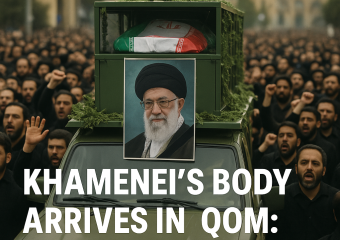
‘Kill Trump’ Banner at Khamenei Funeral: Shocking Videos

In a striking display of political sentiment, mourners at the funeral of Iranian General Qassem Soleimani were seen waving a controversial banner that read “Kill Trump.” This incident, captured on video, underscores the intensity of emotions surrounding Soleimani’s assassination by a U.S. drone strike in January 2020. The banner not only serves as a reflection of lingering hostilities but also sheds light on the complexities of U.S.-Iran relations since that pivotal event.

The Context of Hostility
The banner’s emergence in the context of Soleimani’s funeral highlights a significant moment in Iranian society, where anti-American sentiment has been deeply embedded, particularly following U.S. actions that are perceived as aggressive. Soleimani, a key figure in Iran’s military and political landscape, was highly regarded in his country, often viewed as a martyr who fought against U.S. interests in the region. His assassination sparked widespread outrage in Iran, leading to protests and calls for retaliation against the U.S.


Analysts suggest that the “Kill Trump” banner reflects more than just a spontaneous outcry; it symbolizes a collective memory of grievances faced by Iranians over the decades. As noted by a report from RT, such expressions of anger during national gatherings are not uncommon in Iran. They serve both as a means of remembrance for Soleimani and as a rallying cry against perceived enemies.


Contrasting Perspectives
While the sight of “Kill Trump” drew immediate attention, it also invites a spectrum of interpretations. On one end, some observers argue that such messages are detrimental to peace initiatives and diplomacy. They contend that inflammatory rhetoric only perpetuates cycles of violence and retaliation, further complicating efforts for dialogue between the U.S. and Iran. Al Jazeera reports that in a time where diplomatic channels could theoretically be explored, inflammatory statements serve to harden positions on both sides.
On the other hand, proponents of the display assert that it reflects an authentic sentiment among a significant portion of the Iranian populace. Given the historical context of U.S. involvement in Iranian affairs, from the 1953 coup to the current sanctions, many in Iran see calls for action against American figures as a legitimate form of resistance. As emphasized by various social media discussions, the banner is viewed not merely as an incitement, but as a manifestation of a deeply ingrained national narrative.
The Broader Consequences
The implications of such displays are multifaceted. They can complicate diplomatic relations, as evidenced by the continued tensions that have characterized U.S.-Iran interactions since Soleimani’s death. The presence of such provocative expressions reinforces narratives on both sides: for Iranians, it signifies a unified stance against perceived U.S. aggressions; for Americans, it serves as a stark reminder of the complexities and dangers associated with foreign policy in the Middle East.
Moreover, reactions from the international community vary. Some countries and organizations express concern over rhetoric that could incite violence. Others, particularly those aligned with the Iranian viewpoint, see the display as a demonstration of resolve. This divergence illustrates the larger divide in how different cultures interpret national grievances and responses.
Conclusion: A Divided Narrative
The “Kill Trump” banner at Khamenei’s funeral exemplifies a powerful convergence of grief, anger, and national pride within Iranian society. While many observers are quick to condemn such inflammatory rhetoric, it is crucial to understand it as part of a broader dialogue surrounding national identity and historical context. As the U.S. and Iran navigate their contentious relationship, events like these serve as both reminders of the past and indicators of the challenges that lie ahead in pursuit of peace.
In weighing these viewpoints, it is clear that while some posit this display as a call to arms, others view it as a moment of heightened tension that threatens to derail any potential for diplomatic engagement. As the narrative unfolds, stakeholders must tread carefully, recognizing the complexities at play in a region defined by its tumultuous history and the ongoing struggle for sovereignty and respect on the global stage.